Ch 28: Fundamentals of Circuits
Knight Calc - Physics for Scientists and Engineers 5th Edition
Knight Calc5th EditionPhysics for Scientists and EngineersISBN: 9780137344796Not the one you use?Change textbook
Chapter 28, Problem 27

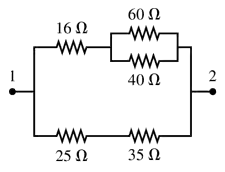
What is the equivalent resistance between points 1 and 2 in FIGURE EX28.27?
Circuit diagram showing resistors of 16Ω, 60Ω, 40Ω, 25Ω, and 35Ω connected between points 1 and 2.

Verified step by step guidance
1
Step 1: Identify the configuration of resistors in the circuit. The circuit contains resistors in series and parallel combinations. Specifically, the 60 Ω and 40 Ω resistors are in parallel, while the 16 Ω, 25 Ω, and 35 Ω resistors are in series with the equivalent resistance of the parallel combination.
Step 2: Calculate the equivalent resistance of the 60 Ω and 40 Ω resistors in parallel using the formula for parallel resistance: Req=11R1+1R2, where R₁ = 60 Ω and R₂ = 40 Ω.
Step 3: Add the equivalent resistance of the parallel combination to the resistors in series. The total equivalent resistance is given by: Rtotal=Req+16+25+35.
Step 4: Perform the addition of the resistances step by step. First, calculate the equivalent resistance of the parallel combination, then add the series resistances.
Step 5: Verify the result by ensuring all resistances are accounted for and the calculations follow the rules for combining resistors in series and parallel.

Verified video answer for a similar problem:

This video solution was recommended by our tutors as helpful for the problem above.
Was this helpful?

Key Concepts

Here are the essential concepts you must grasp in order to answer the question correctly.

Equivalent Resistance

Equivalent resistance is the total resistance of a circuit that can replace multiple resistors. It simplifies the analysis of complex circuits by allowing us to treat them as a single resistor. The equivalent resistance can be calculated differently for resistors in series and parallel, affecting how current flows through the circuit.
Recommended video:
Guided course
03:44
Find Equivalent Capacitance #1

Series and Parallel Resistors

Resistors can be connected in series or parallel, which affects the total resistance. In a series connection, the total resistance is the sum of individual resistances, while in a parallel connection, the total resistance can be found using the formula 1/R_total = 1/R1 + 1/R2 + ... + 1/Rn. Understanding these configurations is crucial for calculating equivalent resistance.
Recommended video:
Guided course
12:42
Combining Resistors in Series & Parallel

Ohm's Law

Ohm's Law states that the current (I) through a conductor between two points is directly proportional to the voltage (V) across the two points and inversely proportional to the resistance (R). It is expressed as V = IR. This fundamental law is essential for analyzing circuits and understanding how voltage, current, and resistance interact.
Recommended video:
Guided course
03:07
Resistance and Ohm's Law