Ch 27: Current and Resistance
Knight Calc - Physics for Scientists and Engineers 5th Edition
Knight Calc5th EditionPhysics for Scientists and EngineersISBN: 9780137344796Not the one you use?Change textbook
Chapter 27, Problem 19

What electric field strength is needed to create a 5.0 A current in a 2.0-mm-diameter iron wire?

Verified step by step guidance
1
Determine the resistivity of iron (ρ). This is a material property and can be found in a reference table. For iron, ρ ≈ 1.0 × 10⁻⁷ Ω·m.
Calculate the cross-sectional area (A) of the wire. The diameter is given as 2.0 mm, so the radius (r) is 1.0 mm = 1.0 × 10⁻³ m. Use the formula for the area of a circle: A = πr².
Use Ohm's Law in the form E = Jρ, where E is the electric field strength, J is the current density, and ρ is the resistivity. First, calculate the current density (J) using J = I/A, where I is the current (5.0 A) and A is the cross-sectional area calculated in the previous step.
Substitute the values of J and ρ into the formula E = Jρ to calculate the electric field strength. Ensure all units are consistent (e.g., meters, amperes, ohms).
Simplify the expression to find the electric field strength (E). This will give you the magnitude of the electric field required to create the specified current in the wire.

Verified video answer for a similar problem:

This video solution was recommended by our tutors as helpful for the problem above.
Was this helpful?

Key Concepts

Here are the essential concepts you must grasp in order to answer the question correctly.

Ohm's Law

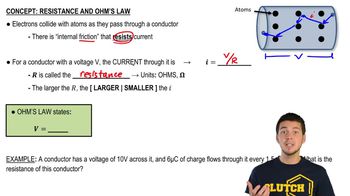
Ohm's Law states that the current (I) flowing through a conductor between two points is directly proportional to the voltage (V) across the two points and inversely proportional to the resistance (R) of the conductor. It is mathematically expressed as V = I × R. This law is fundamental in understanding how electric fields and currents interact in conductive materials.
Recommended video:
Guided course
03:07
Resistance and Ohm's Law

Electric Field Strength

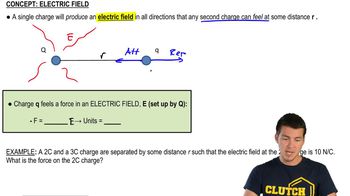
Electric field strength (E) is defined as the force (F) per unit charge (q) experienced by a positive test charge placed in the field. It is measured in volts per meter (V/m). The relationship between electric field strength and current can be explored through the concept of drift velocity in conductors, where a stronger electric field can lead to a higher current.
Recommended video:
Guided course
03:16
Intro to Electric Fields

Resistivity

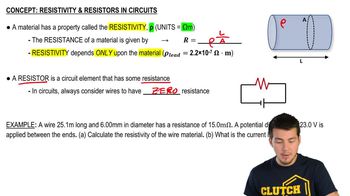
Resistivity is a material property that quantifies how strongly a given material opposes the flow of electric current. It is denoted by the symbol ρ (rho) and is influenced by factors such as temperature and material composition. The resistivity of iron, for example, will affect the resistance of the wire, which in turn influences the electric field strength required to achieve a specific current.
Recommended video:
Guided course
05:25
Resistivity & Resistors in Circuits