
Textbook Question
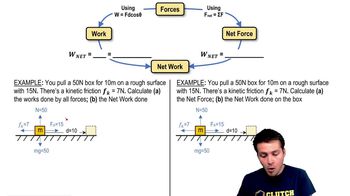
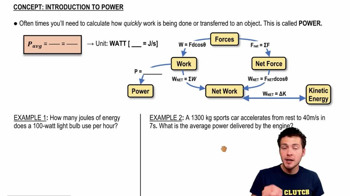
How much work must you do to push a 10 kg block of steel across a steel table at a steady speed of 1.0m/s for 3.0 s? What is your power output while doing so?
2219
views

 Verified step by step guidance
 06:58
06:58
 06:00
06:00 08:59
08:59How much work must you do to push a 10 kg block of steel across a steel table at a steady speed of 1.0m/s for 3.0 s? What is your power output while doing so?
A 1000 kg elevator accelerates upward at 1.0 m/s² for 10 m, starting from rest. How much work does the tension in the elevator cable do on the elevator?
An 8.0 kg crate is pulled 5.0 m up a 30° incline by a rope angled 18 ° above the incline. The tension in the rope is 120 N, and the crate's coefficient of kinetic friction on the incline is 0.25. What is the increase in thermal energy of the crate and incline?
How much work does an elevator motor do to lift a 1000 kg elevator a height of 100 m?
The energy used to pump liquids and gases through pipes is a significant fraction of the total energy consumption in the United States. Consider a small volume V of a liquid that has density ρ. Assume that the fluid is nonviscous so that friction with the pipe walls can be neglected. An upward-pushing force from a pump lifts this volume of fluid a height h at constant speed. How much work does the pump do?
A 70 kg human sprinter can accelerate from rest to 10 m/s in 3.0 s. During the same time interval, a 30 kg greyhound can go from rest to 20 m/s. What is the average power output of each? Average power over a time interval ∆t is ∆E/∆t.