A particle is described by the wave function mm where L = 2.0 mm. Determine the normalization constant c.
Ch 39: Wave Functions and Uncertainty
Knight Calc5th EditionPhysics for Scientists and EngineersISBN: 9780137344796Not the one you use?Change textbook
Chapter 39, Problem 38a
A particle is described by the wave function where L = 2.0 mm. Sketch graphs of both the wave function and the probability density as functions of x.
Verified step by step guidance1
Understand the given wave function: The wave function ψ(x) is piecewise-defined, with an exponential form that depends on whether x is less than or greater than 0. The constant c is a normalization constant, and L is given as 2.0 mm. The wave function is ψ(x) = c * e^(x/L) for x ≤ 0 and ψ(x) = c * e^(-x/L) for x ≥ 0.
Normalize the wave function: To ensure the total probability is 1, integrate the square of the wave function over all space and solve for c. The normalization condition is ∫|ψ(x)|² dx = 1, which becomes ∫[c² * e^(2x/L)] dx from -∞ to 0 + ∫[c² * e^(-2x/L)] dx from 0 to ∞ = 1.
Calculate the probability density: The probability density is given by |ψ(x)|². For x ≤ 0, |ψ(x)|² = c² * e^(2x/L), and for x ≥ 0, |ψ(x)|² = c² * e^(-2x/L). These expressions describe how the probability of finding the particle varies with position x.
Sketch the wave function ψ(x): Plot ψ(x) as a function of x. For x ≤ 0, the wave function increases exponentially as x approaches 0, and for x ≥ 0, it decreases exponentially as x moves away from 0. The graph should be continuous at x = 0.
Sketch the probability density |ψ(x)|²: Plot |ψ(x)|² as a function of x. For x ≤ 0, the probability density decreases exponentially as x becomes more negative, and for x ≥ 0, it decreases exponentially as x becomes more positive. The graph is symmetric about x = 0 and peaks at x = 0.

Verified video answer for a similar problem:
This video solution was recommended by our tutors as helpful for the problem above.
Was this helpful?
Key Concepts
Here are the essential concepts you must grasp in order to answer the question correctly.
Wave Function
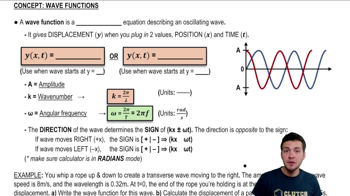
The wave function, denoted as ψ(x), is a fundamental concept in quantum mechanics that describes the quantum state of a particle. It contains all the information about the particle's position and momentum. The square of the wave function's absolute value, |ψ(x)|², gives the probability density of finding the particle at a specific position x.
Recommended video:
Guided course
Intro to Wave Functions
Probability Density
Probability density is derived from the wave function and represents the likelihood of locating a particle within a given region of space. For a one-dimensional wave function, the probability density is calculated as |ψ(x)|². This concept is crucial for interpreting quantum mechanics, as it allows us to predict where a particle is likely to be found upon measurement.
Recommended video:
Guided course
Intro to Density
Exponential Decay
Exponential decay is a mathematical function that describes how a quantity decreases over time or space at a rate proportional to its current value. In the context of the given wave function, the terms eˣ/ᴸ and e−ˣ/ᴸ illustrate how the wave function behaves differently in the regions x ≤ 0 mm and x ≥ 0 mm, leading to distinct probability densities that reflect the particle's confinement and behavior.
Recommended video:
Guided course
Amplitude Decay in an LRC Circuit
Related Practice
Textbook Question
55
views
Textbook Question
Consider the electron wave function where x is in cm. Draw a graph of |ψ(x)|2 over the interval −2 cm ≤ x ≤ 2 cm. Provide numerical scales.
41
views
Textbook Question
Consider the electron wave function where x is in cm. Draw a graph of ψ(x) over the interval −2 cm ≤ x ≤ 2 cm. Provide numerical scales on both axes.
42
views
Textbook Question
A particle is described by the wave function where L = 2.0 mm. Interpret your answer to part b by shading the region representing this probability on the appropriate graph in part a.
1579
views
Textbook Question
Consider the electron wave function where x is in cm. Determine the normalization constant c.
57
views
Textbook Question
A particle is described by the wave function where L = 2.0 mm. Calculate the probability of finding the particle within 1.0 mm of the origin.
1579
views