Ch 13: Newton's Theory of Gravity
Knight Calc - Physics for Scientists and Engineers 5th Edition
Knight Calc5th EditionPhysics for Scientists and EngineersISBN: 9780137344796Not the one you use?Change textbook
Chapter 13, Problem 58d

Large stars can explode as they finish burning their nuclear fuel, causing a supernova. The explosion blows away the outer layers of the star. According to Newton’s third law, the forces that push the outer layers away have reaction forces that are inwardly directed on the core of the star. These forces compress the core and can cause the core to undergo a gravitational collapse. The gravitational forces keep pulling all the matter together tighter and tighter, crushing atoms out of existence. Under these extreme conditions, a proton and an electron can be squeezed together to form a neutron. If the collapse is halted when the neutrons all come into contact with each other, the result is an object called a neutron star, an entire star consisting of solid nuclear matter. Many neutron stars rotate about their axis with a period of ≈ 1 s and, as they do so, send out a pulse of electromagnetic waves once a second. These stars were discovered in the 1960s and are called pulsars. How many revolutions per minute are made by a satellite orbiting 1.0 km above the surface?

Verified step by step guidance
1
Step 1: Understand the problem. The question asks for the number of revolutions per minute made by a satellite orbiting 1.0 km above the surface of a neutron star. To solve this, we need to calculate the orbital period of the satellite and then convert it into revolutions per minute.
Step 2: Use the formula for the orbital velocity of a satellite: \( v = \sqrt{\frac{GM}{r}} \), where \( G \) is the gravitational constant, \( M \) is the mass of the neutron star, and \( r \) is the orbital radius (sum of the neutron star's radius and the satellite's altitude).
Step 3: Calculate the orbital period \( T \) using the relationship \( T = \frac{2\pi r}{v} \). Substitute the expression for \( v \) from Step 2 into this formula to find \( T \).
Step 4: Convert the orbital period \( T \) (in seconds) into revolutions per minute. Use the conversion factor \( 1 \text{ revolution} = T \text{ seconds} \) and \( 1 \text{ minute} = 60 \text{ seconds} \). The number of revolutions per minute is given by \( \text{RPM} = \frac{60}{T} \).
Step 5: Plug in the known values for \( G \), \( M \), the radius of the neutron star, and the satellite's altitude to calculate \( r \), \( T \), and finally \( \text{RPM} \). Ensure all units are consistent (e.g., meters for distance, seconds for time).

Verified video answer for a similar problem:

This video solution was recommended by our tutors as helpful for the problem above.
Video duration:
6m
Was this helpful?

Key Concepts

Here are the essential concepts you must grasp in order to answer the question correctly.

Newton's Third Law of Motion

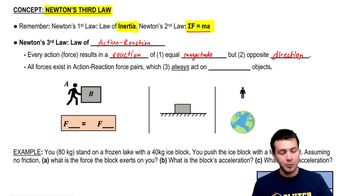
Newton's Third Law states that for every action, there is an equal and opposite reaction. This principle is crucial in understanding how forces interact during a supernova explosion, where the outward force from the explosion generates an inward reaction force on the core, leading to gravitational collapse.
Recommended video:
Guided course
08:01
Newton's Third Law & Action-Reaction Pairs

Gravitational Collapse

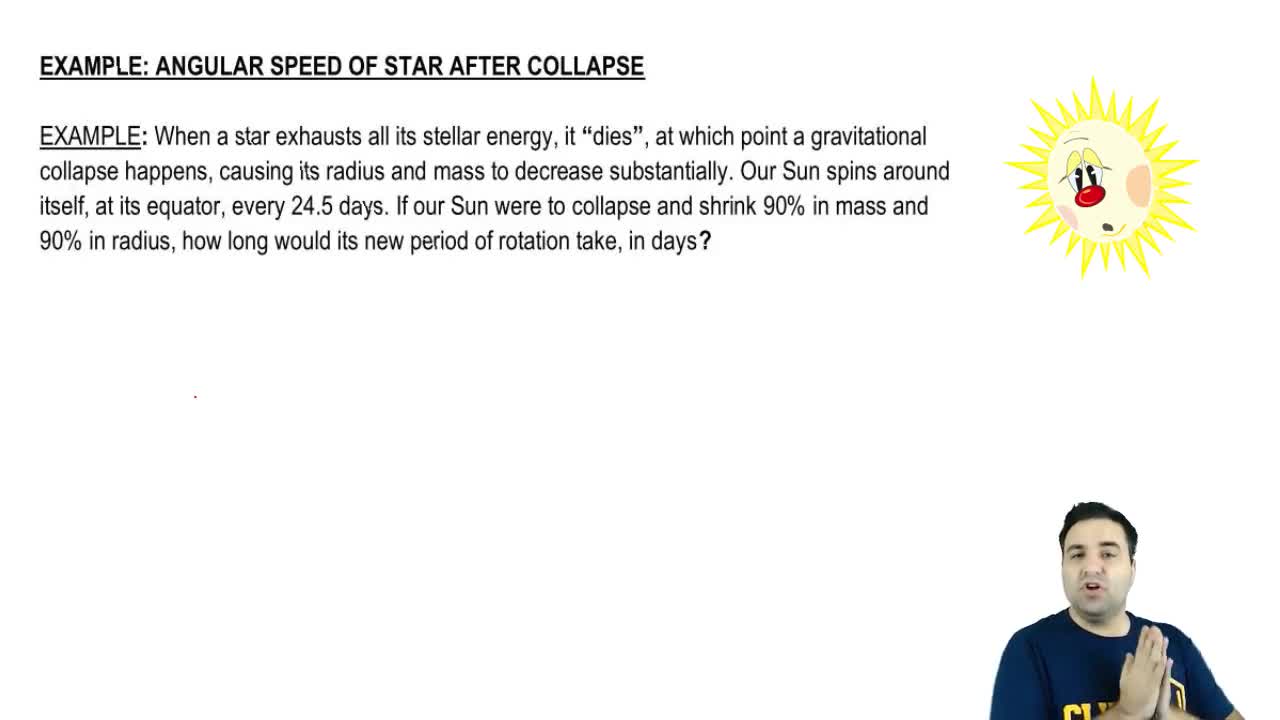
Gravitational collapse occurs when the gravitational forces acting on an object exceed the forces resisting that collapse, leading to a compression of matter. In the context of a supernova, this process can result in the formation of dense objects like neutron stars, as the core's material is crushed under extreme gravitational pressure.
Recommended video:
Guided course
06:36
Star collapses

Neutron Stars and Pulsars

Neutron stars are incredibly dense remnants of massive stars that have undergone gravitational collapse, consisting primarily of neutrons. Some neutron stars are observed as pulsars, which emit beams of electromagnetic radiation due to their rapid rotation, creating a pulsing effect as they rotate, similar to a lighthouse beam.
Recommended video:
Guided course
06:36
Star collapses
Related Practice
Textbook Question

The solar system is 25,000 light years from the center of our Milky Way galaxy. One light year is the distance light travels in one year at a speed of 3.0 x 10⁶ m/s . Astronomers have determined that the solar system is orbiting the center of the galaxy at a speed of 230 km/s . Our solar system was formed roughly 5 billion years ago. How many orbits has it completed?

1717
views
Textbook Question

In 2014, the European Space Agency placed a satellite in orbit around comet 67P/Churyumov-Gerasimenko and then landed a probe on the surface. The actual orbit was elliptical, but we’ll approximate it as a 50-km-diameter circular orbit with a period of 11 days. What is the mass of the comet?

1056
views
Textbook Question

FIGURE P13.57 shows two planets of mass m orbiting a star of mass M. The planets are in the same orbit, with radius r, but are always at opposite ends of a diameter. Find an exact expression for the orbital period T. Hint: Each planet feels two forces.

1166
views
Textbook Question

In 2000, NASA placed a satellite in orbit around an asteroid. Consider a spherical asteroid with a mass of 1.0 x 10¹⁶ kg and a radius of 8.8 km. What is the escape speed from the asteroid?

792
views
Textbook Question

Large stars can explode as they finish burning their nuclear fuel, causing a supernova. The explosion blows away the outer layers of the star. According to Newton's third law, the forces that push the outer layers away have reaction forces that are inwardly directed on the core of the star. These forces compress the core and can cause the core to undergo a gravitational collapse. The gravitational forces keep pulling all the matter together tighter and tighter, crushing atoms out of existence. Under these extreme conditions, a proton and an electron can be squeezed together to form a neutron. If the collapse is halted when the neutrons all come into contact with each other, the result is an object called a neutron star, an entire star consisting of solid nuclear matter. Many neutron stars rotate about their axis with a period of ≈ 1 s and, as they do so, send out a pulse of electromagnetic waves once a second. These stars were discovered in the 1960s and are called pulsars. What is the radius of a geosynchronous orbit?

1869
views
Textbook Question

The solar system is 25,000 light years from the center of our Milky Way galaxy. One light year is the distance light travels in one year at a speed of 3.0 x 10⁸ m/s. Astronomers have determined that the solar system is orbiting the center of the galaxy at a speed of 230 km/s. The gravitational force on the solar system is the net force due to all the matter inside our orbit. Most of that matter is concentrated near the center of the galaxy. Assume that the matter has a spherical distribution, like a giant star. What is the approximate mass of the galactic center?

1044
views