
A person's center of mass is easily found by having the person lie on a reaction board. A horizontal, 2.5-m-long, 6.1 kg reaction board is supported only at the ends, with one end resting on a scale and the other on a pivot. A 60 kg woman lies on the reaction board with her feet over the pivot. The scale reads 25 kg. What is the distance from the woman's feet to her center of mass?
A 4.0-cm-diameter disk with a 3.0-cm-diameter hole rolls down a 50-cm-long, 20° ramp. What is its speed at the bottom? What percent is this of the speed of a particle sliding down a frictionless ramp?
Verified step by step guidance
Verified video answer for a similar problem:
Key Concepts
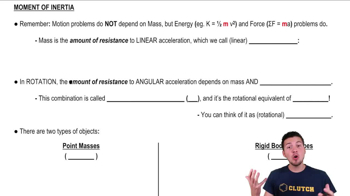
Moment of Inertia
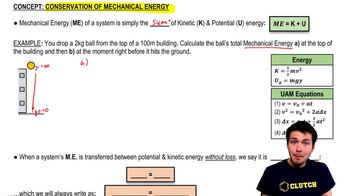
Conservation of Energy
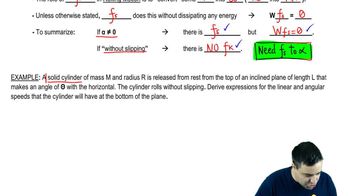
Rolling Motion
Calculate the moment of inertia of the rectangular plate in FIGURE P12.55 for rotation about a perpendicular axis through the center.
Calculate by direct integration the moment of inertia for a thin rod of mass M and length L about an axis located distance d from one end. Confirm that your answer agrees with Table 12.2 when d=0 and when d = L/2.
Determine the moment of inertia about the axis of the object shown in FIGURE P12.52.
Your task in a science contest is to stack four identical uniform bricks, each of length L, so that the top brick is as far to the right as possible without the stack falling over. Is it possible, as FIGURE P12.60 shows, to stack the bricks such that no part of the top brick is over the table? Answer this question by determining the maximum possible value of d.
A 3.0-m-long ladder, as shown in Figure 12.35, leans against a frictionless wall. The coefficient of static friction between the ladder and the floor is 0.40. What is the minimum angle the ladder can make with the floor without slipping?
