Ch 13: Newton's Theory of Gravity
Knight Calc - Physics for Scientists and Engineers 5th Edition
Knight Calc5th EditionPhysics for Scientists and EngineersISBN: 9780137344796Not the one you use?Change textbook
Chapter 13, Problem 12

Asteroid 253 Mathilde is one of several that have been visited by space probes. This asteroid is roughly spherical with a diameter of 53 km. The free-fall acceleration at the surface is 9.9 ✕ 10-3 m/s2. What is the asteroid's mass?

Verified step by step guidance
1
Start by recalling the formula for gravitational acceleration: g = \(\frac{G \cdot M}{r^2}\), where g is the gravitational acceleration, G is the gravitational constant (6.674 \(\times\) 10^{-11} \ \(\text{m}\)^3 \(\text{kg}\)^{-1} \(\text{s}\)^{-2}), M is the mass of the asteroid, and r is the radius of the asteroid.
Rearrange the formula to solve for the mass M: M = \(\frac{g \cdot r^2}{G}\).
Determine the radius of the asteroid. Since the diameter is given as 53 km, the radius r is half of the diameter: r = \(\frac{53}{2}\) \ \(\text{km}\) = 26.5 \ \(\text{km}\) = 26,500 \ \(\text{m}\).
Substitute the known values into the formula: g = 9.9 \(\times\) 10^{-3} \ \(\text{m/s}\)^2, r = 26,500 \ \(\text{m}\), and G = 6.674 \(\times\) 10^{-11} \ \(\text{m}\)^3 \(\text{kg}\)^{-1} \(\text{s}\)^{-2}. The equation becomes M = \(\frac{(9.9 \times 10^{-3}\)) \(\cdot\) (26,500)^2}{6.674 \(\times\) 10^{-11}}.
Simplify the expression to calculate the mass M. Ensure that all units are consistent and perform the arithmetic operations carefully to find the asteroid's mass.

Verified video answer for a similar problem:

This video solution was recommended by our tutors as helpful for the problem above.
Video duration:
3m
Was this helpful?

Key Concepts

Here are the essential concepts you must grasp in order to answer the question correctly.

Gravitational Force

Gravitational force is the attractive force between two masses. It is described by Newton's law of universal gravitation, which states that the force is proportional to the product of the two masses and inversely proportional to the square of the distance between their centers. This concept is crucial for understanding how the mass of an object can be determined from the gravitational acceleration it experiences.
Recommended video:
Guided course
05:41
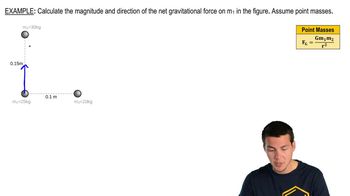
Gravitational Forces in 2D

Free-Fall Acceleration

Free-fall acceleration is the acceleration of an object due solely to the force of gravity, without any other forces acting on it. On the surface of an astronomical body, this acceleration can be calculated using the formula g = G * M / r², where G is the gravitational constant, M is the mass of the body, and r is its radius. In this case, the free-fall acceleration at the surface of the asteroid is given as 9.9 × 10⁻³ m/s².
Recommended video:
Guided course
08:36
Vertical Motion & Free Fall

Mass Calculation

To find the mass of an object using free-fall acceleration, we can rearrange the formula for gravitational acceleration. By substituting the known values of g (free-fall acceleration) and r (radius of the asteroid), we can solve for M (mass). This calculation is essential for determining the mass of asteroid 253 Mathilde based on its size and the gravitational acceleration experienced at its surface.
Recommended video:
Guided course
20:32
Mass Spectrometers