
Ch 36: Special Relativity
Knight Calc - Physics for Scientists and Engineers 5th Edition
Knight Calc5th EditionPhysics for Scientists and EngineersISBN: 9780137344796Not the one you use?Change textbook
Chapter 36, Problem 23

A cube has a density of 2000 kg/m³ while at rest in the laboratory. What is the cube’s density as measured by an experimenter in the laboratory as the cube moves through the laboratory at 90% of the speed of light in a direction perpendicular to one of its faces?

Verified step by step guidance
1
Understand the concept of relativistic density: In special relativity, the density of an object is affected by its relativistic length contraction. The mass of the object remains unchanged, but its volume changes due to the contraction of its length in the direction of motion.
Identify the given values: The rest density of the cube is \( \rho_0 = 2000 \; \text{kg/m}^3 \), and the cube is moving at \( v = 0.9c \), where \( c \) is the speed of light. The motion is perpendicular to one of its faces, so the length contraction will affect only one dimension of the cube.
Recall the formula for relativistic length contraction: The contracted length \( L \) is given by \( L = L_0 \sqrt{1 - \frac{v^2}{c^2}} \), where \( L_0 \) is the rest length, \( v \) is the velocity, and \( c \) is the speed of light. This contraction affects the volume of the cube.
Express the relativistic volume: The rest volume of the cube is \( V_0 = L_0^3 \). After length contraction, the relativistic volume becomes \( V = L_0^2 \cdot L \), where \( L \) is the contracted length. Substitute \( L \) into this expression to get \( V = L_0^3 \sqrt{1 - \frac{v^2}{c^2}} \).
Calculate the relativistic density: The relativistic density \( \rho \) is given by \( \rho = \frac{m}{V} \), where \( m \) is the mass of the cube. Since \( m = \rho_0 V_0 \), substitute \( V \) into the equation to get \( \rho = \frac{\rho_0}{\sqrt{1 - \frac{v^2}{c^2}}} \). Use this formula to determine the relativistic density of the cube.

Verified video answer for a similar problem:

This video solution was recommended by our tutors as helpful for the problem above.
Was this helpful?

Key Concepts

Here are the essential concepts you must grasp in order to answer the question correctly.

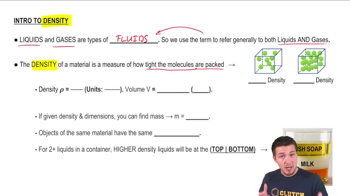
Density

Density is defined as mass per unit volume, typically expressed in kilograms per cubic meter (kg/m³). It is a fundamental property of materials that influences their behavior in various physical contexts, including buoyancy and pressure. In this scenario, the cube's density is initially given as 2000 kg/m³ when at rest.
Recommended video:
Guided course
8:13
Intro to Density

Relativistic Effects

Relativistic effects arise from the principles of Einstein's theory of relativity, which states that the laws of physics are the same for all observers, regardless of their relative motion. As an object approaches the speed of light, its mass effectively increases from the perspective of a stationary observer, leading to changes in how properties like density are perceived. This is crucial for understanding how the cube's density might change as it moves at 90% of the speed of light.
Recommended video:
Guided course
07:40
The Doppler Effect

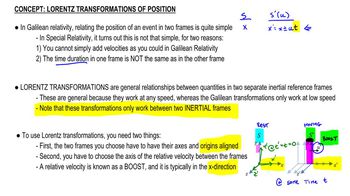
Lorentz Contraction

Lorentz contraction is a phenomenon predicted by special relativity, where an object in motion is measured to be shorter in the direction of its motion from the perspective of a stationary observer. This contraction affects the volume of the cube as it moves at relativistic speeds, which in turn influences the density calculation. Understanding this concept is essential for determining how the cube's density is perceived by the experimenter in the laboratory.
Recommended video:
Guided course
14:16
Lorentz Transformations of Position