
Ch 17: Superposition
Knight Calc - Physics for Scientists and Engineers 5th Edition
Knight Calc5th EditionPhysics for Scientists and EngineersISBN: 9780137344796Not the one you use?Change textbook
Chapter 17, Problem 77

You have two small, identical boxes that generate 440 Hz notes. While holding one, you drop the other from a 20-m-high balcony. How many beats will you hear before the falling box hits the ground? You can ignore air resistance.

Verified step by step guidance
1
Determine the time it takes for the falling box to hit the ground using the kinematic equation for free fall: t = 2hg, where h is the height (20 m) and g is the acceleration due to gravity (9.8 m/s²).
Calculate the velocity of the falling box just before it hits the ground using the equation v = 2gh. This velocity will cause a Doppler shift in the frequency of the sound emitted by the falling box.
Determine the observed frequency of the falling box using the Doppler effect formula: fobs = fsourcevsoundvsound - vfalling, where vsound is the speed of sound in air (approximately 343 m/s), and vfalling is the velocity of the falling box.
Calculate the beat frequency using the formula: fbeat = |fobs - fsource|, where fsource is the original frequency of the stationary box (440 Hz).
Multiply the beat frequency by the time of fall to determine the total number of beats heard before the falling box hits the ground: n = fbeat × t.

Verified video answer for a similar problem:

This video solution was recommended by our tutors as helpful for the problem above.
Video duration:
13m
Was this helpful?

Key Concepts

Here are the essential concepts you must grasp in order to answer the question correctly.

Frequency and Beats

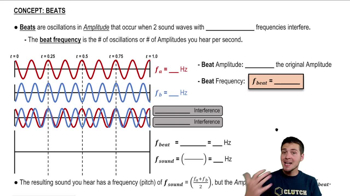
Frequency refers to the number of cycles of a wave that occur in a unit of time, measured in Hertz (Hz). When two sound waves of slightly different frequencies interact, they produce a phenomenon known as beats, which is the periodic variation in sound intensity. The beat frequency is equal to the absolute difference between the two frequencies, allowing us to calculate how many beats will be heard over a given time period.
Recommended video:

Free Fall and Time of Flight

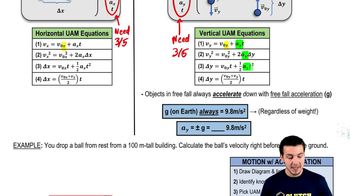
Free fall describes the motion of an object under the influence of gravity alone, without any air resistance. The time it takes for an object to fall from a certain height can be calculated using the equation t = √(2h/g), where h is the height and g is the acceleration due to gravity (approximately 9.81 m/s²). This concept is crucial for determining how long the second box will be in the air before it hits the ground.
Recommended video:
Guided course
08:36
Vertical Motion & Free Fall

Sound Wave Propagation

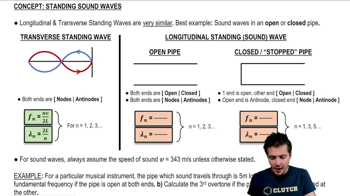
Sound waves are mechanical waves that propagate through a medium, such as air, and their speed is influenced by factors like temperature and pressure. In this scenario, the sound generated by the boxes travels at a constant speed, allowing us to consider the time it takes for the sound of the falling box to reach the observer. Understanding sound wave propagation is essential for calculating the total number of beats heard during the fall.
Recommended video:
Guided course
05:17
Standing Sound Waves
Related Practice
Textbook Question

Piano tuners tune pianos by listening to the beats between the harmonics of two different strings. When properly tuned, the note A should have a frequency of 440 Hz and the note E should be at 659 Hz. What is the frequency difference between the third harmonic of the A and the second harmonic of the E?

1163
views
Textbook Question

Piano tuners tune pianos by listening to the beats between the harmonics of two different strings. When properly tuned, the note A should have a frequency of 440 Hz and the note E should be at 659 Hz. The tuner starts with the tension in the E string a little low, then tightens it. What is the frequency of the E string when she hears four beats per second?

1481
views
Textbook Question

Ultrasound has many medical applications, one of which is to monitor fetal heartbeats by reflecting ultrasound off a fetus in the womb. Consider an object moving at speed vo toward an at-rest source that is emitting sound waves of frequency f0. Show that the reflected wave (i.e., the echo) that returns to the source has a Doppler-shifted frequency fecho = (v+v0 / v-v0) f0 where v is the speed of sound in the medium.

1570
views
Textbook Question

A flutist assembles her flute in a room where the speed of sound is 342 m/s. When she plays the note A, it is in perfect tune with a 440 Hz tuning fork. After a few minutes, the air inside her flute has warmed to where the speed of sound is 346 m/s. How far does she need to extend the 'tuning joint' of her flute to be in tune with the tuning fork?

1804
views
Textbook Question

When mass M is tied to the bottom end of a long, thin wire suspended from the ceiling, the wire's second-harmonic frequency is 200 Hz. Adding an additional 1.0 kg to the hanging mass increases the second-harmonic frequency to 245 Hz. What is M?

1492
views