Ch 02: Kinematics in One Dimension
Knight Calc - Physics for Scientists and Engineers 5th Edition
Knight Calc5th EditionPhysics for Scientists and EngineersISBN: 9780137344796Not the one you use?Change textbook
Chapter 2, Problem 58b

A hotel elevator ascends 200 m with a maximum speed of 5.0 m/s. Its acceleration and deceleration both have a magnitude of 1.0 m/s2. How long does it take to make the complete trip from bottom to top?

Verified step by step guidance
1
Determine the time required for the elevator to accelerate to its maximum speed. Use the kinematic equation: v = u + at, where v is the final velocity (5.0 m/s), u is the initial velocity (0 m/s), and a is the acceleration (1.0 m/s²). Solve for t.
Calculate the distance covered during the acceleration phase using the kinematic equation: s = ut + \(\frac{1}{2}\)at^2. Substitute u = 0, a = 1.0 \(\text{ m/s}\)^2, and the time t found in the previous step.
Determine the distance traveled at constant speed. Subtract the distances covered during acceleration and deceleration from the total distance (200 m). The remaining distance is traveled at the maximum speed of 5.0 m/s.
Calculate the time spent traveling at constant speed using the formula: t = \(\frac{s}{v}\), where s is the distance traveled at constant speed and v is the maximum speed (5.0 m/s).
Add the time for acceleration, the time for deceleration (which is equal to the time for acceleration), and the time for constant speed to find the total time for the trip.

Verified video answer for a similar problem:

This video solution was recommended by our tutors as helpful for the problem above.
Video duration:
14m
Was this helpful?

Key Concepts

Here are the essential concepts you must grasp in order to answer the question correctly.

Kinematics

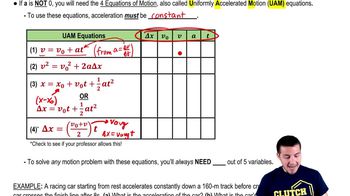
Kinematics is the branch of mechanics that describes the motion of objects without considering the forces that cause the motion. It involves concepts such as displacement, velocity, acceleration, and time. In this problem, kinematic equations will be used to determine the time taken for the elevator to ascend 200 m, factoring in its maximum speed and acceleration.
Recommended video:
Guided course
08:25
Kinematics Equations

Acceleration

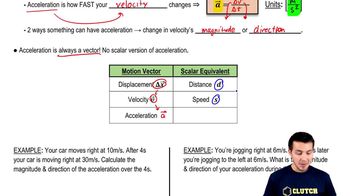
Acceleration is the rate of change of velocity of an object with respect to time. It can be positive (speeding up) or negative (slowing down). In this scenario, the elevator has a constant acceleration of 1.0 m/s² during its ascent, which affects how quickly it reaches its maximum speed and how long it takes to complete the trip.
Recommended video:
Guided course
05:47
Intro to Acceleration

Uniform Motion

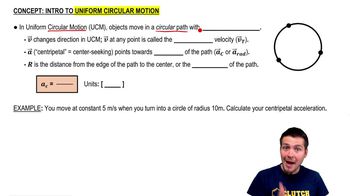
Uniform motion refers to the motion of an object moving at a constant speed in a straight line. In this case, once the elevator reaches its maximum speed of 5.0 m/s, it will travel at this constant speed until it needs to decelerate. Understanding the transition between acceleration, uniform motion, and deceleration is crucial for calculating the total time for the elevator's trip.
Recommended video:
Guided course
03:48
Intro to Circular Motion
Related Practice
Textbook Question

A steel ball rolls across a 30-cm-wide felt pad, starting from one edge. The ball's speed has dropped to half after traveling 20 cm. Will the ball stop on the felt pad or roll off?

2294
views

Textbook Question

You are 9.0 m from the door of your bus, behind the bus, when it pulls away with an acceleration of 1.0 m/s². You instantly start running toward the still-open door at 4.5 m/s. What is the maximum time you can wait before starting to run and still catch the bus?

2781
views
Textbook Question

A 200 kg weather rocket is loaded with 100 kg of fuel and fired straight up. It accelerates upward at 30 m/s² for 30 s, then runs out of fuel. Ignore any air resistance effects. What is the rocket's maximum altitude?

3033
views
Textbook Question

Ann and Carol are driving their cars along the same straight road. Carol is located at x = 2.4 mi at t = 0 h and drives at a steady 36 mph. Ann, who is traveling in the same direction, is located at x = 0.0 mi at t = 0.50 h and drives at a steady 50 mph. Draw a position-versus-time graph showing the motion of both Ann and Carol.

711
views
Textbook Question

A lead ball is dropped into a lake from a diving board 5.0 m above the water. After entering the water, it sinks to the bottom with a constant velocity equal to the velocity with which it hit the water. The ball reaches the bottom 3.0 s after it is released. How deep is the lake?

2825
views
Textbook Question

A 1000 kg weather rocket is launched straight up. The rocket motor provides a constant acceleration for 16 s, then the motor stops. The rocket altitude 20 s after launch is 5100 m. You can ignore any effects of air resistance. What was the rocket's acceleration during the first 16 s?

3988
views