Ch 21: Heat Engines and Refrigerators
Knight Calc - Physics for Scientists and Engineers 5th Edition
Knight Calc5th EditionPhysics for Scientists and EngineersISBN: 9780137344796Not the one you use?Change textbook
Chapter 21, Problem 24

At what cold-reservoir temperature (in ℃) would a Carnot engine with a hot-reservoir temperature of 427℃ have an efficiency of 60%?

Verified step by step guidance
1
Step 1: Recall the formula for the efficiency of a Carnot engine: \( \eta = 1 - \frac{T_c}{T_h} \), where \( \eta \) is the efficiency, \( T_c \) is the cold-reservoir temperature, and \( T_h \) is the hot-reservoir temperature. Note that temperatures must be in Kelvin for this formula.
Step 2: Convert the given hot-reservoir temperature from Celsius to Kelvin using the formula \( T(K) = T(℃) + 273.15 \). For \( T_h = 427℃ \), calculate \( T_h \) in Kelvin.
Step 3: Substitute the given efficiency \( \eta = 0.60 \) and the calculated \( T_h \) into the Carnot efficiency formula \( \eta = 1 - \frac{T_c}{T_h} \). Rearrange the formula to solve for \( T_c \): \( T_c = T_h \cdot (1 - \eta) \).
Step 4: Calculate \( T_c \) in Kelvin using the rearranged formula. Ensure all values are substituted correctly.
Step 5: Convert \( T_c \) from Kelvin back to Celsius using the formula \( T(℃) = T(K) - 273.15 \). This will give the cold-reservoir temperature in Celsius.

Verified video answer for a similar problem:

This video solution was recommended by our tutors as helpful for the problem above.
Video duration:
2m
Was this helpful?

Key Concepts

Here are the essential concepts you must grasp in order to answer the question correctly.

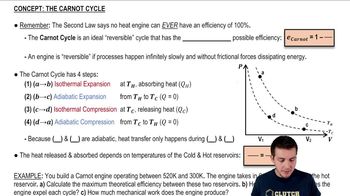
Carnot Efficiency

Carnot efficiency is the maximum possible efficiency of a heat engine operating between two thermal reservoirs. It is defined by the formula η = 1 - (T_c / T_h), where η is the efficiency, T_c is the absolute temperature of the cold reservoir, and T_h is the absolute temperature of the hot reservoir. This concept illustrates the theoretical limits of efficiency based on temperature differences.
Recommended video:
Guided course
06:28
The Carnot Cycle and Maximum Theoretical Efficiency

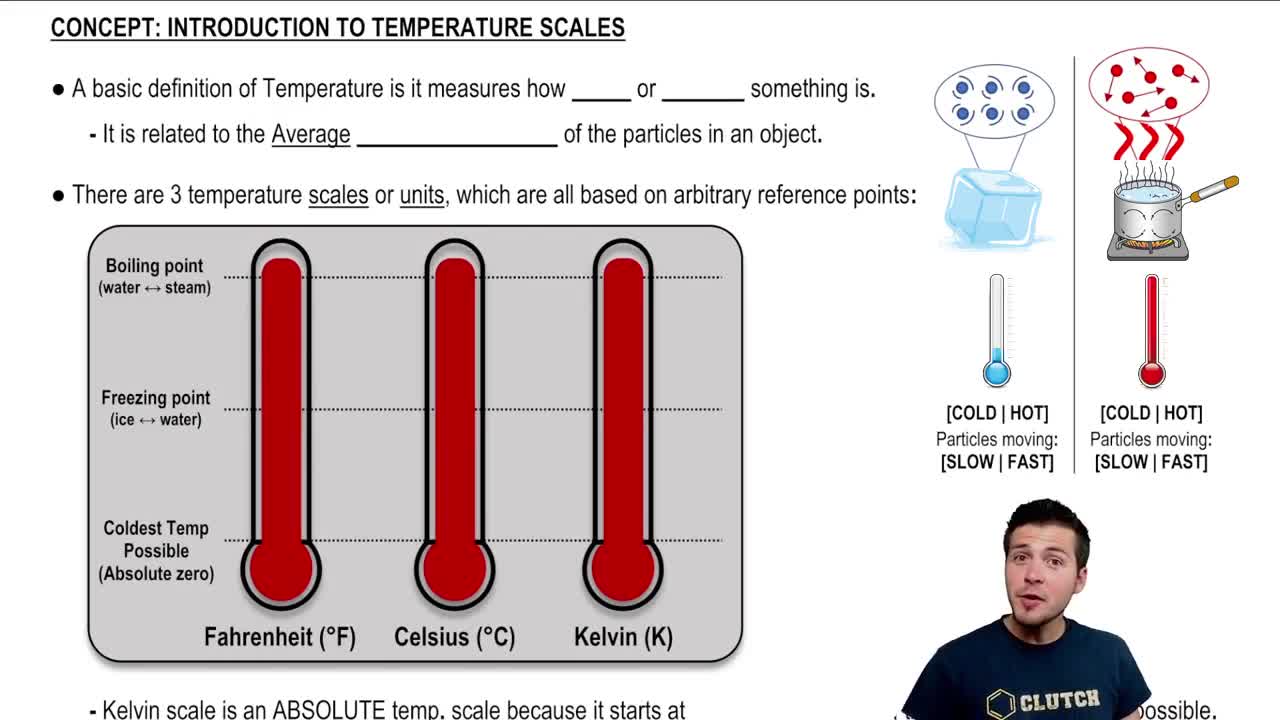
Absolute Temperature

Absolute temperature is measured in Kelvin (K) and is a scale that starts at absolute zero, the point where molecular motion ceases. To convert Celsius to Kelvin, you add 273.15. In the context of thermodynamics, using absolute temperatures is crucial for accurate calculations of efficiency and energy transfer in heat engines.
Recommended video:
Guided course
04:54
Introduction To Temperature Scales

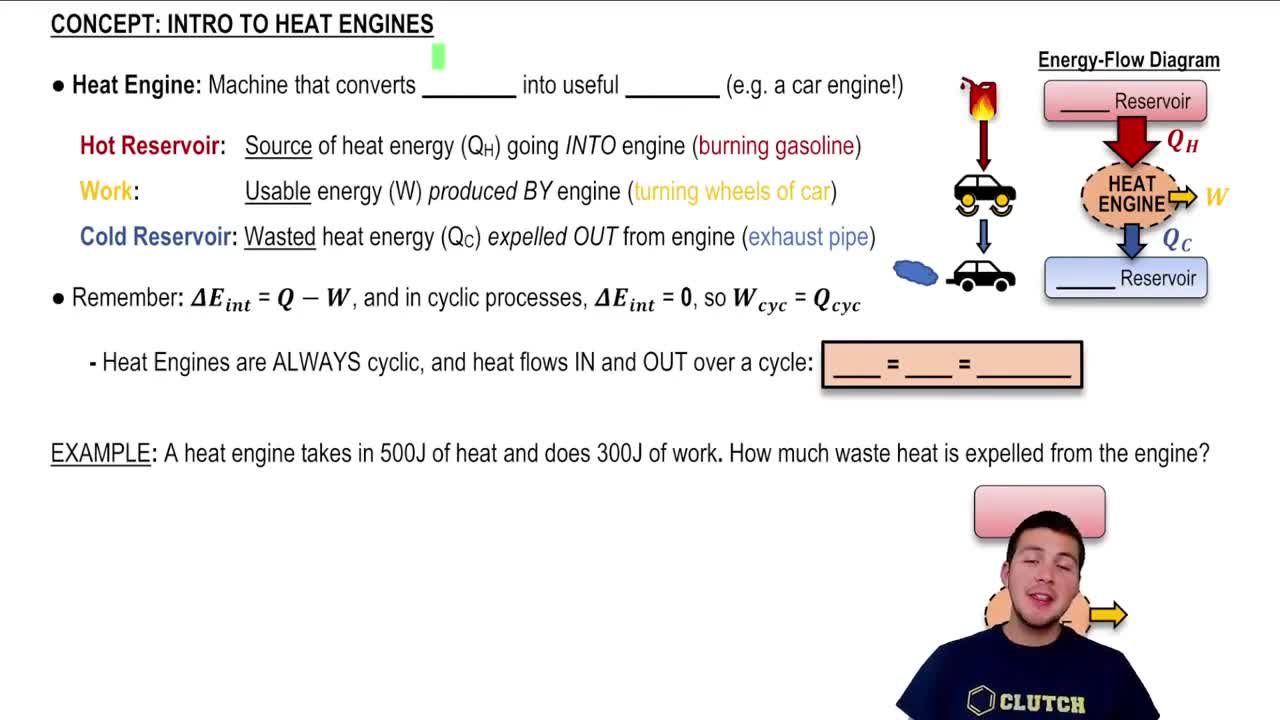
Heat Engine

A heat engine is a device that converts thermal energy into mechanical work by transferring heat from a hot reservoir to a cold reservoir. The efficiency of a heat engine is determined by the ratio of work output to heat input. Understanding the principles of heat engines, including the Carnot cycle, is essential for analyzing their performance and efficiency.
Recommended video:
Guided course
07:35
Introduction to Heat Engines