
Ch 28: Fundamentals of Circuits
Knight Calc - Physics for Scientists and Engineers 5th Edition
Knight Calc5th EditionPhysics for Scientists and EngineersISBN: 9780137344796Not the one you use?Change textbook
Chapter 28, Problem 44

A 2.0-m-long, 1.0-mm-diameter wire has a variable resistivity given by where x is measured from one end of the wire. What is the current if this wire is connected to the terminals of a 9.0 V battery?

Verified step by step guidance
1
Understand the problem: The wire has a variable resistivity, meaning the resistivity changes along its length. To find the current, we need to calculate the total resistance of the wire and then use Ohm's Law, \( I = \frac{V}{R} \), where \( V \) is the voltage and \( R \) is the total resistance.
Express the resistance of a small segment of the wire: The resistance of a small segment \( dx \) of the wire is given by \( dR = \frac{\rho(x) dx}{A} \), where \( \rho(x) \) is the resistivity as a function of \( x \), \( A \) is the cross-sectional area of the wire, and \( dx \) is the infinitesimal length of the segment.
Integrate to find the total resistance: The total resistance \( R \) is the integral of \( dR \) over the length of the wire, \( R = \int_0^L \frac{\rho(x)}{A} dx \), where \( L \) is the total length of the wire. Substitute the expression for \( \rho(x) \) and calculate the integral.
Calculate the cross-sectional area: The cross-sectional area \( A \) of the wire is given by \( A = \pi r^2 \), where \( r \) is the radius of the wire. Since the diameter is given as 1.0 mm, the radius is \( r = 0.5 \times 10^{-3} \) m. Substitute this value into the formula for \( A \).
Use Ohm's Law to find the current: Once the total resistance \( R \) is determined from the integration, use Ohm's Law, \( I = \frac{V}{R} \), where \( V = 9.0 \) V, to calculate the current through the wire.

Verified video answer for a similar problem:

This video solution was recommended by our tutors as helpful for the problem above.
Was this helpful?

Key Concepts

Here are the essential concepts you must grasp in order to answer the question correctly.

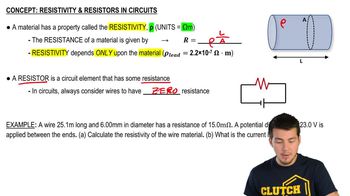
Resistivity

Resistivity is a material property that quantifies how strongly a given material opposes the flow of electric current. It is denoted by the symbol ρ (rho) and is measured in ohm-meters (Ω·m). In this question, the resistivity varies along the length of the wire, which means that the resistance will also change depending on the position along the wire.
Recommended video:
Guided course
05:25
Resistivity & Resistors in Circuits

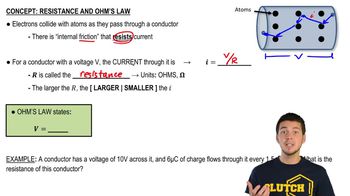
Ohm's Law

Ohm's Law states that the current (I) flowing through a conductor between two points is directly proportional to the voltage (V) across the two points and inversely proportional to the resistance (R) of the conductor. It is mathematically expressed as I = V/R. This law is fundamental for analyzing circuits and will be essential for calculating the current in the wire when connected to the battery.
Recommended video:
Guided course
03:07
Resistance and Ohm's Law

Resistance of a Wire

The resistance (R) of a wire can be calculated using the formula R = ρ(L/A), where ρ is the resistivity, L is the length of the wire, and A is the cross-sectional area. For a cylindrical wire, the cross-sectional area can be determined using the diameter. Since the resistivity varies along the length of the wire in this problem, the total resistance will need to be calculated by integrating the resistivity function over the length of the wire.
Recommended video:
Guided course
09:57
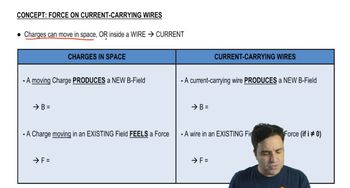
Magnetic Force on Current-Carrying Wire
Related Practice
Textbook Question

A small toaster that operates at 120 V has a heating element made from a 4.4-m-long, 0.70-mm-diameter nichrome wire. The resistivity, density, and specific heat of nichrome are, respectively, 1.5 x 10⁻⁶ Ωm, 8400 kg/m³, and 450 J/kg K. If half the heat energy is lost to the air, how long does it take the heating element to warm from 20℃ to 450℃, about the temperature at which it first begins to glow red?

1256
views
Textbook Question

It seems hard to justify spending \$5.00 for an LED lightbulb when an ordinary incandescent bulb costs 50¢. To see if this makes sense, compare a 60 W incandescent bulb that lasts 1000 hours to a 10 W LED bulb that has a lifetime of 15,000 hours. Both bulbs produce the same amount of visible light. If electricity costs \$0.15/kWh, what is the total cost—purchase price plus energy—to get 15,000 hours of light from each type of bulb? This is called the life-cycle cost.

82
views
Textbook Question

Suppose you have resistors 2.5 Ω, 3.5 Ω, and 4.5 Ω and a 100 V power supply. What is the ratio of the total power delivered to the resistors if they are connected in parallel to the total power delivered if they are connected in series?

62
views
Textbook Question

You have a 2.0 Ω resistor, a 3.0 Ω resistor, a 6.0 Ω resistor, and a 6.0 V battery. Draw a diagram of a circuit in which all three resistors are used and the battery delivers 9.0 W of power.

1450
views
Textbook Question

An electric eel develops a 450 V potential difference between its head and tail. The eel can stun a fish or other prey by using this potential difference to drive a 0.80 A current pulse for 1.0 ms. What are (a) the energy delivered by this pulse and (b) the total charge that flows?

83
views
Textbook Question

To which two points in the circuit of FIGURE P28.45 should a 12 V battery be connected to dissipate the most power?

76
views