
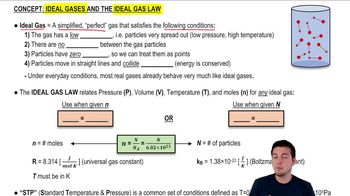
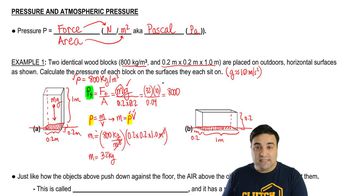
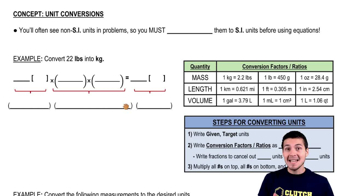
An inflated bicycle inner tube is 2.2 cm in diameter and 200 cm in circumference. A small leak causes the gauge pressure to decrease from 110 psi to 80 psi on a day when the temperature is 20°C. What mass of air is lost? Assume the air is pure nitrogen.
In Problems and you are given the equation(s) used to solve a problem. For each of these, you are to write a realistic problem for which this is the correct equation(s).
Verified step by step guidance
Verified video answer for a similar problem:
Key Concepts
Gas Laws
Pressure and Volume Relationship
Units of Measurement
The cylinder in FIGURE CP18.73 has a moveable piston attached to a spring. The cylinder's cross-section area is 10 cm2, it contains 0.0040 mol of gas, and the spring constant is 1500 N/m. At 20°C the spring is neither compressed nor stretched. How far is the spring compressed if the gas temperature is raised to 100°C?
Five grams of nitrogen gas at an initial pressure of 3.0 atm and at 20°C undergo an isobaric expansion until the volume has tripled. What is the gas temperature after the expansion (in °C)? The gas pressure is then decreased at constant volume until the original temperature is reached.
In Problems and you are given the equation(s) used to solve a problem. For each of these, you are to write a realistic problem for which this is the correct equation(s).
A container of gas at 2.0 atm pressure and 127°C is compressed at constant temperature until the volume is halved. It is then further compressed at constant pressure until the volume is halved again. Show this process on a pV diagram.
Five grams of nitrogen gas at an initial pressure of 3.0 atm and at 20°C undergo an isobaric expansion until the volume has tripled. What is the gas volume after the expansion?
