

Ch 39: Wave Functions and Uncertainty
Knight Calc - Physics for Scientists and Engineers 5th Edition
Knight Calc5th EditionPhysics for Scientists and EngineersISBN: 9780137344796Not the one you use?Change textbook
Chapter 39, Problem 39d

Consider the electron wave function ψ(x)={c1x2x1 cm0x1 cm\(\psi\) (x)=\(\begin{cases}\) c\(\sqrt{1-x^{2}\)} & \(\left\)|x\(\right\)|\(\leq\) 1\(\text{ cm}\) \\ 0 & \(\left\)|x\(\right\)|\(\geq\) 1\(\text{ cm}\) \(\end{cases}\) where x is in cm. If 104 electrons are detected, how many will be in the interval 0.00 cm ≤ x ≤ 0.50 cm?

Verified step by step guidance
1
Step 1: Understand the problem. The wave function ψ(x) describes the probability amplitude of finding an electron at position x. To determine the number of electrons in the interval 0.00 cm ≤ x ≤ 0.50 cm, we need to calculate the probability of finding an electron in this interval and multiply it by the total number of electrons detected (10^4).
Step 2: Recall that the probability density function is proportional to the square of the wave function, |ψ(x)|². For |x| ≤ 1 cm, ψ(x) = √c(1 − x²). Therefore, the probability density function is |ψ(x)|² = c(1 − x²)².
Step 3: To find the probability of detecting an electron in the interval 0.00 cm ≤ x ≤ 0.50 cm, integrate the probability density function |ψ(x)|² over this interval. The integral is: ∫[0.00 to 0.50] c(1 − x²)² dx.
Step 4: Normalize the wave function to determine the constant c. The total probability of finding an electron in the range |x| ≤ 1 cm must equal 1. Set up the normalization condition: ∫[−1 to 1] c(1 − x²)² dx = 1. Solve this integral to find the value of c.
Step 5: Once c is determined, evaluate the integral ∫[0.00 to 0.50] c(1 − x²)² dx to find the probability of detecting an electron in the interval 0.00 cm ≤ x ≤ 0.50 cm. Multiply this probability by 10^4 to calculate the number of electrons detected in this interval.

Verified video answer for a similar problem:

This video solution was recommended by our tutors as helpful for the problem above.
Video duration:
9m
Was this helpful?

Key Concepts

Here are the essential concepts you must grasp in order to answer the question correctly.

Wave Function

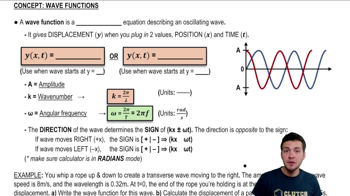
The wave function, denoted as ψ(x), describes the quantum state of a particle, such as an electron, in terms of its position. It contains all the information about the system and is used to calculate probabilities of finding the particle in a specific region of space. The square of the wave function's absolute value, |ψ(x)|², gives the probability density, which indicates the likelihood of locating the particle at a given position.
Recommended video:
Guided course
08:30
Intro to Wave Functions

Probability Density

Probability density is a measure derived from the wave function that indicates the likelihood of finding a particle in a specific interval of space. For a one-dimensional wave function, the probability density is given by |ψ(x)|². To find the total probability of locating the particle within a certain range, one must integrate the probability density over that interval.
Recommended video:
Guided course
8:13
Intro to Density

Normalization

Normalization is a crucial concept in quantum mechanics that ensures the total probability of finding a particle in all possible positions equals one. This is achieved by adjusting the wave function so that the integral of the probability density over the entire space equals one. In this context, it is important to confirm that the wave function is properly normalized before calculating the number of electrons in a specific interval.
Recommended video:
Guided course
08:17
The Normal Force
Related Practice
Textbook Question

Heavy nuclei often undergo alpha decay in which they emit an alpha particle (i.e., a helium nucleus). Alpha particles are so tightly bound together that it’s reasonable to think of an alpha particle as a single unit within the nucleus from which it is emitted. A 238U nucleus, which decays by alpha emission, is 15 fm in diameter. Model an alpha particle within a 238U nucleus as being in a one-dimensional box. What is the maximum speed an alpha particle is likely to have?

29
views
Textbook Question

A particle is described by the wave function ψ(x)={cex/Lx0 mmcex/Lx0 mm\(\psi\) (x)=\(\begin{cases}\) ce^{x/L} & x\(\leq\) 0\(\text{ mm}\) \\ ce^{-x/L} & x\(\geq\) 0\(\text{ mm}\) \(\end{cases}\) mm where L = 2.0 mm. Determine the normalization constant c.

55
views
Textbook Question

A pulse of light is created by the superposition of many waves that span the frequency range f₀ − (1/2) Δf ≤ f ≤ f₀ + (1/2) Δf, where f₀ = c/λ is called the center frequency of the pulse. Laser technology can generate a pulse of light that has a wavelength of 600 nm and lasts a mere 6.0 fs (1 fs = 1 femtosecond =10−15 s). What is the spatial length of the laser pulse as it travels through space?

51
views
Textbook Question

A particle is described by the wave function ψ(x)={cex/Lx0 mmcex/Lx0 mm\(\psi\) (x)=\(\begin{cases}\) ce^{x/L} & x\(\leq\) 0\(\text{ mm}\) \\ ce^{-x/L} & x\(\geq\) 0\(\text{ mm}\) \(\end{cases}\) where L = 2.0 mm. Interpret your answer to part b by shading the region representing this probability on the appropriate graph in part a.

1579
views
Textbook Question

Heavy nuclei often undergo alpha decay in which they emit an alpha particle (i.e., a helium nucleus). Alpha particles are so tightly bound together that it’s reasonable to think of an alpha particle as a single unit within the nucleus from which it is emitted. The probability that a nucleus will undergo alpha decay is proportional to the frequency with which the alpha particle reflects from the walls of the nucleus. What is that frequency (reflections/s) for a maximum-speed alpha particle within a 238U nucleus?

60
views
Textbook Question

A particle is described by the wave function ψ(x)={cex/Lx0 mmcex/Lx0 mm\(\psi\) (x)=\(\begin{cases}\) ce^{x/L} & x\(\leq\) 0\(\text{ mm}\) \\ ce^{-x/L} & x\(\geq\) 0\(\text{ mm}\) \(\end{cases}\) where L = 2.0 mm. Calculate the probability of finding the particle within 1.0 mm of the origin.

1579
views