
For an object starting from rest and accelerating with constant acceleration, distance traveled is proportional to the square of the time. If an object travels 2.0 furlongs in the first 2.0 s, how far will it travel in the first 4.0 s?
Ch 05: Force and Motion
Knight Calc5th EditionPhysics for Scientists and EngineersISBN: 9780137344796Not the one you use?Change textbook
Chapter 5, Problem 8
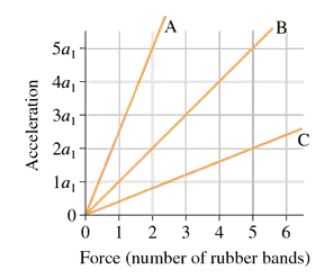
FIGURE EX5.8 shows an acceleration-versus-force graph for three objects pulled by rubber bands. The mass of object B is 0.20 kg. What are the masses of objects A and C? Explain your reasoning.

Verified step by step guidance1
Step 1: Analyze the graph provided. The graph shows acceleration (y-axis) versus force (x-axis) for three objects (A, B, and C). The slope of each line represents the relationship between force and acceleration, which is inversely proportional to the mass of the object according to Newton's second law: .
Step 2: Use the given information for object B. The mass of object B is 0.20 kg. From the graph, the slope of the line for object B can be calculated as . The slope is constant for each object and represents . For object B, the slope is , which simplifies to . This corresponds to .
Step 3: Compare the slopes of the lines for objects A and C relative to object B. The slope for object A is steeper than that of object B, indicating a smaller mass (since is larger for smaller masses). The slope for object C is less steep than that of object B, indicating a larger mass.
Step 4: Calculate the relative masses. The slope for object A is approximately twice that of object B, meaning the mass of object A is half the mass of object B. Similarly, the slope for object C is approximately half that of object B, meaning the mass of object C is twice the mass of object B.
Step 5: Conclude the reasoning. Using the relationships derived from the graph and the given mass of object B (0.20 kg), the mass of object A is kg, and the mass of object C is kg.

Verified video answer for a similar problem:
This video solution was recommended by our tutors as helpful for the problem above.
Was this helpful?
Key Concepts
Here are the essential concepts you must grasp in order to answer the question correctly.
Newton's Second Law of Motion
Newton's Second Law states that the acceleration of an object is directly proportional to the net force acting on it and inversely proportional to its mass. This relationship is expressed by the formula F = ma, where F is the force, m is the mass, and a is the acceleration. Understanding this law is crucial for analyzing the acceleration-versus-force graph, as it allows us to relate the forces applied to each object with their respective accelerations.
Recommended video:
Guided course
Intro to Forces & Newton's Second Law
Slope of a Graph
In a force versus acceleration graph, the slope represents the mass of the object being analyzed. The steeper the slope, the smaller the mass, as a greater force results in a higher acceleration. By determining the slope of the lines for objects A and C in relation to object B, whose mass is known, we can calculate their respective masses based on the proportionality established by Newton's Second Law.
Recommended video:
Guided course
Slope
Proportional Relationships
Proportional relationships occur when two quantities maintain a constant ratio. In the context of the graph, the acceleration of each object is proportional to the force applied, allowing us to compare the slopes of the lines for objects A, B, and C. By using the known mass of object B and its corresponding slope, we can derive the masses of objects A and C by establishing their ratios relative to B.
Recommended video:
Guided course
Proportional Reasoning
Related Practice
Textbook Question
2702
views
Textbook Question
FIGURE EX5.14 shows an object's acceleration-versus-force graph. What is the object's mass?
3709
views
Textbook Question
A jet plane is speeding down the runway during takeoff. Air resistance is not negligible. Identify the forces on the jet.
1715
views
Textbook Question
A chandelier hangs from a chain in the middle of a dining room. Identify the forces on the chandelier.
1822
views
Textbook Question
What is the acceleration, as a multiple of g, if this force is applied to a 110 kg bicyclist? This is the combined mass of the cyclist and the bike.
2710
views
Textbook Question
A baseball player is sliding into second base. Identify the forces on the baseball player.
2070
views
