Ch 08: Dynamics II: Motion in a Plane
Chapter 8, Problem 21

The normal force equals the magnitude of the gravitational force as a roller-coaster car crosses the top of a 40-m-diameter loop-the-loop. What is the car's speed at the top?

Verified step by step guidance
1
Identify the forces acting on the roller-coaster car at the top of the loop. The forces are the gravitational force \( F_g = m g \) (acting downward) and the normal force \( F_N \) (also acting downward). At the top of the loop, the centripetal force required to keep the car in circular motion is provided by the sum of these two forces.
Write the equation for the centripetal force \( F_c \) at the top of the loop: \( F_c = F_g + F_N \). Since the problem states that the normal force equals the gravitational force, substitute \( F_N = F_g \) into the equation.
Express the centripetal force in terms of the car's speed \( v \) and the radius of the loop \( r \): \( F_c = \frac{m v^2}{r} \). Substitute \( F_c = F_g + F_N = 2 F_g = 2 m g \) into this equation.
Solve for the car's speed \( v \): \( \frac{m v^2}{r} = 2 m g \). Cancel \( m \) from both sides (assuming the car's mass is nonzero), and rearrange to get \( v^2 = 2 g r \).
Substitute the radius of the loop \( r \) (which is half the diameter, \( r = \frac{40}{2} = 20 \ \text{m} \)) and the acceleration due to gravity \( g = 9.8 \ \text{m/s}^2 \) into the equation \( v^2 = 2 g r \). Take the square root to find \( v \).

Verified video answer for a similar problem:

This video solution was recommended by our tutors as helpful for the problem above.
Video duration:
6m
Was this helpful?

Key Concepts

Here are the essential concepts you must grasp in order to answer the question correctly.

Normal Force

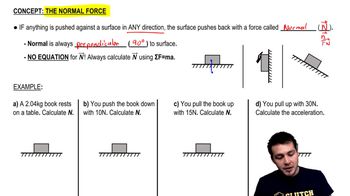
The normal force is the perpendicular force exerted by a surface against an object in contact with it. In the context of circular motion, such as a roller-coaster car at the top of a loop, the normal force acts upward against the weight of the car, which is directed downward due to gravity. At the top of the loop, the normal force and gravitational force must balance to maintain circular motion.
Recommended video:
Guided course
08:17
The Normal Force

Gravitational Force

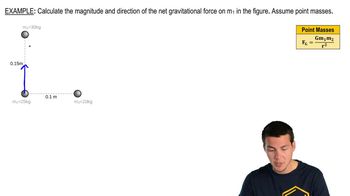
Gravitational force is the attractive force between two masses, calculated using Newton's law of universal gravitation. For an object near the Earth's surface, this force can be simplified to the weight of the object, given by the equation F_gravity = m * g, where m is mass and g is the acceleration due to gravity (approximately 9.81 m/s²). At the top of the loop, this force acts downward and influences the car's motion.
Recommended video:
Guided course
05:41
Gravitational Forces in 2D

Centripetal Force and Speed

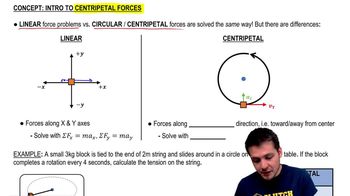
Centripetal force is the net force required to keep an object moving in a circular path, directed towards the center of the circle. At the top of the loop, the centripetal force is provided by the difference between gravitational force and normal force. The speed of the roller-coaster car can be determined using the centripetal force equation, F_c = m * v²/r, where v is the speed and r is the radius of the loop.
Recommended video:
Guided course
06:48
Intro to Centripetal Forces
Related Practice
Textbook Question

Communications satellites are placed in circular orbits where they stay directly over a fixed point on the equator as the Earth rotates. These are called geosynchronous orbits. The altitude of a geosynchronous orbit is 3.58 x 10⁷ m (approximately 22,00 miles). Astronomical data are inside the back cover of the book. What is the weight of a 2000 kg satellite in a geosynchronous orbit?

316
views
Textbook Question

A car drives over the top of a hill that has a radius of 50 m. What maximum speed can the car have at the top without flying off the road?

1932
views
1
rank
Textbook Question

The weight of passengers on a roller coaster increases by 50% as the car goes through a dip with a 30 m radius of curvature. What is the car's speed at the bottom of the dip?

1391
views
Textbook Question

A 500 g ball moves in a vertical circle on a 102-cm-long string. If the speed at the top is 4.0 m/s, then the speed at the bottom will be 7.5 m/s. (You'll learn how to show this in Chapter 10.) What is the gravitational force acting on the ball?

586
views
Textbook Question

A 500 g ball moves in a vertical circle on a 102-cm-long string. If the speed at the top is 4.0 m/s, then the speed at the bottom will be 7.5 m/s. (You'll learn how to show this in Chapter 10.) What is the tension in the string when the ball is at the top?

1142
views
Textbook Question

A heavy ball with a weight of 100 N (m = 10.2 kg) is hung from the ceiling of a lecture hall on a 4.5-m-long rope. The ball is pulled to one side and released to swing as a pendulum, reaching a speed of 5.5 m/s as it passes through the lowest point. What is the tension in the rope at that point?

629
views