Ch 15: Oscillations
Knight Calc - Physics for Scientists and Engineers 5th Edition
Knight Calc5th EditionPhysics for Scientists and EngineersISBN: 9780137344796Not the one you use?Change textbook
Chapter 15, Problem 7c

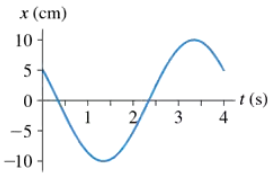
FIGURE EX15.7 is the position-versus-time graph of a particle in simple harmonic motion. What is vmax?

Verified step by step guidance
1
Identify the amplitude (A) of the motion from the graph. The amplitude is the maximum displacement from the equilibrium position. From the graph, the amplitude is 4 cm.
Determine the period (T) of the motion. The period is the time it takes for one complete cycle of motion. From the graph, the particle completes one cycle from t = 0 to t = 4 s, so T = 4 s.
Calculate the angular frequency (ω) using the formula: ω = 2π / T. Substitute the value of T = 4 s into the formula to find ω.
Use the formula for maximum velocity in simple harmonic motion: vₘₐₓ = Aω. Substitute the values of A (4 cm) and ω (calculated in the previous step) into this formula.
Ensure the units are consistent. If needed, convert the amplitude from cm to meters before calculating vₘₐₓ. The final expression for vₘₐₓ will be in meters per second (m/s).

Verified video answer for a similar problem:

This video solution was recommended by our tutors as helpful for the problem above.
Video duration:
2m
Was this helpful?

Key Concepts

Here are the essential concepts you must grasp in order to answer the question correctly.

Simple Harmonic Motion (SHM)

Simple Harmonic Motion is a type of periodic motion where an object oscillates around an equilibrium position. The motion is characterized by a restoring force proportional to the displacement from the equilibrium, leading to sinusoidal position, velocity, and acceleration graphs. In SHM, the maximum displacement from the equilibrium is known as the amplitude.
Recommended video:
Guided course
07:52
Simple Harmonic Motion of Pendulums

Velocity in SHM

In Simple Harmonic Motion, the velocity of the oscillating object varies sinusoidally with time. The maximum velocity, denoted as vₘₐₓ, occurs as the object passes through the equilibrium position. It can be calculated using the formula vₘₐₓ = ωA, where ω is the angular frequency and A is the amplitude of the motion.
Recommended video:
Guided course
7:27
Escape Velocity

Position-Time Graph

A position-time graph visually represents the position of an object as a function of time. In the context of SHM, this graph typically shows a sinusoidal wave, indicating periodic motion. The slope of the graph at any point gives the instantaneous velocity, and the maximum slope corresponds to the maximum velocity of the particle.
Recommended video:
Guided course
03:04
Curved Position-Time Graphs & Acceleration