
Ch 27: Current and Resistance
Knight Calc - Physics for Scientists and Engineers 5th Edition
Knight Calc5th EditionPhysics for Scientists and EngineersISBN: 9780137344796Not the one you use?Change textbook
Chapter 27, Problem 35

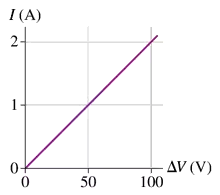
FIGURE EX27.35 is a current-versus-potential-difference graph for a material. What is the material's resistance?
Graph showing current (I) in amperes versus potential difference (ΔV) in volts, illustrating a linear relationship.

Verified step by step guidance
1
Step 1: Recall Ohm's Law, which states that the resistance (R) of a material is given by the formula: R=ΔVI, where ΔV is the potential difference and I is the current.
Step 2: Analyze the graph provided. The graph shows a linear relationship between current (I) and potential difference (ΔV), indicating that the material obeys Ohm's Law. The slope of the graph represents the reciprocal of resistance.
Step 3: Identify two points on the graph to calculate the slope. For example, at ΔV = 50 V, I = 1 A, and at ΔV = 100 V, I = 2 A.
Step 4: Calculate the slope of the graph using the formula for slope: I2-I1ΔV2-ΔV1. Substitute the values from the graph: 2-1100-50.
Step 5: Once the slope is calculated, take its reciprocal to find the resistance: R=1slope. This will give the material's resistance.

Verified video answer for a similar problem:

This video solution was recommended by our tutors as helpful for the problem above.
Was this helpful?

Key Concepts

Here are the essential concepts you must grasp in order to answer the question correctly.

Ohm's Law

Ohm's Law states that the current (I) flowing through a conductor between two points is directly proportional to the voltage (V) across the two points, given by the formula V = IR, where R is the resistance. This relationship is fundamental in understanding how electrical circuits operate and is crucial for calculating resistance from current and voltage values.
Recommended video:
Guided course
03:07
Resistance and Ohm's Law

Resistance

Resistance is a measure of the opposition to the flow of electric current in a material. It is defined as the ratio of voltage to current (R = V/I) and is measured in ohms (Ω). In the context of the provided graph, the slope of the line represents the resistance of the material, indicating how much voltage is needed to produce a certain amount of current.
Recommended video:
Guided course
05:25
Resistivity & Resistors in Circuits

Linear Relationship

A linear relationship in a graph indicates that two variables change at a constant rate relative to each other. In the current-versus-potential-difference graph, the straight line suggests that as the voltage increases, the current increases proportionally, which is characteristic of ohmic materials. This linearity allows for straightforward calculations of resistance using the slope of the line.
Recommended video:
Guided course
07:31
Linear Thermal Expansion