My Best PAL for Anatomy: Pearson’s Practice Anatomy Lab
Anyone who has ever taken Anatomy knows it can be a memorization-heavy course. This is especially true if the lab portion only occurs once a week, as it did for me. Preparing for practicals was a nightmare; we only had one minute per station to recall hundreds of terms and physiological concepts.
Then I dug through the Pearson website that hosted our textbook and found my best buddy for the next two semesters: PAL.
Meet PAL: Your Virtual Anatomy Lab
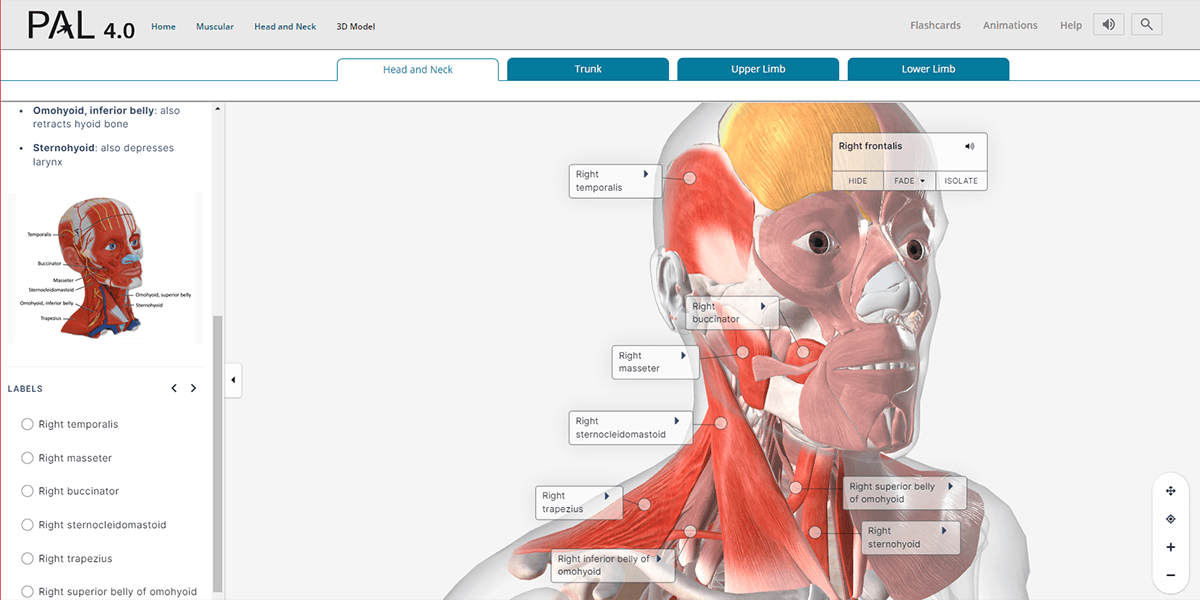
Practice Anatomy Lab (PAL) 4.0 is a virtual study and practice tool, giving students 24/7 access to the most widely used lab specimens. These include human cadavers, anatomical models, histology slides, cats, fetal pigs, and dissections of sheep brains and cow eyes.
My most-used feature was the anatomical and fully manipulable 3D models. They made it infinitely easier to see where certain anatomical structures were relative to each other.
A Tool for Every Learning Style
As a visual learner, I found that PAL was one of my best friends during my time in Anatomy. It can be yours, too, no matter what type of learner you are.
PAL includes built-in audio pronunciations in addition to 3D animations, mobile-friendly flashcards, practice quizzes, and practice fill-in-the-blank lab practical questions. This means any type of learner—visual, auditory, reading, or writing—can use PAL to their advantage.
Study Anytime, Anywhere
While anatomy labs tend to meet once a week for a few hours, PAL is available to you 24/7 and is included with MasteringA&P. In addition to the manipulable 3D models, I found it convenient that I could access it and still have a similar experience away from the lab.
It is also common practice for photography of certain cadavers to be prohibited, but PAL provides virtual cadavers that you can view at any time. Constantly refreshing my memory of models and cadavers was much more helpful than trying to recall them from a single lab session.
Find What Works for You
If you’re a student using Pearson materials for your anatomy class, I encourage you to explore the platform and discover what makes learning easier for you. While the 3D models were my key to success as a visual learner, PAL is packed with features designed to help every type of learner master the material.
Do you have a compelling story or student success tips you’d like to see published on the Pearson Students blog? If you are a college student and interested in writing for us – click here to pitch your idea and get started!
About the author

Alexis Ele
Alexis Ele is a sophomore at the University of Nevada, Reno. She is a double major in psychology and nursing. She has a strong passion for mental health care and, as such, hopes to work as a psychiatric nurse practitioner after graduation. Outside of her academics, she loves to try new restaurants, play different sports and instruments, and is currently working as a Pearson Campus Ambassador and English consultant.