Teaching and Learning blog

Explore insights, trends, and research that impact teaching, learning, and leading.

Explore posts in other areas.

PreK-12Pearson studentsProfessional

  • A group of students in a library
    How do you get your students career ready?
    By Pearson

    Teaching career readiness is a challenge. Preparing your students with technical skills and practical expertise to succeed in the workforce is no small task. From setting goals to crafting compelling resumes to mastering virtual interviews, the modern job search process requires a comprehensive skill set that you can help students build.

    With the right tools and strategies, you can set your students up for long-term career success.

    Building a career vision

    You can’t start a career journey if you don’t know the destination. Students need to know what they’re working towards. Certified Professional Career Coach, Amanda Augustine, explains, "The biggest mistake I see job hunters make is that they don't start with a goal. They immediately just skip to the resume writing process. But it's really hard to write a resume if you have absolutely no idea what job you’re looking for."

    Your students can’t be what they can’t see. They won’t know their main goal if they don’t explore their options. They shouldn’t be waiting until college, or even high school, to see what careers they can pursue. Starting in middle school, your students should start understanding the good, bad, and challenging aspects of different professions. This early exploration helps them make informed decisions about their education and develop targeted skills that align with their career aspirations.

    Tools like Pearson’s Career Explorer and Learning Blade give your students fun, gamified avenues to explore different career paths. Pearson’s Career Explorer includes an immersive role-playing experience, students explore career pathways, match their interests to real-world opportunities, and see how their academic choices impact their future. 

    Learning Blade provides mission-based learning that challenges middle schoolers to solve real-world problems while exploring STEM careers, technologies, and industry concepts.

    Your students can research various industries, understand salary expectations, identify required skills, and explore company cultures. This foundational work enables students to create long-term goals, and eventually, targeted application materials that speak directly to employers' needs rather than generic documents that fail to make an impact.

    Gaining key skills and credentials

    Once your students have a vision for their future, they can start building key job skills. Your students may be interested in pursuing jobs in any number of career clusters. Whether students they’re focused on public service and safety, healthcare and human services, marketing and sales, digital technology, construction, advanced manufacturing, arts and entertainment, financial services, or management and entrepreneurship, there are ways to build skills that employers demand.

    The best news is that you don’t have to build these skills without help. Knowledge Matters simulations put high school students into the driver’s seat, creating authentic job scenarios where students make decisions, solve problems, and see the impact of their choices all in a risk-free virtual environment.

    If you’re looking for the full learning pathway, you can also help students focus on key competencies through curriculum aligned with industry-based certifications. Not only will they gain experience, but they can also walk away with a credential that benefits them in their job search. With credentials in fields from skilled trades to emergency medical services to information technology, we have the credentials to get your students ready for the job hunt.

    Putting their best foot forward

    Once they’ve built the skills and earned real credentials in your classroom, they need to show their technical competencies and professional polish. And nothing ruins professional polish faster than spelling and grammatical errors. As Amanda noted, "Spelling and grammatical errors are by far the number one mistake that employers considered to be a deal breaker." While this might seem trivial, employers view these errors as indicators of carelessness and lack of attention to detail.

    Beyond basic proofreading, your students should understand their professional brand and persona. The way they present themselves in professional communications and in-person interactions will be different than the way they present themselves in casual, friend situations. Amanda advised on three resume and written communication factors to focus on:

    1. Using an appropriate email address
    2. Understanding what contact information to include on a resume. Phone and email are a yes. Home address is a no.
    3. Learning to write in a professional tone, avoiding the shortcuts, and slang common in text messaging.

    Building a strong resume only matters if students bring that polished persona into the interview. Today, virtual interviews are now standard practice. Students must be comfortable interviewing on Teams or Zoom, requiring different skills than in-person meetings.

    Like building a strong resume, help your students focus on a few key areas:

    1. Making eye contact with the camera
    2. Creating professional backgrounds
    3. Minimizing distractions
    4. Handling technical difficulties gracefully.

    Give your students a chance to develop all these skills with mock interviews. Not only can they understand the difference between in-person and video interviews, they’ll also learn to refine their answers, reduce filler words, and build confidence in articulating their experiences and qualifications.

    Partnering with technology

    Throughout their career exploration and job search, you can help your students understand how to partner with technology to reach their goals. Artificial intelligence (AI) and other new tools are reshaping nearly every job, and students need to understand how and when to use technology effectively.

    Employers now use sophisticated tools to verify the authenticity of writing samples and analyze interview responses. You want your students to understand the appropriate use of AI assistance. For example, AI is a great tool for formatting and optimizing a resume. It’s not acceptable to use AI for generating work samples.

    Helping your students understand AI and other technology platforms allows them to walk into work with confidence that they know the tools for the job. With curriculum and industry-recognized certifications like Critical Career Skills Generative AI Foundations, Professional Communication, and IC3 Digital Literacy certifications, your students can gain, master, and prove their skills in key areas. Not only are these certifications a great resume booster, they help students bring value to an employer from day one.

    It’s time to start their career journey

    Entering the workforce after graduation isn’t always a smooth transition. Help close the classroom to the career gap by giving your students the skills they need, from early career exploration to practical job search skills. They’ll thank you when they leave with invaluable advantages in an increasingly competitive marketplace.

    Looking for other resources to help your students become career-ready? Connect with the Pearson Career Ready team for more information here.  

    As you know, career readiness isn’t a single moment. It’s a journey of discovery, growth, and confidence. Pearson Career Ready connects every step, giving educators like you a clear roadmap to guide every student forward with confidence. Learn more here.  

  • Students in a classroom looking at a laptop.
    Prove and connect: The value of industry certifications
    By Pearson

    In Career and Technical Education (CTE), students aren't just learning, they're preparing for their futures. Each project, skill, and challenge builds confidence and career readiness.

    But how do students prove those skills to colleges, employers, and industry? The answer isn't found in a transcript alone. It's found in industry-recognized certifications. Certifications give learners credible proof of what they can do, helping them demonstrate readiness and connecting them to meaningful opportunities beyond the classroom.

    Find out how these credentials can deliver measurable value for your CTE programs and students.

    Certifications keep education relevant in a fast-changing job market.

    With workforce demands constantly changing, CTE programs are also continually evolving their curriculum and coursework. Up-to-date industry certifications help you keep on top of employer demands and needs.

    In partnership with our clients, such as Adobe, Microsoft, Autodesk, and Intuit, our portfolio of certifications are updated to make sure each exam covers the latest technology and skills required by industry. This allows you to connect your curriculum with workforce demands not just local expectations. Plus, retraining and stacking multiple credentials reinforces lifelong learning, which is essential in technology, business, and other dynamic CTE areas.

    Certifications prove what your students can do. Not just what they know.

    In today’s classroom, there’s no shortage of exams. But not all tests are created equally. Some tests only measure what a student has memorized, not necessarily how they can apply that knowledge in real life.

    Veteran middle school teacher, Kim Kayser, noted the difference between a standard test and a certification exam. “Tests assess what students know. Certifications show what students are able to do. I want to see how they can translate their knowledge into skills that directly impact their lives and work after leaving school,” said Kayser.

    How are certifications different than other tests? All our certifications are psychometrically validated to ensure they accurately and consistently measure the intended skills. Each exam is developed in partnership with leading technology companies with objectives reflecting current workplace demands. Plus, when your students sit down to take an exam, they’ll be asked to demonstrate skills through performance-based tasks and real-world scenarios.

    Industry credentials, therefore, are not an add-on, or another grade on their transcript. A benchmark arbitrarily set. Instead, they are an industry-recognized achievement for educators and students alike. Educators know what employers expect and can adjust their teaching accordingly. Students understand what skills they need to build, whether that’s building a website, coding, or working through technical workflows.

    This distinction matters. We don’t want students sitting for just another test. We want them to be able to validate their skills and to prove and explain those hard-won capabilities in their next job interview.

    Certifications build career momentum and direction.

    As students look ahead to the workforce, many will be surprised by the various pathways they can take after high school. Some students will choose a four-year degree. Some may go into the workforce. In today’s economy, there’s no wrong way to enter the world of work, as long as students feel prepared and ready for the job.

    Entering the workforce, whether before or after college, means students need a strong resume. Certification is an early win, a great way to verify expertise when students may not have a lot of work experience.

    Brittany Nicholson, CTE and computer science educator, shared that many of her ninth graders earn their first certification before they’ve even fully formed a career plan. Those credentials become something tangible they can show when they apply for college or on job applications for internships or entry-level positions.

    Kurt Campbell, a full stack software engineer, described how accreditations he earned as a student, became real leverage in interviews and client conversations. His credentials, paired with his work portfolio, helped him quickly communicate his expertise to people who didn’t yet know him or his work.

    Of course, not every student is like Kurt. Some may not know what they want to do after school. For this group, certifications provide a low-risk way to test-drive a pathway they’re considering. If a student learns Python or WordPress and realizes, “This isn’t for me,” that insight comes without the cost of a college course or a major change later.

    That makes certification a win-win. Students with a clear pathway can build momentum early, while students who are still deciding can explore options, test their interests, and discover what fits, without taking unnecessary risks.

    Certification supports equity.

    Ultimately, your goal is to help all your students succeed. However, not all your students are on the same point in their journey, or even on the same pathway. This can make classroom goals and equitable experiences difficult to create.

    Luckily, giving students access to industry exams in school is a great way to level the playing field. Students don’t need to rely on family networks or funding to build their skills or job opportunities. Credentials both expose and empower, helping students discover what they’re good at and what careers might be possible.

    Raae Wolfram, a senior security solution engineer at Microsoft, offered a complementary perspective from the workforce side. “Certifications build credibility and can help successfully launch a career transition, and I’m speaking from personal experience,” said Wolfram. “My degree didn’t align with my chosen career path, but earning certifications signaled my discipline, self-directed learning, and readiness.”

    Whether earned in school or as part of a career transition, certifications can act as a structured, scalable mechanism for expanding opportunity.

    Certifications amplify education.

    “Certifications don’t replace education. They amplify it,” said Nicholson. When embedded thoughtfully, these exams can:

    • Keep programs aligned with workforce expectations
    • Validate learning with third-party approval
    • Give your students early résumé-building wins
    • Expand equitable access to career exploration

    Make your students’ skills visible, portable, and recognized. Your students don’t just learn, they leave your classroom with proof of what they can do.

    Looking for certifications to help your students become career-ready? Explore our industry-recognized certifications here.

    As you know, career readiness isn’t a single moment. It’s a journey of discovery, growth, and confidence. Pearson Career Ready connects every step, giving educators like you a clear roadmap to guide every student forward with confidence. Learn more here.  
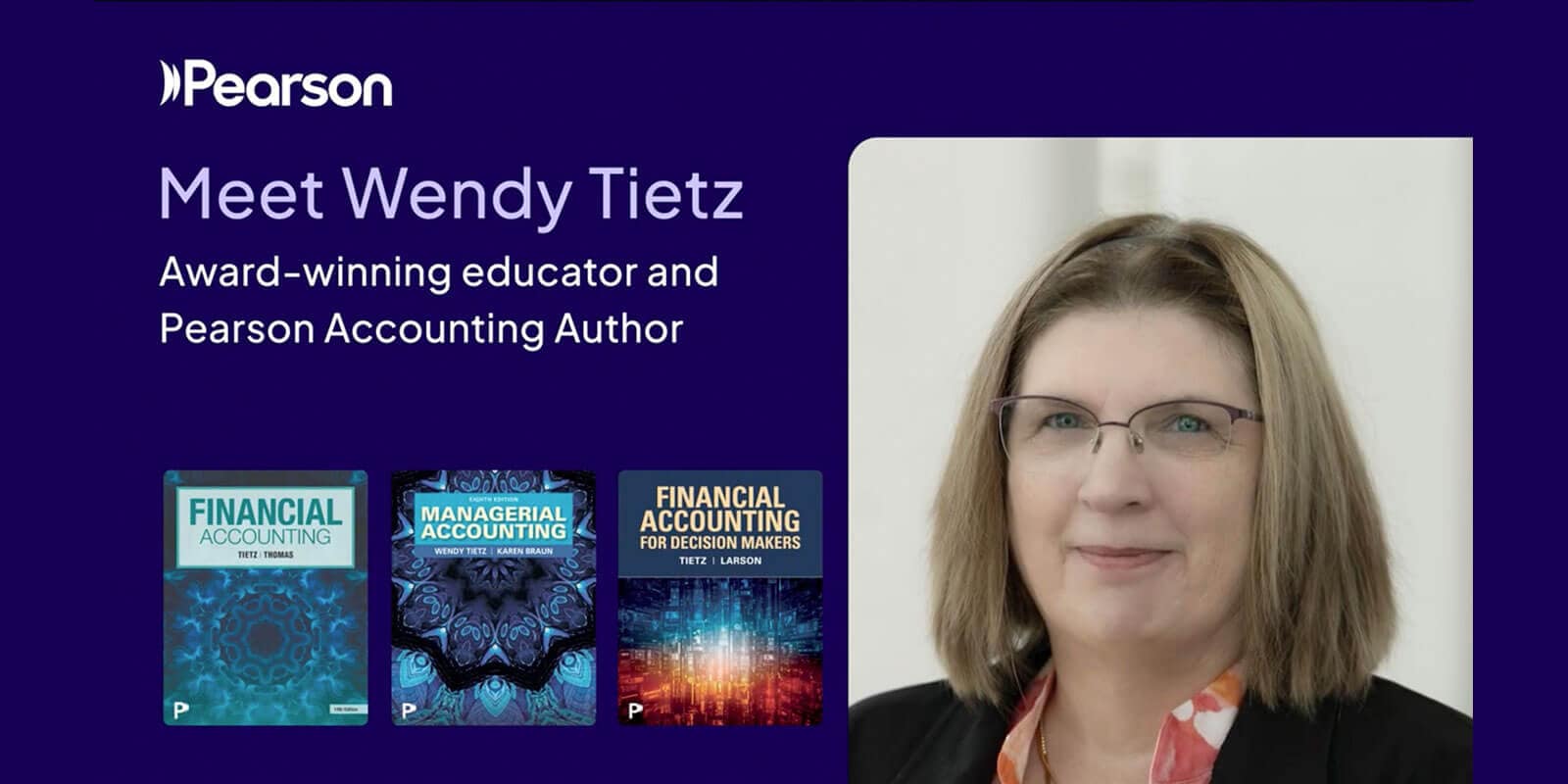
  • A video screencap with a photo of the author reading "Meet Wendy Tietz - award-winning educator and Pearson Accounting Author"
    Teaching Accounting in an Age of Distraction
    By Dr. Wendy Tietz

    Meet Wendy Tietz — passionate, award-winning educator and Pearson Accounting Author who is redefining what it means to teach accounting in an age of distraction and AI. 

    For many students, accounting arrives with a reputation — numbers-heavy, rule-bound, and far removed from the careers they imagine for themselves. Walk into Wendy Tietz's classroom, and that perception begins to shift.

  • A smiling student writes on a board while conferring with classmates
    Preparing IT Students to Excel in an AI-driven Workplace
    By Dr. Jason Davidson

    Students have never been more connected to technology. They navigate apps, social media and digital platforms with ease. Yet many information technology educators continue to face a common challenge: students who appear digitally fluent often lack confidence when learning to use workplace technologies effectively.

    For Jason Davidson, Assistant Professor of Business Technology and Analytics at Butler University and Pearson Author of the Exploring Microsoft 365 series, building that confidence is a critical part of preparing students for success.

    "As an educator, what keeps me motivated is watching students grow to be the best versions of themselves," he says. "I really love helping students find the confidence to excel and go into the workplace and immediately make a difference on day one."

    From Digital Comfort to Workforce Readiness

    Davidson sees a challenge many educators will recognize: students often arrive in the classroom comfortable with everyday technology, but less confident using the workplace tools they will need in their careers. This gap becomes especially clear when students begin working with Excel.

    "Excel is not a program that one would use for recreation," Davidson explains. "It's very much a popular business tool."

    For many students, formulas and functions can make Excel feel intimidating, unfamiliar, and overly technical. When that perception takes hold, they may mistake the normal challenges of learning for a lack of ability. For educators, this reframes the issue: early struggles are often less about capability and more about confidence.

    Why Experiential Learning Works

    As AI and data tools become part of everyday work, employers increasingly need graduates who can do more than follow instructions. Experiential learning helps students build the confidence and judgement to interpret results, communicate insights, and apply technology to real-world business problems.

    "What makes the Exploring Series unique is the emphasis on experiential learning," Davidson says. "We really want the students to dig deeper than just a surface level understanding."

    Davidson wants students to "truly master what you can do in Excel to immediately gain actual insights that will help them advance their career, their business, and live their dreams."

    This is where experiential learning becomes a bridge to career readiness. Excel is not the destination. It is a vehicle for teaching students how to analyze information, solve problems, and make informed decisions with data.

    In an AI-driven workplace, those skills matter more than ever. As tools make it easier to generate outputs, the differentiator becomes the human work around those outputs: asking the right questions, confirming results, and communicating insights responsibly.

    A Confidence-First Approach with MyLab

    Davidson uses MyLab IT simulations and grader projects to help students build confidence through practice. He describes the simulations as an “opening confidence booster” because they let students work at their own pace and receive immediate feedback in a supportive environment.

    "What I like about The Sims is it's a simulated environment that is stress free for the students," he says. "It has built-in learning aids. The students can work at their own pace and they get immediate feedback."

    Immediate feedback helps students build momentum and become more comfortable learning through mistakes.

    As students gain confidence, Davidson introduces MyLab grader projects, which requires students to complete work directly in the Excel environment. The progression mirrors what students will encounter outside the classroom, helping them move from guided practice to authentic application.

    Together, MyLab IT simulations and grader projects guide students from confidence-building practice to real-world application, helping them demonstrate their skills in ways that reflect the workplace.

    AI Literacy with Purpose

    As AI reshapes education and the workplace, Davidson believes students need more than access to new tools. They need AI literacy and judgement to use them effectively.

    "AI literacy has become so important in the current academic landscape," he says.

    In his courses, AI is not treated as an answer machine. Students learn to evaluate outputs critically, recognize when AI is useful, and understand where its limitations lie.

    That means using AI ethically, understanding data governance, and validating information rather than accepting AI-generated responses at face value. As the tools become more powerful, Davidson argues, judgement becomes even more important.

    MyLab IT’s AI Literacy Modules and Copilot Pro Simulations support this approach by teaching students how to use AI tools responsibly, validate results, and cite AI ethically and effectively. Each completed module is recognized with a Credly badge, giving students a workforce credential they can carry beyond the classroom.

    For Davidson, the opportunity is not to replace learning, but to help students engage with it more critically and confidently.

    Beyond the Classroom

    Davidson’s approach reminds educators that effective learning is not only about teaching students what to do. It is also about helping them believe they can do it, then giving them meaningful opportunities to apply their skills.

    By combining experiential learning, confidence-building practice, authentic application, and responsible AI literacy, Davidson helps students prepare not just to use Excel, but to work thoughtfully with data in an increasingly AI-driven world.

    The result is simple but powerful: when students build confidence first, they are better prepared to learn, adapt, and contribute from day one and throughout their careers.

  • Students sitting in a university classroom
    MyLab Economics Helps Diverse Learners at King’s College London Succeed at Scale
    By Denise Hawkes, PhD

    At a glance

    Institution: King’s College London, King’s Business School

    Courses: Principles of Economics (Year 1, 250 students) & Intermediate Microeconomics (Year 2,70 students)

    Professor: Denise Hawkes

    Challenge: In a cohort where no two students share the same academic background, the risk of leaving learners behind is real

    Solution: Embedded into lectures, tutorials, and assessment MyLab® Economics provides support beyond the classroom.

    Impact: Improved engagement, stronger confidence among lower attaining students, and significant time savings for staff

    The challenge: Large cohorts, different starting points

    Teaching economics across large cohorts is challenging at the best of times. At King’s College London, Professor Denise Hawkes faced an additional layer of complexity: extreme diversity in student backgrounds.

    Her courses bring together students from mathematics, finance, languages, humanities, and study‑abroad programmes from leading global institutions.

    “I might have a maths‑with‑finance student sitting next to someone doing fashion design. Their strengths are completely different.”

    Some students arrive confident with quantitative skills but struggle to apply economic theory. Others excel in critical thinking but lack mathematical confidence. With limited contact hours, addressing every learner need in class wasn't realistic.

    “I can’t do everything in a two‑hour lecture and a one‑hour tutorial. And everything for everyone is different.”

    Denise needed a way to level the playing field for all learners, support them beyond the classroom, and improve engagement without increasing her workload.

    The solution: embedding MyLab Economics into course design

    Drawing on her experience using MyLab at another institution, Denise proposed integrating MyLab Economics directly into the learning design at King's College not as an optional resource, but as a core component of how students would learn.

    “MyLab is absolutely fundamental to everything we’re doing.”

    Her approach was deliberate and multifaceted. MyLab Economics gave students flexibility in how they engaged with content: auto-graded practice questions with instant feedback, case studies and real-world news analysis, textbook readings, videos, and AI-supported study tools.

    “Some students read, some never read but practise constantly. The lab gives them that choice.”

    This approach allowed students to work at their own pace, revisit challenging topics, and build confidence outside of class.

    With core practice happening in MyLab Economics, contact time transformed. Lectures now focus on application, discussion, and engagement, rather than repetition.

    Graduate Teaching Assistants benefited too. Weekly question sets were selected directly in MyLab, tutorials could be adapted to each group's needs, and they spent more time supporting students and less time planning content.

    “It gave the GTAs certainty, but also flexibility. Different groups could focus on what they actually needed.”

    When it comes to assessment strategy, MyLab Economics proves to be an essential tool. Denise Hawkes’ use of practice tests and mid-term assessments helps students understand expectations and improves results through repetition.

    The robust question bank streamlined assessment creation, and combined with digital marking tools, the time savings were dramatic.

    “I marked 70 exam papers in three hours. It’s saved me so much time.”

    But perhaps most importantly, students were actually using it—and improving.

    “You could see students come back and do significantly better after practising.”

    The impact: stronger engagement and better outcomes

    While multiple factors influence results, Denise observed clear benefits after introducing MyLab Economics to her courses. Many students spent 20+ hours working in MyLab, repeatedly using practice tests to improve performance, and students came to lectures better prepared and ready to interact. Most importantly, MyLab Economics helped support students who needed it most.

    “MyLab has moved the bottom end of the distribution. We’ve had far fewer fails compared to previous years.”

    Educator reflection

    For Denise, MyLab Economics doesn’t replace great teaching, it makes it possible at scale.

    “Without MyLab, all you have is the lecture and a textbook. MyLab gives students real choice in how they learn.”

    With thoughtful integration, MyLab Economics helps institutions support diverse cohorts effectively, improve engagement at scale, reduce staff workload, and build student confidence and independence.

  • Lisa Urry teaching in a classroom
    Turning Curiosity into Connection in Biology Classrooms
    By Lisa Urry and Rebecca Orr

    For educators like Lisa Urry and Rebecca Orr, biology isn’t just a subject—it’s a gateway to curiosity, discovery, and lifelong learning. Their work on Campbell Biology and Campbell Biology in Focus reflects a shared mission: to move students beyond memorization and into meaningful engagement with the living world.

    A passion for teaching that sparks discovery

    Lisa Urry, a longtime professor at Mills College, and Rebecca Orr, who has been teaching at Collin College since 2007, both bring decades of classroom experience to their work. What drives them is simple but powerful: helping students truly understand biology.

    For Urry, the magic of teaching lies in designing moments where students take ownership of their learning—where they ask questions, explore patterns, and make sense of what they observe. Orr echoes this sentiment, finding fulfillment in watching students grow into who they aspire to be.

    Together, they represent a shift in biology education—from delivering information to creating experiences that inspire transformation.

    Creating a dynamic learning environment

    A major turning point came with the evolution of digital learning. For Urry and Orr, the transition to eTextbooks wasn't simply a change in format—it was an opening of possibility.

    Static pages gave way to something far more engaging. Today's biology students can interact with dynamic visuals and videos, answer questions in real time, and actively test their understanding as they learn. Reading alone is no longer enough. The goal is to read, do, and interact—building deeper understanding through every step of the process.

    This shift reflects a broader philosophy that shapes everything Urry and Orr create: learning should be dynamic.

    They also recognize a very real challenge facing today's students—maintaining attention and focus in an increasingly distracted world. Rather than fighting against this reality, they design with it in mind. Their approach breaks content into short, digestible segments, weaves in frequent low-stakes assessments, and delivers immediate feedback that reinforces learning in the moment.

    The result? Bite-sized interactions that keep students engaged, build confidence, and make even the most complex concepts feel approachable.

    Making biology relevant and exciting in the age of AI

    At the heart of Urry and Orr's approach is a simple but powerful idea: relevance. By intentionally connecting concepts to students' everyday lives, they transform biology from an abstract subject into something immediate, exciting, and worth caring about. The goal was never just comprehension—it was curiosity.

    That same commitment to meaningful engagement extends into how they approach one of education's newest challenges: AI.

    Rather than viewing artificial intelligence as a threat to learning, Urry and Orr see it as an opportunity to teach students how to think more intentionally. Instead of turning to outside tools for quick answers, students are encouraged to stay within the learning environment, using Mastering Biology and AI study tools in the etextbook – drawing from vetted Campbell Biology content. As educators, Urry and Orr want students to use AI to ask deeper questions, sit with complexity, and develop the kind of critical thinking that no shortcut can replace.

    In this way, AI becomes less of a crutch and more of a catalyst, pushing students to engage more deeply rather than simply think less.

    Curiosity: the heart of modern biology education

    If there's one message Urry and Orr want every student and educator to carry with them, it's this: don't just memorize, wonder.

    True learning begins with curiosity. When students pause to study a diagram, ask a question they don't yet know the answer to, or test their understanding just to see how far they've come, something powerful happens. Biology stops being a subject they need to survive and becomes a world they want to explore.

    This is the vision that drives everything Urry and Orr do. By blending innovative tools, intentional teaching strategies, and a genuine passion for student success, they are helping reimagine what biology education can look like.

    For students, that means showing up with an open mind and a willingness to engage. For educators, it means trusting that the right tools and the right approach can make all the difference.

    Together, curiosity and intention can transform the classroom—one eager learner at a time.

  • Serina Haddad teaching in a classroom
    Bringing Data to Life: A New Vision for Business Statistics
    By Serina Haddad

    Of all the courses on a business student’s schedule, which one is most likely to be met with a sense of dread? For many, the answer is statistics. It’s a challenge every educator in the field recognizes: students entering the classroom already armed with anxiety, anticipating a semester of dense, abstract concepts. This anxiety, as author and educator Dr. Serina Haddad notes, often “turns into a cycle of self-doubt and affects their performance.”

    So, how do we as educators break this cycle? How do we transform the statistics classroom from a place of fear into a hub of curiosity and empowerment? Drawing on her years of experience in the corporate world and over 14 years of teaching statistics at Rollins College and other higher education institutions, Dr. Haddad believes the answer lies in forging a powerful connection with students by making data immediate, relevant, and interactive.

    From Anxiety to Engagement

    Dr. Haddad’s approach begins with a simple premise: demystify the subject. “We really need to show the relevance,” she insists. “We need to show how simple the content is and how it connects with day-to-day things that they go through.” Instead of diving into complex theory, she starts with accessible examples, like calculating the average time it takes to get to class. This small shift reframes statistics not as an obstacle, but as a tool for understanding the world.

    Technology, when used thoughtfully, becomes another key ally in reducing anxiety. Dr. Haddad has found that breaking down MyLab assignments into smaller, more manageable chunks keeps students engaged and builds their confidence. But the real game-changer in her classroom is Excel.

    “For me, Excel is a foundational tool for classroom instruction,” she explains. Far from being just a program for basic formulas, she uses it to facilitate interactive learning. “It allows students to work hands-on on a data set during class and see results immediately, and that helps them feel included.” By using a tool that is inexpensive, widely used in business, and central to their internships and future jobs, students see the immediate value of their learning. This hands-on approach, where students can manipulate data and see the story unfold, sparks genuine interest and keeps them invested. Recognizing this, the fourth edition of her textbook, Business Statistics, now includes customizable Excel files for each chapter, allowing instructors to seamlessly integrate this active learning model into their own courses.

    Preparing students for a data-driven world

    Beyond the classroom, the entire landscape of data analysis is shifting, and Dr. Haddad argues that our teaching must evolve with it. “There is a clear shift from computation to actual interpretation,” she states. With software handling the heavy lifting of calculations, the crucial skills for today’s students are interpretation and storytelling. The essential question is no longer just “What is the answer?” but “What are the numbers telling us?”

    This shift underscores the growing importance of data literacy. Dr. Haddad captures her students’ attention with a powerful statistic: one in five U.S. students earns a business degree. “What is your competitive advantage?” she asks them. The answer, she posits, is data proficiency. To compete, students must be able to not only analyze data but also think critically and derive meaningful insights—a skill developed through experiential learning. By having students download and experiment with real-world data sets through MyLab Statistics, they learn to see beyond the numbers, make mistakes, and build the problem-solving skills essential for their careers.

    Keeping up with technology, particularly the rapid developments in AI, is another challenge educators face. Dr. Haddad encourages a mindset of lifelong learning, advocating for embedding AI tools into the curriculum. This includes the critical conversations around ethics, bias, and the danger of over-reliance on these powerful new tools. “I think Pearson is doing a fantastic job keeping up with technology and building AI tools to help

    instructors and students. Students are able to practice with a customizable study plan, seeing their strengths and weaknesses when they work with problems,” she states, “it’s an amazing way to use AI for learning.”

    Beyond the Classroom

    Dr. Haddad’s vision is a powerful reminder that teaching business statistics is about more than formulas and distributions. It’s about empowering students to become confident, data-literate professionals who can cut through the noise, tell compelling stories with data, and hold a competitive edge in a world that demands it.

    Her approach transforms the classroom into a dynamic space where anxiety is replaced by engagement, and abstract theories are made tangible. The new “Focus on Analytics” feature in the fourth edition of Business Statistics further bridges this gap, showing students the direct, real-world application of statistics in business analytics.