Voices of Impact: How One Biology Professor is Changing Lives in the Classroom and Around the World
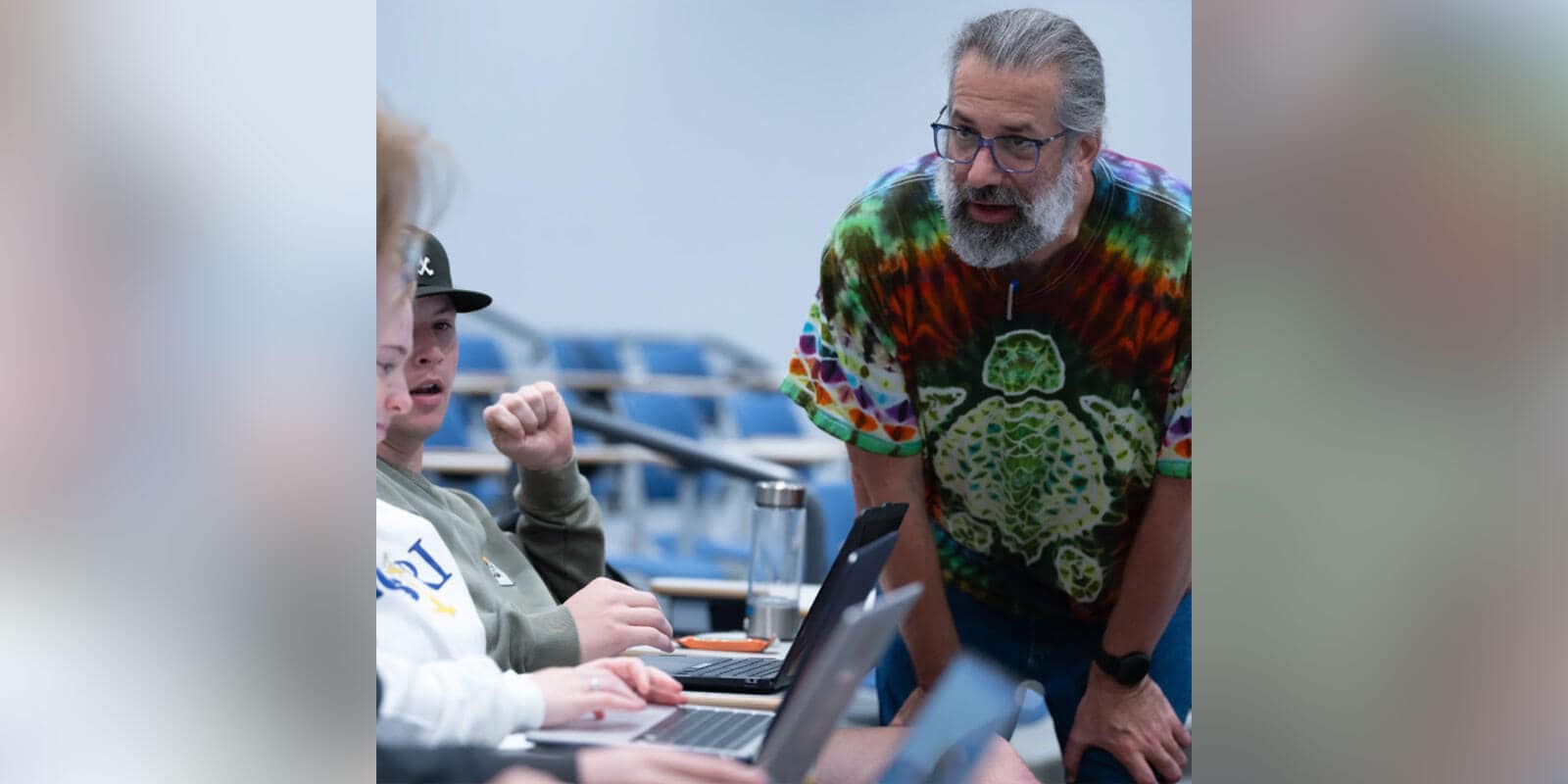
Meet Eric Simon—Harvard-trained biologist, passionate educator, and humanitarian who proves that great teaching extends far beyond the classroom walls.
From Computer Code to Life's Code
Eric Simon's journey to becoming one of biology education's most innovative voices began with an unusual combination: computer science and biology. "When I was an undergraduate, I really enjoyed both computer science and biology, so I actually became a double major," he explains. This unique background in computational biology would later prove invaluable as he became a pioneer in educational technology.
After earning his PhD in biochemistry from Harvard, Eric discovered his true calling wasn't just in research—it was in teaching. "While I was at Harvard, I worked as a teaching fellow and found that I really enjoyed teaching. I actually became a teaching consultant in their Teaching and Learning Center and knew by the time I graduated, I wanted a job that had a pretty strong teaching emphasis."
That was over 25 years ago, and Eric has never looked back.
The Art of Making Science Irresistible
What sets Eric apart is his specialization in something many educators find challenging: teaching non-science majors. "I found that what I actually like the most is teaching non science majors. I've been specializing in teaching non majors introductory biology courses for the last 23 years at New England College. It's just a really, really satisfying job for me, and I really enjoy trying to explain science to non-scientists."
His secret? Understanding that biology isn't abstract—it's everywhere. "Biology is all around us. Everybody knows the importance of biology in their lives. I always tell my students you don't have a choice about whether or not this topic will affect your life, because it will. Your only choice is whether you approach it from an educated standpoint or not."
Eric also taps into what renowned biologist E.O. Wilson called "biophilia"—the innate love humans have for nature. "Almost everybody when they see a turtle, they go, 'oh,' and they're attracted to it. So I try to tap into that inner biophilia that I know exists in all my students."
Revolutionary Teaching Methods
Eric has completely transformed his approach to education over the years. "In the last several years I've moved pretty far away from any kind of lecturing. Now most of our time, about 3/4 of our time in the classroom is spent on small group activities where the students are helping each other."
But his innovation goes deeper than collaborative learning. Eric focuses on equipping students with life skills, not just biological facts. "My favorite type of assignment is one that is providing them with a skill that they will be able to use later in their lives. If I'm helping you learn how to take a large body of information and summarize it in a way that you can then quickly get the answers you need, that's going to be a skill that's going to help in whatever job you have."
From Early Tech Adopter to Textbook Revolutionary
Eric's path to authoring began with his forward-thinking approach to technology. "Around 1999, I was a very early adopter of instructional technologies. I was creating websites for my courses before my school even had a website." This innovation caught the attention of publishers, leading to his integration into the Campbell author team and eventually to his work on Campbell Essential Biology.
His favorite innovation? The "Teach Me, Show Me, Quiz Me" feature that transforms static textbook figures into dynamic learning experiences. "Instead of seeing the finished figure, you get a video of me explaining the figure and building it up piece by piece. Then students can view the complete figure, and finally, they have to build the figure themselves by putting labels in the right places."
Teaching Critical Thinking in the Digital Age
Perhaps Eric's most important contribution is preparing students to navigate our information-saturated world. "Probably the single most important skill that I'm trying to teach my students is how to recognize reliable scientific information. Students have the world at their fingertips, and they have to learn to be their own librarians."
He continues: "If I had to pick one thing that I want them to learn, it's not some piece of content, but rather it's the skill of how to distinguish reliable scientific information from bogus scientific information."
A Heart for Global Impact
Beyond his classroom innovations, Eric demonstrates extraordinary compassion through his humanitarian work in Tanzania. What started as a simple mistake—bringing thumb drives to a school without electricity—became a life-changing mission. "I met the head of the school and asked what they needed. She said, 'We need food. These kids walk up to 5 kilometers, spend 10 hours in school, then walk home 5 kilometers without any food.'"
Today, Eric's charity feeds 1,400 students across two schools every day of the school year. "We’ve been able to bring the price of lunch way down by buying in bulk, in advance, from local farmers," he explains, describing how he personally travels to Tanzania each July to support this cause.
The impact has been transformative: "Because we started feeding the kids, enrollment went up from 850 to 1,315. Retention went up, test scores went up." The community even named their second school after Lucas Mhina, Eric's local partner who helps coordinate the food delivery.
The Teacher Who Never Stops Learning
Eric's commitment to education extends beyond traditional boundaries. He leads international trips for both students and lifelong learners, taking groups to places like Machu Picchu, Tanzania, Costa Rica, and Panama. These experiences enrich his teaching and provide real-world contexts for biological concepts.
His current focus on teaching "relevant skills" rather than just relevant content represents the cutting edge of educational thinking. "Pretty much everybody does relevant content now. What most people don't think about is how to teach relevant skills—skills that cut across all content areas and beyond biology."
A Legacy of Learning and Caring
Eric Simon embodies what it means to be an educator in the fullest sense. From his innovative textbook features that help students visualize complex processes, to his
humanitarian work that literally feeds hungry children, he demonstrates that great teaching is about more than transferring knowledge—it's about transforming lives.
In a world where scientific literacy has never been more crucial, educators like Eric are ensuring that every student—whether they become scientists or not—leaves the classroom better equipped to understand, evaluate, and engage with the world around them.
Eric Simon proves that the best teachers don't just educate minds—they touch hearts and change the world, one student at a time.
If you would like to learn more and connect with Eric Simon directly, please reach out to him at SimonBiology@gmail.com
About Eric Simon

Eric J. Simon is a professor in the Department of Biology and Health Science at New England College (Henniker, New Hampshire). He teaches introductory biology to science majors and nonscience majors, as well as upper-level courses in tropical marine biology and careers in science. Dr. Simon received a B.A. in biology and computer science, an M.A. in biology from Wesleyan University, and a Ph.D. in biochemistry from Harvard University. His research focuses on innovative ways to use technology to increase active learning in the science classroom, particularly for nonscience majors. Dr. Simon is the author of the introductory biology textbook Biology: The Core, 2nd Edition, and a coauthor of Campbell Biology: Concepts & Connections, 9th Edition, and Campbell Essential Biology, 7th Edition.