
Students blog

Explore the latest trends, tips, and experiences in college life in this blog written by fellow students.

Explore posts in other areas.

PreK-12Higher EducationProfessional

  • A group of students posing at the front of a classroom.

    The College Experience: Campus Involvement as a Commuter Student

    Monica Rodriguez

    A Commuter’s Perspective

    When I first started college, I never imagined how challenging it would be to get involved on campus as a commuter student. I often left campus in the late afternoon and headed straight home. By the time most events happened, I was already settled in for the night. On top of that, I’m naturally introverted, so the thought of showing up to large gatherings felt intimidating.

    For a while, I convinced myself that campus life just wasn’t for me. However, joining the Latin American Student Organization (LASO) showed me the true value of campus involvement and transformed my college experience.

    How Joining a Club Changed My Experience

    During my first year, I took a chance and went to a LASO meeting even though I didn’t feel ready. I didn’t know anyone, and it felt easier to stick to my usual routine of going to class and driving home.

    As a commuter, it’s easy to feel like campus is temporary, like you’re just passing through instead of belonging somewhere. I had no idea how much that one step would end up shaping my experience.

    Over time, LASO became more than just a student organization to me. It turned into a place where I met people who understood my culture, shared my values, and helped me feel seen. I began staying on campus longer, attending socials, and saying yes to events I would have skipped before.

    Eventually, I stepped into a leadership role as Marketing Chair on the executive board. In this role, I helped plan events, run social media, and collaborate with other organizations. Taking on that role challenged me in the best ways and helped me grow beyond the limits I had set for myself.

    Leadership brought experiences I never expected. I’ve tabled at events, met students I wouldn’t have crossed paths with otherwise, and gained confidence in talking to new people.

    As someone who’s always been introverted, I realized that being a leader isn’t about being loud. It’s about being intentional, creating space for others, and representing a community you care about.

    Finding My Place(s) on Campus

    Getting involved in LASO also made it easier to explore other organizations. I recently joined Women in Business (WIB) and participated in events like Coffee with WIB, recruiter panels, and even a season finale watch party for The Summer I Turned Pretty. I’ve attended other campus events like waffle night, and even small moments like those have helped me feel more connected.

    Looking back, I’m grateful I didn’t let commuting or being introverted keep me from getting involved. It wasn’t always easy to stay on campus longer or walk into a room alone, but the friendships, opportunities, and confidence I’ve gained have made it worth it.

    If there’s one thing I’ve learned, it’s that involvement doesn’t look the same for everyone. You don’t have to live on campus or be outgoing to find your place.

    Sometimes all it takes is showing up once and giving yourself a chance to explore something new. For me, that one step changed everything. It can do the same for other students who feel like campus isn’t built for them.

    You don’t have to be everywhere or do everything to be involved. You just have to start somewhere.

    Do you have a compelling story or student success tips you’d like to see published on the Pearson Students blog?  If you are a college student and interested in writing for us – click here to pitch your idea and get started! 

     

  • Image shows a lit lamp post at sunset surrounded by campus buildings

    Campus After Dark: The Benefits of Night Classes

    Gia Noorani

    Many college students know the struggle of heading to an 8:00 a.m. lecture, half-asleep after a long night of studying. Years of waking up before sunrise in high school taught me that my best days don’t start with rushing to class.

    I’ve found that taking classes at night has improved my sleep, boosted my productivity, and promoted a healthier learning environment. In this blog, I’ll share my success with evening courses, from improving my sleep and flexibility to enhancing my academic success.

    Scheduling Freedom with Late Classes

    Sleep is a word I had nearly forgotten as a college student. But what if there were a way to make it familiar again?

    College has been a transformative time for me, and the scenery isn't the only thing that has changed. My entire schedule shifted as I learned to juggle lectures, studying, work, clubs, and a social life. With so much to balance while finding my footing in adulthood, prioritizing my sleep has been a challenge.

    For me, night classes have offered a solution to this struggle. When my class starts at 7 p.m. instead of 7 a.m., I can recharge before loading my brain with new knowledge. I’ve found that going to class groggy isn’t ideal for my learning style, so I prefer going at night when I’m more alert.

    During the day, I can eat an energy-packed, nutritious meal, work on homework, attend clubs, and complete my to-do list. By evening, I can focus completely on class, knowing I’ve already accomplished my other daily tasks. Afterward, all that’s left is to get a good night’s sleep, ensuring I’m refreshed for the next day.

    Academic Benefits from Evening Classes

    Not only have night courses improved my sleep, but they have also improved my academic performance. When I’m tired, it’s harder for me to absorb new information or recall what I’ve already learned.

    Instead of cramming for an exam until 3 a.m., I can use my free time during the day to study under optimal conditions. I've found this leads to better overall academic confidence and even performance. Additionally, having time during the day to review assignments has helped prevent me from missing important deadlines that I might otherwise have missed.

    Ultimately, attending night classes has helped me regulate my sleep schedule and boost my academic performance. Getting better rest has helped me use my free time more effectively, creating a healthier and more productive learning environment. When course registration rolls around, you might consider if night classes are the right choice for you, too.

    Do you have a compelling story or student success tips you’d like to see published on the Pearson Students blog?  If you are a college student and interested in writing for us – click here to pitch your idea and get started! 

     

  • The image shows a pencil pouch with the words Teacher Survival Kit on it surrounded by small graphics, also pictured are a rainbow keychain and a picture of 4 colored post it note packs.

    The Student Teacher Survival Kit

    Madeline Beavis

    Let’s be honest… student teaching is exciting, challenging, and a little nerve-wracking all at once! You’re now stepping into the classroom not just to observe, but to actually teach, inspire, and learn alongside your students.

    As someone who has completed two semesters of student teaching, I’m here to pass along what I’ve learned. These five essential tips will help you make the most of your journey with stability, preparation, and confidence.

    1. Build Strong Relationships Early

    From day one, invest time in learning your students’ names, interests, and personalities. Show genuine curiosity and care, and don’t be afraid to have some fun! This is one of the fastest ways to earn your students' trust. It will also help you design tailored lesson plans and determine which classroom management techniques will work best.

    Building rapport with your mentor teacher and other school staff is equally important—they are your greatest allies and support system!

    2. Keep a “Lesson Journal”

    After each lesson, jot down what worked, what didn’t, and what you might tweak next time. Include any ideas you have for future lessons, planning, or student feedback. Don’t just focus on your mistakes (because you will make them, and they are valuable lessons to learn); remember to celebrate all the little victories too!

    This reflective habit will accelerate your growth and provide a record of ideas and strategies to carry into your first teaching job.

    3. Prepare… But Stay Flexible

    Detailed planning is important, but classrooms are living, breathing spaces. A fire drill, a tech glitch, or an unexpected student question can take you in a new direction: embrace it! Flexibility doesn’t mean losing control; it means adapting to the moment while keeping your learning goals in sight.

    4. Develop Your “Teacher Voice” (Literally and Figuratively)

    You don’t need to shout to command respect, but you do need presence. As a student teacher, you’re in a unique spot. You’re not the main authority, but you’re still a key leader in the classroom.

    Practice speaking clearly and calmly, and use pauses for emphasis. Finding your voice takes time, so don’t be afraid to experiment and reflect on what works best for you.

    5. Take Care of You!

    Teaching is exhausting! It’s easy to burn out when you’re pouring so much energy into lesson planning, grading, and managing a classroom.

    Prioritize rest, nutrition, and downtime (yes, you’re allowed to have a life outside of teaching!). Lean on your mentor teacher for support, both academically and emotionally. A rested teacher is a better teacher.

    Student teaching isn’t just about proving yourself; it’s about learning, growing, and discovering who you are as an educator. Keep your survival kit close, be a sponge, and remember: you’ve got this!

    Do you have a compelling story or student success tips you’d like to see published on the Pearson Students blog?  If you are a college student and interested in writing for us – click here to pitch your idea and get started! 
     

  • Cartoon graphic shows blog title along with student resting their head over an open book and pencil along with a hand poised over a calendar and a clock.

    From Procrastinator to Planner: How I Took Control of My Time in College

    Kohle Nash

    When I first started college, I thought I could get by doing what I had always done in high school: waiting until the last minute and cramming the night before. That approach worked for a while, until I found myself juggling multiple classes, extracurriculars, a part-time job, and what felt like endless deadlines. I was constantly exhausted and falling behind. I knew something had to change.

    The turning point came when I missed a major project deadline that significantly impacted my grade. I realized I wasn’t just jeopardizing my academic success, but I was also burning out. That’s when I decided to overhaul how I managed my time. I wasn’t trying to become perfect overnight; I just needed better systems.

    Calendar Blocking: Map Your Week

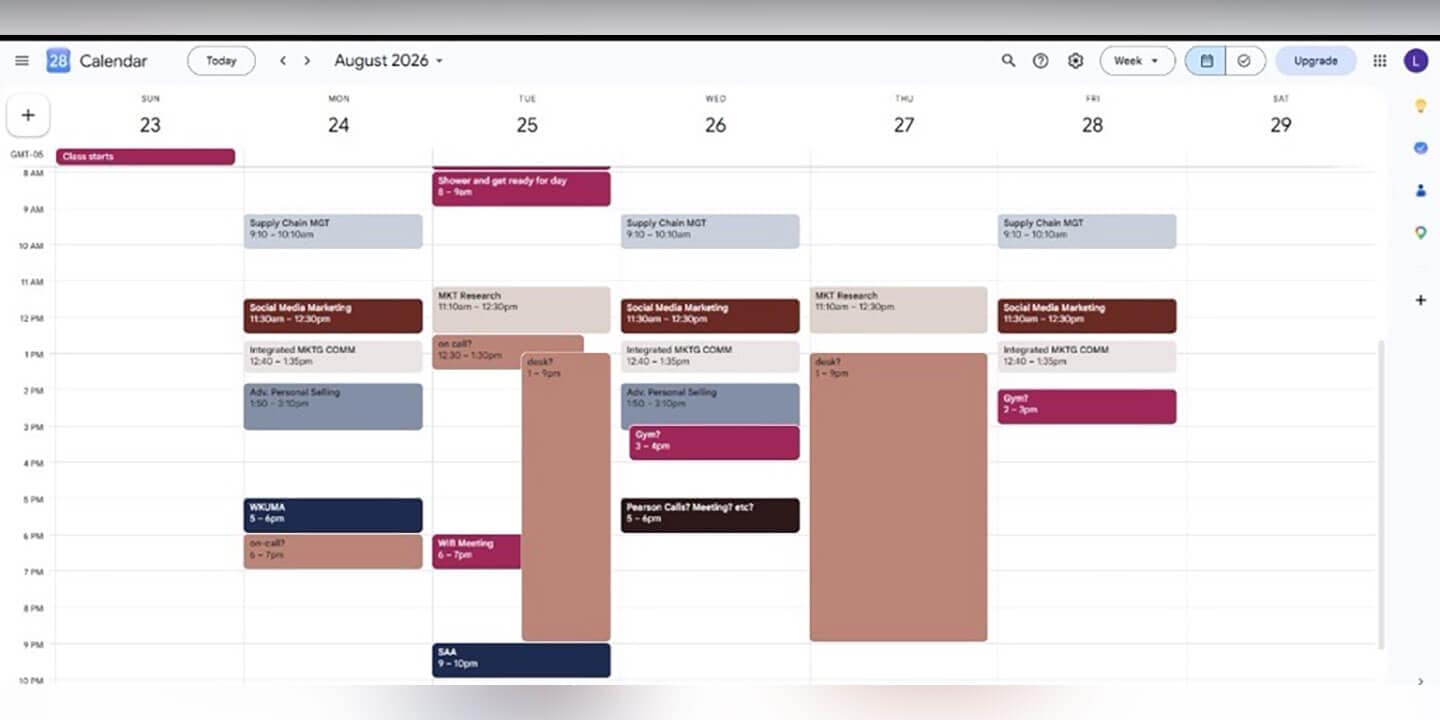
    First, I started using calendar blocking. Every Sunday, I’d sit down and map out the upcoming week in my calendar. This included class times, study sessions, meals, and even breaks. This practice helped me see where my time was really going and allowed me to plan ahead for big assignments.

    Eisenhower Matrix: Prioritize Tasks

    I also learned about the Eisenhower Matrix, a method for prioritizing tasks based on urgency and importance. This tool helped me avoid the trap of “urgent but unimportant” tasks (like constantly checking emails). Instead, I could focus on meaningful activities, such as studying for an exam or finishing a paper early.

    Digital Boundaries: Avoid Distractions

    Another game-changer was setting digital boundaries. I turned off most notifications on my phone and used website blockers to keep me off distracting sites while studying. It wasn’t easy at first, especially when all my friends were texting about weekend plans. However, I found that even short, focused study sessions became more productive.

    Patience Over Perfection: Give Yourself Grace

    Most importantly, I gave myself grace. Some weeks I stuck to my schedule perfectly; other times, life happened. But instead of giving up, I treated every week as a fresh start.

    Now, I still get busy, but I don’t feel overwhelmed. I sleep more, stress less, and even have time to do things I enjoy, like reading and spending time with friends. Managing your time in college isn’t about being perfect; it’s about being intentional. And trust me, once you take control of your schedule, everything else starts to feel more manageable.

    Do you have a compelling story or student success tips you’d like to see published on the Pearson Students blog?  If you are a college student and interested in writing for us – click here to pitch your idea and get started! 

     

  • Three students seated in a classroom, all three are holding papers; one shows a math diagram on it.

    Finding My Path: The Unexpected Joy of Changing Majors

    Arnold Taylor

    I thought I knew exactly what I wanted to do when I entered college. I was adamant about choosing a degree that would fit my interests and professional objectives. However, as the semesters passed, I realized things weren't going as well as I had hoped.

    I was having trouble keeping up with the requirements of my curriculum, and my grades started to decline. Understanding the subject matter wasn't enough; I was also overburdened and, to be honest, ill-prepared for the time management techniques I would need to be successful.

    I initially tried to persevere, believing things would improve if I put in more effort. However, despite my best efforts, I was unable to strike a balance. I eventually had to acknowledge that this was not the right path for me. I made the difficult decision to switch my major after giving it a lot of thought and having some painful talks with mentors and family.

    Resetting the Clock on Time Management

    It felt like a fresh start when I changed my major. I wasn't sure if I was making the right decision because I was entering a field with which I wasn't familiar. In addition, I had to address the behaviors that had first caused my problems, particularly my ineffective time management. I knew that improving my time management skills, staying on top of homework, and balancing my personal and academic lives were essential to succeed in this new major.

    I began by establishing modest, achievable objectives for myself. I made a plan to prioritize my tasks and divided my responsibilities into smaller, more realistic chunks. When I needed assistance, I learned to ask for it from instructors, fellow students, or campus resources. I eventually discovered a rhythm that suited me.

    Discovering New Passion in a New Major

    What surprised me the most was how much I ended up loving my new major. I initially made the change out of necessity, but as I got deeper into the coursework, I realized that this was where I was meant to be. The subject matter fascinated me more than I expected, and I felt more engaged and motivated than ever before. It was a reminder that, sometimes, the best opportunities come from moments when life doesn’t go as planned.

    Growth Through Self-Awareness and Adaptability

    I learned more from this experience than just the material for a new major. I gained the ability to take charge of my academic path and adjust when things don't go as planned. I also learned how crucial it is to be truthful with myself about my advantages and disadvantages and to make the required adjustments to position myself for success. Most significantly, I came to understand that it is when we venture outside of our comfort zones that we grow.

    One of the most difficult but also the best decisions I've ever made was switching my major. It forced me to become more self-aware, more disciplined, and more confident in my capacity to overcome obstacles. I’m grateful for the challenges because they led me to a field I love, proving that sometimes the path we don’t plan is the best one.

    Do you have a compelling story or student success tips you’d like to see published on the Pearson Students blog?  If you are a college student and interested in writing for us – click here to pitch your idea and get started! 

     

  • A view through a window with streamers, party hats, balloons, and a Happy New Year banner at sunrise.

    New Year, New Me? How to Actually Stick to Your Resolutions

    Juanita Shirin Jeyakumar

    January 1: You wake up bright and early. It’s a new year, and you feel like a new person with a fresh set of goals. You plan to spend more time outside, go to the gym every day, and stay on top of all your assignments.

    Then February hits. Your gym sends you a text message saying they miss you. It’s been days since you’ve seen the light of day, and you’re two weeks behind on your lectures.

    If you’re worried this will happen again next year (and the next), use this how-to guide to stick to your New Year's resolutions.

    Step 1: Set Small, Realistic Goals

    It’s easy to get ambitious and set huge goals, but this can be unrealistic, especially when your motivation inevitably dips. Rather than setting a goal to go to the gym every day, set a goal to move your body for thirty minutes instead. Sometimes, a simple walk around your neighborhood is easier to commit to than driving to the gym for a full workout.

    Step 2: Find an Accountability Partner

    I’ll be the first to admit it’s easy to let go of goals when no one else knows about them. If no one is going to question your progress, it makes it much easier to quit.

    That’s where an accountability partner comes in. It could be a family member, roommate, partner, or friend. Their job is to hold you responsible and encourage you to stay on track.

    Didn’t stick to your goal? They’ll motivate you to try again. Plus, embarking on a journey is always easier when you're not alone.

    Step 3: The Two-Month Commitment

    On average, it takes a little more than two months of consistent practice to form a new habit (Lally et al., 2009). If you commit to achieving your goal for two months, these actions can develop into a habit and, eventually, a lifestyle.

    Instead of overwhelming yourself with a year-long commitment, focus on the next two months. It makes the whole thing seem less intimidating. Before you know it, you’ll have created a new routine.

    Step 4: It’s a Privilege

    Eventually, keeping up with your New Year's resolutions will feel as effortless as any other habit. Still, some days will be a lot easier than others.

    On days when motivation seems elusive, try reframing your thoughts about your to-do list. Instead of saying, “I have to,” try saying, “I get to.” For example: “I get to move my body every day,” “I get to have an amazing education,” “I get to fuel my body with good things,” or “I get to enjoy nature.” Every day is a privilege and recognizing this can help you feel more grateful for your life.

    Through it all, remember to love yourself and give yourself grace. Better yet, add that goal to the top of your list.

    Bibliography

    Lally, Phillippa, van Jaarsveld, Cornelia H. M., Potts, Henry W. W., and Wardle, Jane. “How Are Habits Formed: Modelling Habit Formation in the Real World.” European Journal of Social Psychology 40, no. 6 (July 2009): 998–1009. https://doi.org/10.1002/ejsp.674.

    Do you have a compelling story or student success tips you’d like to see published on the Pearson Students blog?  If you are a college student and interested in writing for us – click here to pitch your idea and get started! 

     

  • A black couch with two black and white striped pillows, a ghost pillow, a strawberry throw blanket, and a blue and white throw blanket draped over the back.

    TV Marathons for College Break

    Madeline Beavis

    As fall semester comes to an end and finals begin, college students face endless readings, problem sets, and late-night study sessions. But once the work is finally done, exams are submitted, and essays are written, nothing feels better than sinking into the couch, grabbing a snack, and launching a good old-fashioned, TV marathon. Here are four shows worth lining up to pass the time during winter break... so go relax, you've earned it!

    1. Yellowjackets

    If you haven’t been pulled into the chaos yet, now is the time. Yellowjackets is the perfect mix of psychological thriller, survival horror, and messy coming-of-age drama. The show follows a high school girls’ soccer team stranded in the wilderness after a plane crash. The story bounces between their terrifying fight to survive in the ’90s and the dark fallout in their adult lives. It’s got cult vibes, mystery boxes, and the kind of “I need to know what happens next” cliffhangers that will absolutely ruin your sleep schedule—in the best way possible.

    2. We Were Liars

    Based on the wildly popular YA novel by E. Lockhart, We Were Liars is gearing up to be an experience when it hits Prime Video. Set on a private island off Massachusetts, the story follows a wealthy family hiding dangerous secrets. It’s told through the eyes of Cadence Sinclair, who is struggling to piece together the events of a previous and pivotal summer. Think Pretty Little Liars energy but with more psychological twists and a beach-goth atmosphere. Perfect for curling up and losing track of time.

    3. Timeless

    This recommendation is a personal favorite of mine! It’s not a new show, but it has a timeless plot (no pun intended). This time-travel adventure follows a historian, a soldier, and a scientist as they chase a rogue operative through America’s past, from the Hindenburg disaster to Watergate. Each episode blends action, clever storytelling, and real historical events while weaving in deeper questions about identity, morality, and the power of rewriting history. Suspenseful yet heartfelt, Timeless is perfect for anyone who craves high-stakes drama, fascinating “what ifs,” and a touch of history.

    4. Stranger Things, Season 5

    The long-awaited final chapter of the Hawkins story will arrive in three volumes. The first drops on November 26, with later releases on December 25 and December 31. Expect Eleven, Mike, and the gang to face their darkest, most harrowing threat yet, with all the supernatural scares and nostalgic charm we’ve come to love in the previous seasons.

    Bonus Watch: The Bear

    And if you’re hungry too, check out The Bear. This award-winning dramedy follows “Carmy,” a young chef who takes over his family’s sandwich shop in Chicago. He tries to transform it into something great while barely holding his own life together. It’s chaotic, funny, and unexpectedly heartfelt, with dialogue that moves as fast as the kitchen itself. Just be warned: you’ll probably find yourself craving Italian beef by the second episode.

    Whether you’re in the mood for survival horror, family drama, or supernatural throwdowns, these shows are tailor-made for late-night marathons after long days of school and life. Stock up on snacks, silence the notifications, and let mind wander around new worlds for a while!

    Do you have a compelling story or student success tips you’d like to see published on the Pearson Students blog?  If you are a college student and interested in writing for us – click here to pitch your idea and get started! 

     

  • A computer screen showing coding language.

    Applying AI in a Beneficial Way to Your Education

    David Marquez

    Education is a vital resource for our technical and social interaction with the communities around us. As technology progresses, K-12 and Higher Education find themselves at the behest of new tools and avenues of learning in our contemporary world. Computers, calculators, and mobile devices drastically changed how we learn in the classroom. What used to be bound to a physical location has become available 24/7 through digital technologies. The internet gave us easy, quick access to the expanse of human knowledge at the click of a button. Now, there is a new digital tool sweeping across the world, useful in every point of life: generative AI. 
 

    Having become popular in the past couple of years, generative AI chatbots specifically have taken over the news with their dramatic changes to industries, everyday life, and the classroom. A controversial topic as well by the way it learns and the validity of its output, this new technology has yet again flipped the table concerning certain practices and learning objectives. Within the classroom, generative AIs like Chat GPT, Perplexity, and Claude have found themselves to be useful tools for completing assignments and education. By simply asking the AI chatbot, you are given an answer based on the information bestowed. This technology, however, has also been used for academically dishonest tasks. That doesn’t mean that this new tool is immediately the worst product to come out. Like a calculator, AI is a tool, and like every tool, you use it to better your work. If you rely on it too heavily, you will get nowhere in the end. 
 

    Taking computer science classes in AI allows me to expand my programs beyond an assignment’s basic requirements. With AI, I have been able to understand more deeply the complex concepts I apply to my code, making me a more well-rounded computer scientist and computer programmer. However, when I used this tool, I didn’t ask the chatbot how to do the assignment. If I ran into issues I couldn’t solve or questions I would like to learn more about, I fed information to the AI detailing. In response, you can get not only an answer but detailed feedback that leads up to that answer and possible information beyond.  
     
    Now, this isn’t entirely a computer science tool. As a writing assistant, chatbot AI models can assist with small tasks in your writing. By utilizing the chatbot as a tool and a reference, we can come to understand the interaction as a conversation; you want to balance out the back and forth to not be so one-sided. The more one-sided it becomes, the more you might not find what you want from that AI. Or you might find you’ve taken too much and are coming up with something you do not understand. 
 

    An amazing contemporary technology, generative AI has completely changed the different stages of the world. Like a tool, it is good to start using it early. By understanding AI, you can further develop your skills and become more productive in whatever facet of your life you are working on, remembering that you work alongside it, not for it. 

    Do you have a compelling story or student success tips you’d like to see published on the Pearson Students blog?  If you are a college student and interested in writing for us – click here to pitch your idea and get started! 

     

  • A phone showing ChatGPT at the top of the screen and the words AI Study Tools on the left.

    AI for College: A First-Year Guide to Studying Smarter

    Logan Fulford

    First-Year Overwhelm

    How did you feel during your first year in college? Were you overwhelmed and maybe a little worried that you might fail your classes? That was exactly how I felt.

    I was extremely nervous about starting college because it was intimidating. Reading teacher reviews for courses like Business Calculus only added to my anxiety.

    I was convinced I could fail my exams along with half of the class and began to question whether I was cut out for college at all. I knew that college was a big step up from high school. The fear of falling behind was constantly in the back of my mind.

    Making the Most of Campus Support

    As someone who plans for every situation, I created a strategy to make sure I didn’t fail. First, I took advantage of every resource available to me. I regularly attended Supplemental Instruction sessions, visited my professors’ office hours, and worked through extra practice problems whenever I could.

    These resources helped immensely, but I still struggled to study efficiently, especially before major exams or when study guides weren't provided.

    Expanding to Modern Resources

    With the rise of AI over the past few years, I decided to create my own study resource. I began uploading my lecture notes, textbook chapters, and practice problems into an AI tool (e.g., ChatGPT, Claude, or NotebookLM). I would then ask it to generate a list of key terms and thirty multiple-choice questions, complete with answers and explanations.

    This approach completely changed the way I studied. I no longer had to spend countless hours cramming before exams or feel lost while reviewing material. Instead, I could study a little each day. This helped me develop a deeper understanding of the topics and retain information much better.

    Sharing My Strategy

    This method didn’t just help me. Once I started seeing real results (better grades, less stress, and more confidence), I shared this strategy with friends who were also struggling. Before long, their grades improved, too. Many also told me they felt way less anxious about exams.

    Even now, in our second year of college, my friends and I continue to use this method. It allows us to study consistently during the week while still leaving time to enjoy the activities we love.

    Using AI the Right Way

    While this method is incredibly effective, it’s important to be mindful of its limitations. Generative AI should be used as a study aid, not as a tool for cheating. To use it ethically, rely on it only to reinforce what you’ve learned, not to replace traditional studying.

    Since most AI gathers information from sources across the internet, it’s crucial to double-check that the material is accurate. AI-based studying should complement your learning, not serve as a substitute for it.

    Personalize Your Study Strategy

    While this method was a game-changer for me, it might not work for everyone. Each person has their own unique way of learning. Consider adding AI study guides while continuing to rely on your go-to study methods.

    It's a great daily tool to help you jumpstart a consistent study routine and reinforce details you might otherwise forget. College is challenging, but with commitment and an effective studying strategy, success is well within reach.

    Do you have a compelling story or student success tips you’d like to see published on the Pearson Students blog?  If you are a college student and interested in writing for us – click here to pitch your idea and get started!