Ch. 22 - Microbial Diseases of the Nervous System
Tortora - Microbiology: An Introduction 14th Edition
Tortora14th EditionMicrobiology: An IntroductionISBN: 9780138200398Not the one you use?Change textbook
Chapter 18, Problem 2

Which of the following does not have an animal reservoir or vector?
a. Listeriosis
b. Cryptococcosis
c. Amebic meningoencephalitis
d. Rabies
e. African trypanosomiasis

Verified step by step guidance
1
Step 1: Understand the concept of animal reservoirs and vectors. An animal reservoir is a species that harbors a pathogen without being affected by it, serving as a source of infection. A vector is an organism, often an arthropod, that transmits a pathogen from one host to another.
Step 2: Analyze each disease option to identify if it involves an animal reservoir or vector. For example, rabies is well-known to have animal reservoirs (such as bats, dogs) and is transmitted through animal bites.
Step 3: Consider listeriosis, which is caused by Listeria monocytogenes, a bacterium commonly found in soil, water, and contaminated food, but it does not rely on an animal reservoir or vector for transmission to humans.
Step 4: Review cryptococcosis, caused by Cryptococcus neoformans, which is primarily found in the environment (especially in bird droppings) and does not require an animal reservoir or vector for infection.
Step 5: Evaluate amebic meningoencephalitis and African trypanosomiasis, both of which involve animal reservoirs or vectors (free-living amoebae in water for the former, tsetse flies as vectors for the latter). Use this information to determine which disease does not have an animal reservoir or vector.

Verified video answer for a similar problem:

This video solution was recommended by our tutors as helpful for the problem above.
Video duration:
1m

Key Concepts

Here are the essential concepts you must grasp in order to answer the question correctly.

Animal Reservoirs and Vectors

An animal reservoir is a species that harbors a pathogen without being affected, serving as a source of infection. Vectors are organisms, often arthropods, that transmit pathogens between hosts. Understanding which diseases involve animal reservoirs or vectors helps identify transmission routes and control measures.
Recommended video:
02:33
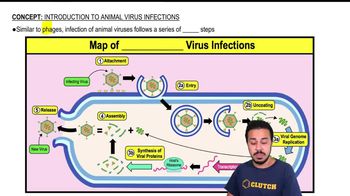
Introduction to Animal Virus Infections

Zoonotic Diseases

Zoonotic diseases are infections naturally transmitted between animals and humans. Many pathogens causing zoonoses rely on animal reservoirs or vectors for their life cycle. Recognizing zoonotic diseases aids in understanding the role of animals in disease spread and prevention strategies.
Recommended video:
04:57
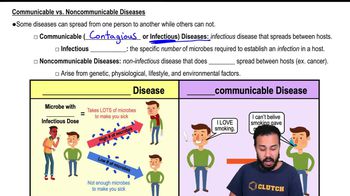
Communicable vs. Noncommunicable Diseases

Pathogen Transmission Modes

Pathogens can be transmitted via direct contact, vectors, environmental sources, or other routes. Some diseases, like cryptococcosis, are acquired from environmental sources rather than animals. Identifying the transmission mode is crucial to determine if an animal reservoir or vector is involved.
Recommended video:
03:40
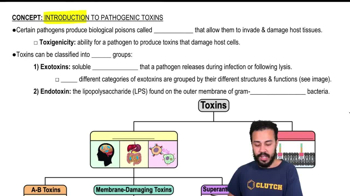
Introduction to Pathogenic Toxins
Related Practice
Textbook Question

What treatment is used against tetanus under the following conditions?

a. Before a person suffers a deep puncture wound

b. After a person suffers a deep puncture wound

1240
views

Textbook Question

Why is the following description used for wounds that are susceptible to C. tetani infection: “. . . Improperly cleaned deep puncture wounds . . . ones with little or no bleeding . . .”?

1217
views
Textbook Question

Provide the following information on poliomyelitis: etiology, method of transmission, symptoms, prevention. Why aren’t the Salk and Sabin vaccines considered treatments for poliomyelitis?

1234
views
Textbook Question

If C. tetani is relatively sensitive to penicillin, why doesn’t penicillin cure tetanus?

1445
views
Textbook Question

Which of the following is false?

a. Only puncture wounds by rusty nails result in tetanus.

b. Rabies is seldom found in rodents (e.g., rats, mice).

c. Polio is transmitted by the fecal-oral route.

d. Arboviral encephalitis is rather common in the United States.

e. All of the above are true.

857
views
Textbook Question

A 12-year-old child hospitalized for Guillain-Barré syndrome had a 4-day history of headache, dizziness, fever, sore throat, and weakness of legs. Seizures began 2 weeks later. Bacterial cultures were negative. The child died 3 weeks after hospitalization. An autopsy revealed inclusions in brain cells that tested positive in an immunofluorescence test. This patient probably had

a. Rabies.

b. Creutzfeldt-Jakob disease.

c. Botulism.

d. Tetanus.

e. Leprosy.

1456
views