Pearson+ LogoPearson+ Logo
Ch. 31 - Fungi
Campbell - Campbell Biology 12th Edition
Urry12th EditionCampbell BiologyISBN: 9785794169850Not the one you use?Change textbook
Chapter 31, Problem 3

The closest relatives of fungi are thought to be the
a. Animals
b. Vascular plants
c. Mosses
d. Slime molds

Verified step by step guidance
1
Understand the evolutionary relationships between different groups of organisms. Fungi, animals, and plants are all part of the eukaryotic domain, but they belong to different kingdoms.
Consider the characteristics that fungi share with other organisms. Fungi are heterotrophic like animals, meaning they obtain their food by absorbing nutrients from other organisms.
Examine the phylogenetic tree of life, which shows the evolutionary relationships between different species. Fungi and animals are more closely related to each other than to plants or other groups.
Review the concept of a clade, which is a group of organisms that includes a common ancestor and all its descendants. Fungi and animals belong to the same clade known as Opisthokonta.
Conclude that based on evolutionary biology and phylogenetic studies, the closest relatives of fungi are animals, as they share a more recent common ancestor with fungi than with plants, mosses, or slime molds.

Verified video answer for a similar problem:

This video solution was recommended by our tutors as helpful for the problem above.
Video duration:
35s
Was this helpful?

Key Concepts

Here are the essential concepts you must grasp in order to answer the question correctly.

Fungi

Fungi are a kingdom of organisms that include yeasts, molds, and mushrooms. They are eukaryotic, meaning their cells have a nucleus, and they obtain nutrients through absorption. Fungi play crucial roles in ecosystems as decomposers and symbionts, and they have unique characteristics such as chitin in their cell walls.
Recommended video:

Phylogenetic Relationships

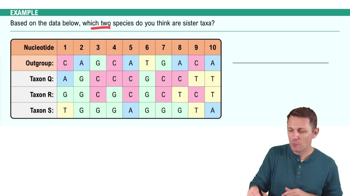
Phylogenetic relationships refer to the evolutionary connections between different organisms, often depicted in a phylogenetic tree. These relationships are determined by genetic, morphological, and biochemical data, helping scientists understand how species are related and their common ancestors. In the context of fungi, understanding their closest relatives involves examining these evolutionary links.
Recommended video:
04:13
Building Phylogenetic Trees Example 2

Eukaryotic Kingdoms

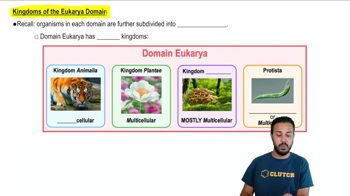
Eukaryotic kingdoms include Animalia, Plantae, Fungi, and Protista, each characterized by cells with a nucleus and other organelles. Animals are multicellular and heterotrophic, plants are primarily autotrophic, and fungi absorb nutrients. Protists are diverse, including slime molds, which share some characteristics with fungi but are distinct in their life cycles and cellular organization.
Recommended video:
Guided course
02:28
Kingdoms of the Eukarya Domain