Pearson+ LogoPearson+ Logo
Ch. 55 - Ecosystems and Restoration Ecology
Campbell - Campbell Biology 12th Edition
Urry12th EditionCampbell BiologyISBN: 9785794169850Not the one you use?Change textbook
Chapter 55, Problem 1

Which of the following organisms is correctly paired with a trophic level?


a. cyanobacterium—secondary consumer
b. grasshopper—primary consumer
c. zooplankton—primary producer
d. grass—decomposer

Verified step by step guidance
1
Identify the role of each organism in an ecosystem based on their source of energy and their position in the food chain.
Understand that primary producers are organisms that produce their own food through photosynthesis or chemosynthesis, typically plants and some bacteria.
Recognize that primary consumers are organisms that eat primary producers, these are usually herbivores.
Acknowledge that secondary consumers eat primary consumers, and decomposers break down dead material and waste products.
Match each organism with the correct trophic level based on their roles: cyanobacteria (photosynthetic bacteria), grasshopper (herbivore), zooplankton (typically consume phytoplankton), and grass (a plant).

Verified video answer for a similar problem:

This video solution was recommended by our tutors as helpful for the problem above.
Video duration:
2m
Was this helpful?

Key Concepts

Here are the essential concepts you must grasp in order to answer the question correctly.

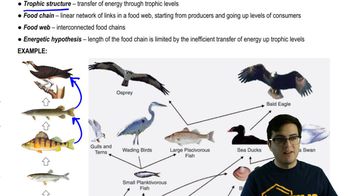
Trophic Levels

Trophic levels represent the hierarchical positions of organisms in an ecosystem based on their feeding relationships. The primary levels include producers (organisms that create energy through photosynthesis), primary consumers (herbivores that eat producers), secondary consumers (carnivores that eat primary consumers), and decomposers (organisms that break down dead material). Understanding these levels is crucial for analyzing food webs and energy flow in ecosystems.
Recommended video:
Guided course
03:14
Trophic Structure

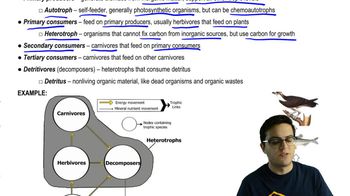
Producers and Consumers

Producers, such as plants and cyanobacteria, are organisms that synthesize their own food using sunlight or chemical energy, forming the base of the food chain. Consumers are classified into primary consumers (herbivores) that eat producers, and secondary consumers (carnivores) that eat other consumers. Recognizing the roles of these organisms helps in identifying their correct trophic levels.
Recommended video:
Guided course
04:16
Producers and Consumers

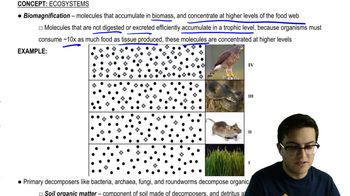
Decomposers

Decomposers, including fungi and bacteria, play a vital role in ecosystems by breaking down dead organic matter and recycling nutrients back into the soil. They are essential for nutrient cycling and maintaining ecosystem health. Unlike producers and consumers, decomposers do not fit neatly into the traditional trophic levels, as they contribute to the ecosystem's energy flow by decomposing organic material.
Recommended video:
Guided course
02:25
Biomagnification and Decomposers