Pearson+ LogoPearson+ Logo
Ch. 55 - Ecosystems and Restoration Ecology
Campbell - Campbell Biology 12th Edition
Urry12th EditionCampbell BiologyISBN: 9785794169850Not the one you use?Change textbook
Chapter 55, Problem 4

Nitrifying bacteria participate in the nitrogen cycle mainly by
a. Converting nitrogen gas to ammonia
b. Releasing ammonium from organic compounds, thus returning it to the soil
c. Converting ammonium to nitrate, which plants absorb
d. Incorporating nitrogen into amino acids and organic compounds

Verified step by step guidance
1
Understand the role of nitrifying bacteria in the nitrogen cycle. Nitrifying bacteria are crucial for converting nitrogen compounds into forms that plants can absorb.
Identify the specific process that nitrifying bacteria are involved in. They are primarily responsible for converting ammonium (NH₄⁺) into nitrate (NO₃⁻).
Recognize that this conversion is a two-step process: first, ammonium is oxidized to nitrite (NO₂⁻) by bacteria such as Nitrosomonas, and then nitrite is further oxidized to nitrate by bacteria such as Nitrobacter.
Consider the options given in the problem. Option c, 'converting ammonium to nitrate, which plants absorb,' directly describes the role of nitrifying bacteria.
Conclude that the correct answer is option c, as it accurately reflects the function of nitrifying bacteria in the nitrogen cycle.

Verified video answer for a similar problem:

This video solution was recommended by our tutors as helpful for the problem above.
Video duration:
1m
Was this helpful?

Key Concepts

Here are the essential concepts you must grasp in order to answer the question correctly.

Nitrogen Cycle

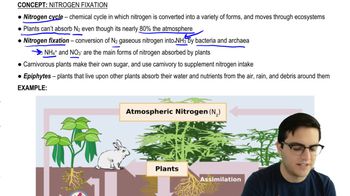
The nitrogen cycle is a crucial ecological process that transforms nitrogen into various chemical forms, making it accessible to living organisms. It involves several stages, including nitrogen fixation, nitrification, assimilation, ammonification, and denitrification. Understanding this cycle is essential for comprehending how nitrogen moves through the environment and supports life.
Recommended video:
Guided course
06:31
Nitrogen Cycle

Nitrifying Bacteria

Nitrifying bacteria are a group of microorganisms that play a vital role in the nitrogen cycle by converting ammonia into nitrites and then into nitrates. This process, known as nitrification, is essential for making nitrogen available to plants in a form they can absorb and utilize for growth. These bacteria are typically found in soil and aquatic environments.
Recommended video:
Guided course
04:46
2) Transform Recombinant DNA into Bacteria

Nitrate Absorption by Plants

Plants absorb nitrates from the soil as a primary source of nitrogen, which is crucial for synthesizing proteins and other essential compounds. Nitrates are the end product of nitrification, a process facilitated by nitrifying bacteria. This absorption is a key step in the nitrogen cycle, linking soil nutrient availability to plant growth and ecosystem productivity.
Recommended video:
Related Practice
Textbook Question

Which of the following organisms is correctly paired with a trophic level?


a. cyanobacterium—secondary consumer

b. grasshopper—primary consumer

c. zooplankton—primary producer

d. grass—decomposer

357
views
Textbook Question

Which of these ecosystems has the lowest net primary production per square meter?

a. A salt marsh

b. An open ocean

c. A coral reef

d. A tropical rain forest

1153
views
Textbook Question

The discipline that applies ecological principles to returning degraded ecosystems to a more natural state is known as

a. Restoration ecology

b. Thermodynamics

c. Eutrophication

d. Biogeochemistry

1176
views
Textbook Question

Which of the following has the greatest effect on the rate of chemical cycling in an ecosystem?

a. The rate of decomposition in the ecosystem

b. The production efficiency of the ecosystem's consumers

c. The trophic efficiency of the ecosystem

d. The location of the nutrient reservoirs in the ecosystem

1223
views
Textbook Question

Which of the following was a result of the Hubbard Brook watershed deforestation experiment?

a. Most minerals were not recycled within the intact forest ecosystem

b. Calcium levels remained high in the soil of deforested areas

c. Deforestation decreased water runoff

d. The nitrate concentration in waters draining the deforested area became dangerously high

1385
views
Textbook Question

Which of the following would be considered an example of bioremediation?

a. Adding nitrogen-fixing microorganisms to a degraded ecosystem to increase nitrogen availability

b. Using a bulldozer to regrade a strip mine

c. Reconfiguring the channel of a river

d. Adding seeds of a chromium-accumulating plant to soil contaminated by chromium

1447
views