Ch. 9 - Cellular Respiration and Fermentation
Campbell - Campbell Biology 12th Edition
Urry12th EditionCampbell BiologyISBN: 9785794169850Not the one you use?Change textbook
Chapter 9, Problem 3

The final electron acceptor of the electron transport chain that functions in aerobic oxidative phosphorylation is
a. Oxygen.
b. Water.
c. NAD+.
d. Pyruvate.

Verified step by step guidance
1
Understand the context: The electron transport chain is a series of protein complexes located in the inner mitochondrial membrane that transfers electrons from electron donors to electron acceptors via redox reactions.
Identify the process: Aerobic oxidative phosphorylation is the process by which cells generate ATP using oxygen as the final electron acceptor in the electron transport chain.
Recognize the role of oxygen: Oxygen is crucial in this process because it accepts electrons at the end of the electron transport chain, allowing the chain to continue functioning and ATP to be produced.
Consider the options: Evaluate each option given in the problem. Oxygen (a) is known to be the final electron acceptor in aerobic respiration. Water (b) is a product formed when oxygen accepts electrons and combines with protons. NAD+ (c) is an electron carrier, not an acceptor. Pyruvate (d) is involved in glycolysis, not the electron transport chain.
Conclude the reasoning: Based on the understanding of aerobic oxidative phosphorylation, oxygen is the final electron acceptor, allowing the electron transport chain to function efficiently and produce ATP.

Verified video answer for a similar problem:

This video solution was recommended by our tutors as helpful for the problem above.
Video duration:
3m
Was this helpful?

Key Concepts

Here are the essential concepts you must grasp in order to answer the question correctly.

Electron Transport Chain

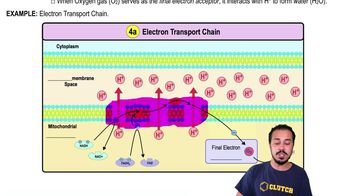
The electron transport chain (ETC) is a series of protein complexes located in the inner mitochondrial membrane. It functions to transfer electrons from electron donors like NADH and FADH2 to electron acceptors through redox reactions, ultimately driving the synthesis of ATP via oxidative phosphorylation.
Recommended video:
Guided course
07:41
Electron Transport Chain

Aerobic Oxidative Phosphorylation

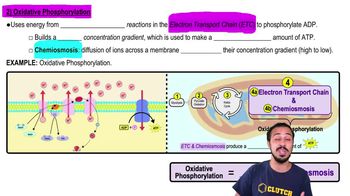
Aerobic oxidative phosphorylation is the process by which cells generate ATP using oxygen as the final electron acceptor. This occurs in the mitochondria, where the electron transport chain facilitates the transfer of electrons to oxygen, forming water and enabling ATP production through chemiosmosis.
Recommended video:
Guided course
06:27
Oxidative Phosphorylation

Final Electron Acceptor

In the context of the electron transport chain, the final electron acceptor is the molecule that receives electrons at the end of the chain. In aerobic respiration, oxygen serves as the final electron acceptor, allowing the formation of water and the continuation of ATP synthesis.
Recommended video:
Guided course
07:41
Electron Transport Chain