Pearson+ LogoPearson+ Logo
Ch. 9 - Cellular Respiration and Fermentation
Campbell - Campbell Biology 12th Edition
Urry12th EditionCampbell BiologyISBN: 9785794169850Not the one you use?Change textbook
Chapter 9, Problem 6

When electrons flow along the electron transport chains of mitochondria, which of the following changes occurs?
a. The pH of the matrix increases.
b. ATP synthase pumps protons by active transport.
c. The electrons gain free energy.
d. NAD+ is oxidized.

Verified step by step guidance
1
Understand the role of the electron transport chain (ETC) in mitochondria: The ETC is a series of protein complexes located in the inner mitochondrial membrane that facilitates the transfer of electrons from electron donors like NADH and FADH2 to oxygen, the final electron acceptor.
Recognize the process of chemiosmosis: As electrons move through the ETC, protons (H+) are pumped from the mitochondrial matrix into the intermembrane space, creating a proton gradient across the inner mitochondrial membrane.
Consider the effect of the proton gradient: The accumulation of protons in the intermembrane space lowers the pH there, while the matrix becomes more alkaline, indicating an increase in pH.
Understand the role of ATP synthase: ATP synthase is a protein complex that uses the energy from the proton gradient to synthesize ATP from ADP and inorganic phosphate. It does not pump protons by active transport; instead, it allows protons to flow back into the matrix, driving ATP synthesis.
Evaluate the options: Based on the understanding of the ETC and chemiosmosis, determine which option correctly describes a change that occurs when electrons flow along the electron transport chains of mitochondria.

Verified video answer for a similar problem:

This video solution was recommended by our tutors as helpful for the problem above.
Video duration:
2m
Was this helpful?

Key Concepts

Here are the essential concepts you must grasp in order to answer the question correctly.

Electron Transport Chain

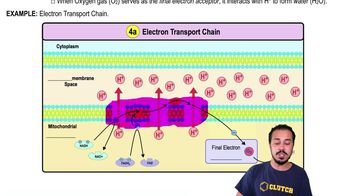
The electron transport chain (ETC) is a series of protein complexes located in the inner mitochondrial membrane. It facilitates the transfer of electrons from electron donors like NADH and FADH2 to electron acceptors such as oxygen, through redox reactions. This process generates a proton gradient across the membrane, which is crucial for ATP synthesis.
Recommended video:
Guided course
07:41
Electron Transport Chain

Proton Gradient and pH Change

As electrons move through the ETC, protons are pumped from the mitochondrial matrix into the intermembrane space, creating a proton gradient. This gradient results in a lower pH in the intermembrane space compared to the matrix. The flow of protons back into the matrix through ATP synthase drives the synthesis of ATP, increasing the matrix's pH.
Recommended video:

Role of NAD+ in Cellular Respiration

NAD+ is a crucial coenzyme in cellular respiration, acting as an electron carrier. It is reduced to NADH when it accepts electrons during glycolysis and the Krebs cycle. In the ETC, NADH is oxidized back to NAD+, releasing electrons that contribute to the electron flow and proton gradient necessary for ATP production.
Recommended video:
Guided course
03:39
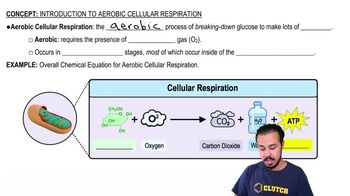
Introduction to Cellular Respiration
Related Practice
Textbook Question

The final electron acceptor of the electron transport chain that functions in aerobic oxidative phosphorylation is

a. Oxygen.

b. Water.

c. NAD+.

d. Pyruvate.

3256
views
Textbook Question

In mitochondria, exergonic redox reactions

a. Are the source of energy driving prokaryotic ATP synthesis.

b. Provide the energy that establishes the proton gradient.

c. Reduce carbon atoms to carbon dioxide.

d. Are coupled via phosphorylated intermediates to endergonic processes.

2454
views
Textbook Question

What is the oxidizing agent in the following reaction?

Pyruvate + NADH + H+ → Lactate + NAD+

a. Oxygen

b. NADH

c. Lactate

d. Pyruvate

4836
views
Textbook Question

Most CO2 from catabolism is released during

a. Glycolysis.

b. The citric acid cycle.

c. Lactate fermentation.

d. Electron transport.

4212
views
Textbook Question

Step 3 in Figure 9.8 is a major point of regulation of glycolysis. The enzyme phosphofructokinase is allosterically regulated by ATP and related molecules (see Concept 8.5). Considering the overall result of glycolysis, would you expect ATP to inhibit or stimulate activity of this enzyme? Explain.

(Hint: Make sure you consider the role of ATP as an allosteric regulator, not as a substrate of the enzyme.)

1660
views
Textbook Question

The proton pump shown in Figures 7.17 and 7.18 is a type of ATP synthase (see Figure 9.14). Compare the processes shown in the two figures, and say whether they are involved in active or passive transport (see Concepts 7.3 and 7.4).

1061
views