Pearson+ LogoPearson+ Logo
Ch. 12 - The Cell Cycle
Freeman - Biological Science 8th Edition
Freeman8th EditionBiological ScienceISBN: 9780138276263Not the one you use?Change textbook
Chapter 12, Problem 5

Identify at least two events in the cell cycle that must be completed successfully for daughter cells to share an identical complement of chromosomes.

Verified step by step guidance
1
Understand that the cell cycle consists of several phases, including interphase (G1, S, G2) and mitotic phase (mitosis and cytokinesis). Each phase has specific events crucial for successful cell division.
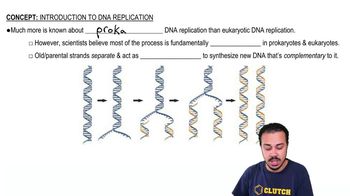
Recognize that during the S phase of interphase, DNA replication occurs. This is a critical event where the entire genome is duplicated, ensuring that each daughter cell will receive an identical set of chromosomes.
Identify that during mitosis, specifically in the metaphase, chromosomes align at the metaphase plate. This alignment ensures that each daughter cell will receive one copy of each chromosome during the subsequent separation.
Acknowledge the importance of anaphase in mitosis, where sister chromatids are pulled apart to opposite poles of the cell. This separation is crucial for ensuring that each daughter cell ends up with an identical set of chromosomes.
Finally, understand that cytokinesis, the division of the cytoplasm, must occur successfully to physically separate the two daughter cells, each containing the identical complement of chromosomes achieved through the previous steps.

Verified video answer for a similar problem:

This video solution was recommended by our tutors as helpful for the problem above.
Video duration:
1m
Was this helpful?

Key Concepts

Here are the essential concepts you must grasp in order to answer the question correctly.

DNA Replication

DNA replication is a critical process during the S phase of the cell cycle where the cell's DNA is duplicated. This ensures that each daughter cell receives an exact copy of the genetic material. The replication process involves unwinding the DNA double helix and synthesizing a new complementary strand for each original strand, resulting in two identical DNA molecules.
Recommended video:
Guided course
03:37
Introduction to DNA Replication

Mitotic Spindle Formation

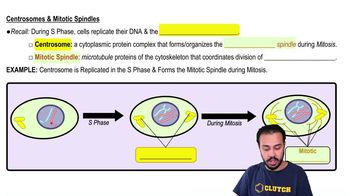
Mitotic spindle formation occurs during mitosis and is essential for the equal distribution of chromosomes to the daughter cells. The spindle fibers, composed of microtubules, attach to the centromeres of the chromosomes and help align them at the cell's equatorial plane. This ensures that each daughter cell receives an identical set of chromosomes during cell division.
Recommended video:
Guided course
04:02
Centrosomes & Mitotic Spindles

Chromosome Segregation

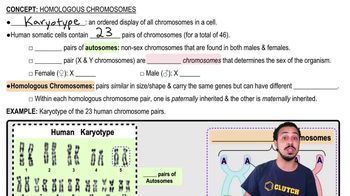
Chromosome segregation is the process during anaphase of mitosis where sister chromatids are pulled apart to opposite poles of the cell. This separation is facilitated by the shortening of spindle fibers and ensures that each daughter cell inherits an identical set of chromosomes. Proper segregation is crucial to prevent genetic imbalances in the resulting daughter cells.
Recommended video:
Guided course
08:09
Homologous Chromosomes