Pearson+ LogoPearson+ Logo
Ch. 2 - Water and Carbon: The Chemical Basis of Life
Freeman - Biological Science 8th Edition
Freeman8th EditionBiological ScienceISBN: 9780138276263Not the one you use?Change textbook
Chapter 2, Problem 12

The current average pH of our oceans is 8.1. What is the concentration of protons in the oceans? How has the proton concentration changed in our oceans when compared to before the industrial revolution, when the average pH was 8.2? Express this change as a percentage increase.

Verified step by step guidance
1
Calculate the concentration of protons (H+) in the ocean for the current average pH of 8.1 using the formula: \( [H^+] = 10^{-pH} \).
Calculate the concentration of protons (H+) in the ocean for the pH before the industrial revolution, which was 8.2, using the same formula: \( [H^+] = 10^{-pH} \).
Compare the two proton concentrations to find the absolute change in proton concentration. This can be done by subtracting the proton concentration at pH 8.2 from the proton concentration at pH 8.1.
To find the percentage increase in proton concentration, use the formula: \( \text{Percentage Increase} = \left( \frac{\text{New Concentration} - \text{Old Concentration}}{\text{Old Concentration}} \right) \times 100\% \).
Interpret the results to understand how the proton concentration in the oceans has changed due to changes in pH levels, reflecting on the impact of acidification.

Key Concepts

Here are the essential concepts you must grasp in order to answer the question correctly.

pH Scale

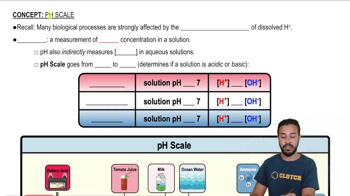
The pH scale measures the acidity or alkalinity of a solution, ranging from 0 to 14. A pH of 7 is neutral, while values below 7 indicate acidity and above 7 indicate alkalinity. Each whole number change on the pH scale represents a tenfold change in hydrogen ion concentration, meaning that a decrease in pH corresponds to an increase in proton concentration.
Recommended video:

Proton Concentration

Proton concentration in a solution is directly related to its pH value. The formula to calculate proton concentration ([H+]) from pH is [H+] = 10^(-pH). Therefore, a lower pH indicates a higher concentration of protons, which is crucial for understanding changes in ocean chemistry over time, particularly in relation to ocean acidification.
Recommended video:
Guided course
04:51
Concentration Gradients and Diffusion

Ocean Acidification

Ocean acidification refers to the decrease in pH levels of ocean waters due to increased carbon dioxide (CO2) emissions. Since the industrial revolution, the absorption of CO2 by oceans has led to a measurable drop in pH, resulting in higher proton concentrations. This change can have significant impacts on marine life, particularly organisms that rely on calcium carbonate for their shells and skeletons.
Recommended video:
Guided course
03:57
Seasonal Turnover & Ocean Upwelling