The global “One Health” movement fosters collaborations at the intersection of human health, veterinary health, and environmental health. Explain why “One Health” seeks to reduce the use of antibiotics in farm animals to improve human health.
Over half of the world’s human population lives in cities. Are species adapting to life in these novel urban environments? A global team of researchers (including Tiffany Longo, Jesse Bragger, and Summer Shaheed, shown in in the photo) used white clover as a study system to find out. They measured the production of a compound called hydrogen cyanide (HCN) in rural and urban clover plants. Production of HCN deters herbivores and increases tolerance to drought but has a cost: Clover must expend energy to produce HCN.
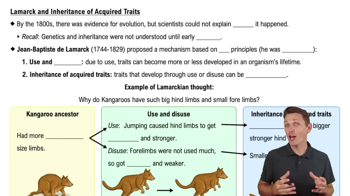
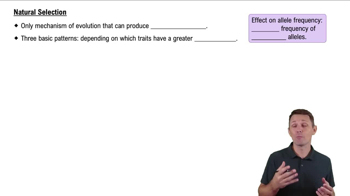
Compare how evolution by inheritance of acquired characters and the theory of evolution by natural selection would explain the observation that HCN production is often high in rural environments with many herbivores and low in urban environments with few herbivores.
Verified step by step guidanceKey Concepts
Evolution by Inheritance of Acquired Characters
Natural Selection
Trade-offs in Resource Allocation
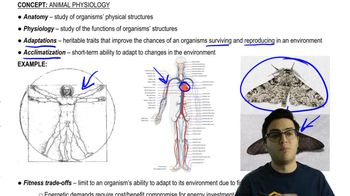
Coral reefs are biodiverse ecosystems that provide food, income, coastal protection, and many other services to millions of people. Yet coral reefs are under threat from human impacts such as climate change—many corals cannot tolerate the warming ocean water and have suffered massive 'bleaching' events, which can be fatal. Researchers have discovered that some corals have the capacity to acclimatize to warmer water, while other corals do not. The researchers fear that because corals are long-lived colonial animals and thus evolve slowly, they may not be able to adapt to global warming fast enough to avoid extinction. Explain how the difference between acclimatize and adapt is important to the fate of corals.
The geneticist James Crow wrote that successful scientific theories have the following characteristics: (1) They explain otherwise puzzling observations; (2) they provide connections between otherwise disparate observations; (3) they make predictions that can be tested; and (4) they are heuristic, meaning that they open up new avenues of theory and experimentation. Crow added two other elements of scientific theories that he considered important on a personal, emotional level: (5) They should be elegant, in the sense of being simple and powerful; and (6) they should have an element of surprise. How well does the theory of evolution by natural selection fulfill these six criteria?
What is an evolutionary adaptation?
a. A trait that improves the fitness of its bearer, compared with individuals without the trait
b. A trait that changes in response to environmental influences within the individual's lifetime
c. The ability of an individual to adjust to its environment
d. A trait that an individual wants so that it can survive
