
Pearson+ LogoPearson+ Logo
Ch. 22 - Evolution by Natural Selection
Freeman - Biological Science 8th Edition
Freeman8th EditionBiological ScienceISBN: 9780138276263Not the one you use?Change textbook
Chapter 22, Problem 6

Some biologists summarize evolution by natural selection with the phrase "mutation proposes, selection disposes." Mutation is a process that creates heritable variation. Explain what the phrase means.

Verified step by step guidance
1
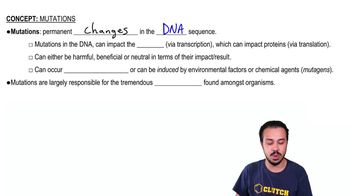
Understand the role of mutation in evolution: Mutation is a random change in the DNA sequence of an organism. These changes can introduce new genetic variations within a population, which are heritable and can be passed on to future generations.
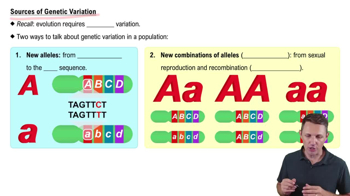
Recognize the significance of genetic variation: Genetic variation is crucial for evolution because it provides the raw material for natural selection to act upon. Without variation, there would be no differences in traits for natural selection to favor or disfavor.
Explore the concept of natural selection: Natural selection is the process by which certain traits become more common in a population because they confer a survival or reproductive advantage. Organisms with advantageous traits are more likely to survive and reproduce, passing those traits to their offspring.
Interpret the phrase 'mutation proposes, selection disposes': This phrase suggests that mutations introduce new genetic possibilities ('proposes'), while natural selection determines which of these possibilities are beneficial and should be retained in the population ('disposes').
Connect mutation and selection in the context of evolution: Together, mutation and natural selection drive the evolutionary process. Mutations generate diversity, and natural selection filters this diversity, leading to adaptation and the evolution of species over time.

Verified video answer for a similar problem:

This video solution was recommended by our tutors as helpful for the problem above.
Video duration:
3m
Was this helpful?

Key Concepts

Here are the essential concepts you must grasp in order to answer the question correctly.

Mutation

Mutation refers to changes in the DNA sequence of an organism's genome. These changes can be caused by errors during DNA replication or external factors like radiation. Mutations introduce genetic variation, which is essential for evolution, as they provide new traits that may be beneficial, neutral, or harmful to the organism.
Recommended video:

Natural Selection

Natural selection is the process by which certain traits become more common in a population because they confer a survival or reproductive advantage. Organisms with advantageous traits are more likely to survive and reproduce, passing these traits to the next generation. Over time, this leads to the adaptation of species to their environments.
Recommended video:
04:43
Natural Selection

Heritable Variation

Heritable variation refers to genetic differences that can be passed from parents to offspring. This variation is crucial for evolution, as it provides the raw material for natural selection to act upon. Without heritable variation, populations would lack the diversity needed to adapt to changing environments or new challenges.
Recommended video:
02:16
Sources of Genetic Variation
Related Practice
Textbook Question

Traits that are derived from a common ancestor, like the bones of human arms and bird wings, are said to be               .

1147
views
Textbook Question

How can evolutionary fitness be measured? Select True or False for each statement.

T/F Document how long individuals survive.

T/F Count the number of healthy, fertile offspring produced.

T/F Determine which individuals are strongest.

T/F Determine which phenotype is the most common.

1257
views
Textbook Question

According to data presented in this chapter, which of the following are correct? Select True or False for each statement. T/F When individuals change in response to challenges from the environment, their altered traits are passed on to offspring. T/F Species are created independently of each other and do not change over time. T/F Populations—not individuals—change when natural selection occurs. T/F The traits of populations become more perfect over time.

695
views
Textbook Question

Why don't the biggest and strongest individuals in a population always produce the most offspring?

a. The biggest and strongest individuals always have higher fitness.

b. In some environments, being big and strong lowers fitness.

c. Sometimes the biggest and strongest individuals may choose to have fewer offspring.

d. Sometimes the number of offspring is not related to fitness.

1007
views
Textbook Question

The global “One Health” movement fosters collaborations at the intersection of human health, veterinary health, and environmental health. Explain why “One Health” seeks to reduce the use of antibiotics in farm animals to improve human health.

435
views
Textbook Question

Coral reefs are biodiverse ecosystems that provide food, income, coastal protection, and many other services to millions of people. Yet coral reefs are under threat from human impacts such as climate change—many corals cannot tolerate the warming ocean water and have suffered massive 'bleaching' events, which can be fatal. Researchers have discovered that some corals have the capacity to acclimatize to warmer water, while other corals do not. The researchers fear that because corals are long-lived colonial animals and thus evolve slowly, they may not be able to adapt to global warming fast enough to avoid extinction. Explain how the difference between acclimatize and adapt is important to the fate of corals.

899
views