Pearson+ LogoPearson+ Logo
Ch. 35 - Water and Sugar Transport in Plants
Freeman - Biological Science 8th Edition
Freeman8th EditionBiological ScienceISBN: 9780138276263Not the one you use?Change textbook
Chapter 35, Problem 11a

Atmospheric CO₂ has been increasing rapidly since the late 1800s, largely due to human activities. Recall that CO₂ enters leaves through stomata and can then be used for photosynthesis. However, transpiration occurs as a result of water evaporating through stomata. How have plants responded to elevated CO₂ levels?
Which of these structural features can help to limit water loss in plants that occupy dry habitats?
a. Abundant companion cells and sieve-tube elements
b. Stomata that are located in pits on the undersides of their leaves, or narrow, needlelike leaves c. extensive networks of xylem and phloem
d. Stomata that are located on the top surface of leaves, or broad leaves

Verified step by step guidance
1
Understand the role of stomata: Stomata are small openings on the surface of leaves that allow for gas exchange. CO2 enters through stomata for photosynthesis, but water vapor also exits through them, leading to transpiration.
Consider the impact of elevated CO2 levels: With increased CO2, plants may adjust their stomatal density or opening size to optimize photosynthesis while minimizing water loss.
Identify adaptations for dry habitats: Plants in arid environments have evolved structural features to reduce water loss, such as stomata located in pits or narrow, needlelike leaves.
Evaluate the options: Option b describes features like stomata in pits and needlelike leaves, which are adaptations to limit water loss by reducing exposure to air and minimizing transpiration.
Conclude which features are beneficial: Based on the adaptations for dry habitats, option b is the most relevant choice for limiting water loss in plants exposed to elevated CO2 levels.

Verified video answer for a similar problem:

This video solution was recommended by our tutors as helpful for the problem above.
Video duration:
2m
Was this helpful?

Key Concepts

Here are the essential concepts you must grasp in order to answer the question correctly.

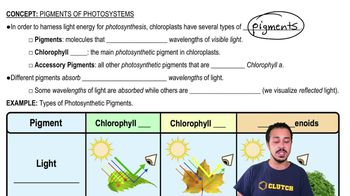
Photosynthesis

Photosynthesis is the process by which plants, algae, and some bacteria convert light energy into chemical energy, using carbon dioxide and water to produce glucose and oxygen. This process primarily occurs in the chloroplasts of plant cells and is essential for plant growth and energy production. Elevated CO2 levels can enhance photosynthesis, potentially increasing plant growth and altering water use efficiency.
Recommended video:
Guided course
05:58
Pigments of Photosynthesis

Transpiration

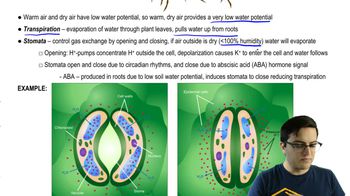
Transpiration is the process of water movement through a plant and its evaporation from aerial parts, such as leaves, stems, and flowers. It occurs mainly through stomata, which are small openings on the leaf surface. Transpiration helps in nutrient transport and temperature regulation but can lead to water loss, especially in dry habitats, making adaptations crucial for survival.
Recommended video:
Guided course
08:29
Water Potential in Soil and Air

Stomatal Adaptations

Stomatal adaptations are structural changes in plants that help regulate gas exchange and water loss. In dry habitats, plants may have stomata located in pits or on the undersides of leaves, or possess narrow, needle-like leaves to minimize water loss. These adaptations help maintain water balance while allowing CO2 uptake for photosynthesis, crucial for survival in arid environments.
Recommended video:
05:24
Adaptive Radiation
Related Practice
Textbook Question

Your friend claims that phloem always carries sugars down a plant. What, if anything, is wrong with that statement?

837
views
Textbook Question

Consider a tree that is 50 m tall and is transpiring roughly 90 liters of water each day. Approximately how many calories will the tree use to transpire this quantity of water?

928
views
Textbook Question

Salt is used to melt snow and keep roads clear during the winter in many cities. Land adjacent to de-iced roads often ends up with a high concentration of salt in the soil. Explain why plants growing near salted roads may appear wilted in the spring.

719
views
Textbook Question

Atmospheric CO₂ has been increasing rapidly since the late 1800s, largely due to human activities. Recall that CO₂ enters leaves through stomata and can then be used for photosynthesis. However, transpiration occurs as a result of water evaporating through stomata.

How have plants responded to elevated CO₂ levels?

What impact, if any, do you predict elevated CO₂ levels will have on the number of stomata in leaves and on the transpiration rate?

617
views
Textbook Question

Atmospheric CO₂ has been increasing rapidly since the late 1800s, largely due to human activities. Recall that CO₂ enters leaves through stomata and can then be used for photosynthesis. However, transpiration occurs as a result of water evaporating through stomata. How have plants responded to elevated CO₂ levels? The amount of water that evaporates from stomata over a period of time is referred to as stomatal conductance, which is determined largely by the number of stomata in a given area of leaf surface. Researchers obtained specimens from preserved collections and measured stomatal conductance in leaves from oak trees and pine trees that grew at various times under different CO₂ levels. The data are shown in the following graph. In general, is the maximum stomatal conductance rate in plants more or less than it was a century ago?

1073
views
Textbook Question

Atmospheric CO₂ has been increasing rapidly since the late 1800s, largely due to human activities. Recall that CO₂ enters leaves through stomata and can then be used for photosynthesis. However, transpiration occurs as a result of water evaporating through stomata.

How have plants responded to elevated CO₂ levels?

One prediction of global climate change is that there will be an increase in periods of drought in some regions. Given the data just presented, will plants be more or less likely to survive periods of drought as they are exposed to rising CO₂ levels?

727
views