Pearson+ LogoPearson+ Logo
Ch. 49 - An Introduction to Ecology
Freeman - Biological Science 8th Edition
Freeman8th EditionBiological ScienceISBN: 9780138276263Not the one you use?Change textbook
Chapter 49, Problem 8

Compare the distribution of the natural terrestrial biomes of eastern North America with the distribution of anthropogenic biomes.

Verified step by step guidance
1
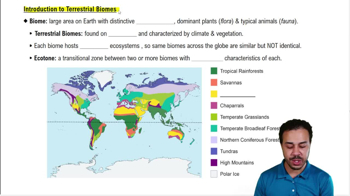
Identify and define the key terms: 'natural terrestrial biomes' refer to regions defined by their climate, geography, and the types of plants and animals that naturally occur there, while 'anthropogenic biomes' are areas where the natural landscapes have been significantly altered by human activities.
Research and list the major natural terrestrial biomes in eastern North America, such as temperate deciduous forests, coniferous forests, grasslands, and wetlands.
Investigate how human activities have transformed these natural biomes into anthropogenic biomes, focusing on urban areas, croplands, and managed forests.
Compare the original distribution of natural biomes with the current distribution of anthropogenic biomes, noting changes in land use, biodiversity, and ecosystem services.
Discuss the ecological implications of these transformations, including impacts on native species, introduction of invasive species, and changes in carbon and water cycles.

Verified video answer for a similar problem:

This video solution was recommended by our tutors as helpful for the problem above.
Video duration:
2m
Was this helpful?

Key Concepts

Here are the essential concepts you must grasp in order to answer the question correctly.

Natural Terrestrial Biomes

Natural terrestrial biomes are large ecological areas characterized by distinct climate conditions, flora, and fauna. In eastern North America, these biomes include temperate deciduous forests, grasslands, and wetlands, each supporting unique ecosystems. Understanding these biomes is essential for comparing them to anthropogenic biomes, as they represent the baseline of natural ecological diversity.
Recommended video:
Guided course
01:55
Introduction to Terrestrial Biomes

Anthropogenic Biomes

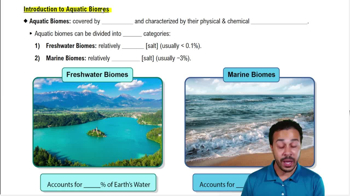
Anthropogenic biomes, or human-altered biomes, are regions where human activity has significantly modified the natural environment. Examples include urban areas, agricultural lands, and industrial zones. These biomes often exhibit reduced biodiversity and altered ecosystem functions compared to their natural counterparts, making it crucial to analyze their distribution in relation to natural biomes.
Recommended video:
Guided course
01:38
Introduction to Aquatic Biomes

Biome Distribution

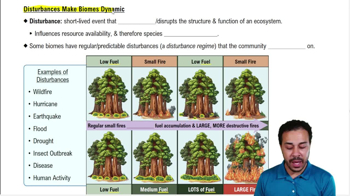
Biome distribution refers to the geographical spread of different biomes across a region, influenced by factors such as climate, soil type, and human impact. In eastern North America, the distribution of natural and anthropogenic biomes can reveal patterns of land use, conservation efforts, and ecological health. Analyzing these distributions helps in understanding the balance between natural ecosystems and human development.
Recommended video:
Guided course
02:09
Disturbances Make Biomes Dynamic
Related Practice
Textbook Question

Which of these statements about aquatic biomes is true? Select True or False for each statement.

T/F The ocean is so vast that it is not influenced by human impacts.

T/F Water depth, water flow, salinity, and nutrient availability are important abiotic factors in aquatic biomes.

T/F Once nutrients sink to the bottom of lakes, they are no longer available to organisms.

1137
views
Textbook Question

Explain how the open ocean is similar to the desert, and how it is not.

1100
views
Textbook Question

Temperate forest in China and temperate forest in North America are part of the same biome but are distinct ecosystems. Explain.

768
views
Textbook Question

Like Earth, Mars has seasons—its Northern Hemisphere experiences winter when its Southern Hemisphere experiences summer. Which statement is the best explanation for seasonality on Mars?

a. Mars is tilted on its axis.

b. Mars has an elliptical orbit that brings it closer to the Sun in summer than in winter.

c. Mars has a circular orbit and maintains a constant distance from the Sun.

d. The Southern Hemisphere of Mars consistently receives direct solar radiation.

1025
views
Textbook Question

Scientists predict that global climate change will cause a greater increase in average temperature at higher latitudes than in the tropics. This seems like good news since most of the world's biodiversity occurs in the tropics. However, recent data suggest that a smaller temperature change in the tropics will cause a larger physiological response in organisms there than the larger temperature change will in organisms in temperate areas. Based on what you have learned about thermal niches in this chapter, propose a hypothesis to explain this result.

1374
views
Textbook Question

<Image?

The red lionfish, Pterois volitans, has beautiful red stripes, streaming fins, and a fearless disposition, and it is deadly. Native to the Pacific Ocean, the red lionfish was first discovered on coral reefs in the Bahamas in 1985. The species has spread to over 3 million square kilometers of the western Atlantic and Gulf of Mexico. Lionfish have a voracious appetite for native fish, are armed with venomous spines, and have no natural predators in their new range.

Why are species like the lionfish considered 'invasive'?

a. They are found in areas where they are not native.

b. They were accidentally introduced by humans.

c. They spread aggressively and displace native species.

d. They are predators of other fish.

1063
views