Ch. 51 - Population Ecology
Freeman - Biological Science 8th Edition
Freeman8th EditionBiological ScienceISBN: 9780138276263Not the one you use?Change textbook
Chapter 51, Problem 9

When wild plant and animal populations are logged, fished, or hunted, only the oldest or largest individuals tend to be taken. Many of the commercially important species are long lived and are slow to begin reproducing. If harvesting is not regulated carefully and exploitation is intense, what impact does harvesting have on a population's age structure? How might harvesting affect the population's life table and growth rate?

Verified step by step guidance
1
Identify the impact on age structure: When only the oldest or largest individuals are harvested, the age structure of the population shifts towards younger individuals. This reduces the proportion of mature, reproducing individuals in the population.
Understand changes in the life table: The life table, which summarizes the survival and reproductive rates of individuals at each age, will show higher mortality rates for older age classes due to harvesting. This can lead to fewer individuals reaching reproductive age, altering the overall fecundity (birth rates) of the population.
Analyze the effect on population growth rate: With fewer mature individuals to reproduce, the growth rate of the population may decline. This is because the growth rate is dependent on birth rates minus death rates, and with harvesting, the death rate of reproductively mature individuals increases.
Consider genetic implications: Selective harvesting of the largest or oldest can also lead to a genetic shift in the population. Traits that might have contributed to longevity or size might become less common, potentially affecting the health and viability of future generations.
Evaluate the need for regulation: To prevent negative impacts such as population decline or genetic shifts, it is crucial to implement and enforce sustainable harvesting practices. Regulations might include limits on the size or age of individuals that can be harvested, or setting quotas on the number of individuals that can be taken from a population.

Verified video answer for a similar problem:

This video solution was recommended by our tutors as helpful for the problem above.
Video duration:
1m
Was this helpful?

Key Concepts

Here are the essential concepts you must grasp in order to answer the question correctly.

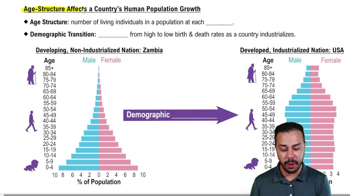
Population Age Structure

Population age structure refers to the distribution of individuals of different ages within a population. It is crucial for understanding reproductive potential and survival rates, as different age groups contribute differently to population dynamics. In the context of harvesting, targeting older individuals can skew this structure, leading to a decline in younger, reproductive individuals and potentially reducing the population's ability to sustain itself.
Recommended video:
Guided course
02:45
Age-Structure Affects a Country's Human Population Growth

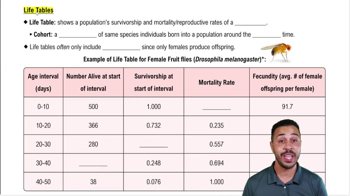
Life Table

A life table is a demographic tool that summarizes the survival and reproduction rates of individuals at various ages within a population. It provides insights into the life expectancy and reproductive output of different age classes. Harvesting practices that disproportionately remove older individuals can alter the life table, leading to decreased overall survival rates and potentially affecting future population growth.
Recommended video:

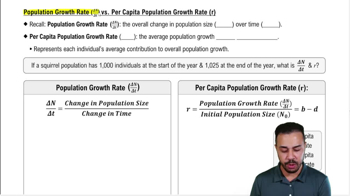
Population Growth Rate

Population growth rate is the rate at which the number of individuals in a population increases or decreases over time, influenced by birth rates, death rates, immigration, and emigration. Intense harvesting can reduce the growth rate by removing key reproductive individuals and disrupting age structure, ultimately leading to population decline. Understanding this concept is essential for managing sustainable harvesting practices.
Recommended video:
Guided course
03:26
Population Growth Rate vs. Per Capita Population Growth Rate
Related Practice
Textbook Question

Pose a hypothesis to explain why the human population has undergone especially rapid growth over the past 200 years. Describe two examples of density-dependent factors that limit human population growth. Is it possible that humans have surpassed Earth's carrying capacity?

798
views
Textbook Question

Explain why biologists want to maintain (a) 'habitat corridors' that connect populations in a metapopulation, and (b) unoccupied habitat that is appropriate for the species in question.

725
views
Textbook Question

Indicate what is correct and incorrect about this statement: If lizards want to survive during climate change, they can evolve new life-history traits.

862
views
Textbook Question

Burmese pythons (Python molurus bivittatus) are constricting snakes that can reach enormous sizes (up to 7 meters in length). They are native to Southeast Asia but were released into southern Florida from the pet trade. Many other snakes occur naturally in this area. Are the introduced pythons a problem? Burmese pythons were first found in the wetlands of Everglades National Park in the 1980s, but only rarely. The accompanying graph shows what happened next. Most of the data are derived from chance encounters of pythons on roads and intermittent search effort near roads (pythons are notoriously difficult to find). Despite the variability in search effort, what type of population growth best describes the trend in the data from 2000 to 2020? a. logistic b. exponential c. linear d. logarithmic


234
views
Textbook Question

<Image>

Burmese pythons (Python molurus bivittatus) are constricting snakes that can reach enormous sizes (up to 7 meters in length). They are native to Southeast Asia but were released into southern Florida from the pet trade. Many other snakes occur naturally in this area. Are the introduced pythons a problem?

Researchers hypothesize that the severe winter of 2010 caused the decline in the number of pythons encountered that year. Is cold weather typically a density-dependent factor or a density-independent factor? Explain the difference.

797
views