Ch. R - Review of Basic Concepts
Lial - College Algebra 13th Edition
Lial13th EditionCollege AlgebraISBN: 9780136881063Not the one you use?Change textbook
Chapter 1, Problem 19

Simplify each expression. See Example 1. (5x2y)(-3x3y4)

Verified step by step guidance
1
Identify the expression to simplify: \((5x^{2}y)(-3x^{3}y^{4})\).
Apply the multiplication property of exponents by multiplying the coefficients (numbers) together: multiply 5 and -3.
Use the product rule for exponents on the variable \(x\): when multiplying like bases, add the exponents, so \(x^{2} \times x^{3} = x^{2+3}\).
Use the product rule for exponents on the variable \(y\): multiply \(y\) (which is \(y^{1}\)) by \(y^{4}\), so \(y^{1} \times y^{4} = y^{1+4}\).
Combine the results from the coefficients and variables to write the simplified expression as a product of the new coefficient and the variables with their summed exponents.

Verified video answer for a similar problem:

This video solution was recommended by our tutors as helpful for the problem above.
Video duration:
2m
Was this helpful?

Key Concepts

Here are the essential concepts you must grasp in order to answer the question correctly.

Multiplication of Monomials

When multiplying monomials, multiply their coefficients (numerical parts) and then multiply variables by adding their exponents if the bases are the same. For example, (5x²)(-3x³) equals -15x⁵.
Recommended video:
03:42
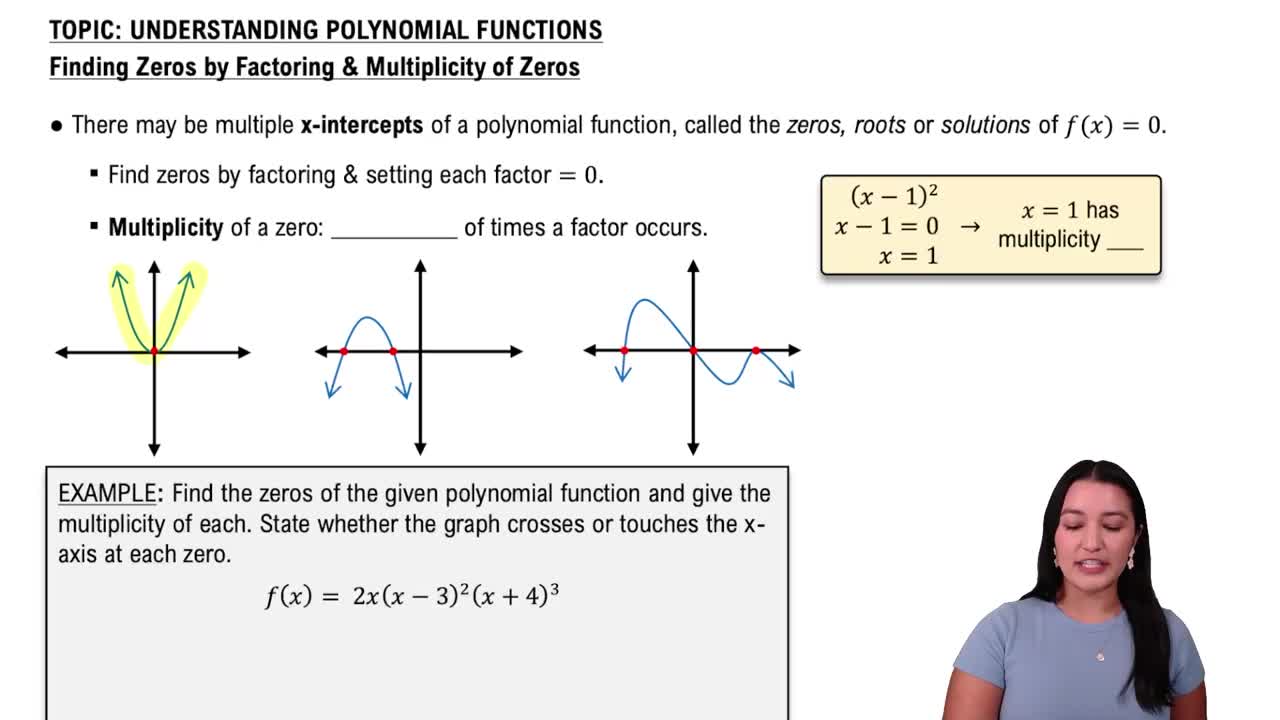
Finding Zeros & Their Multiplicity

Laws of Exponents

The laws of exponents state that when multiplying like bases, add their exponents. For instance, x² * x³ = x^(2+3) = x⁵. This rule applies to all variables with exponents in the expression.
Recommended video:
Guided course
04:06
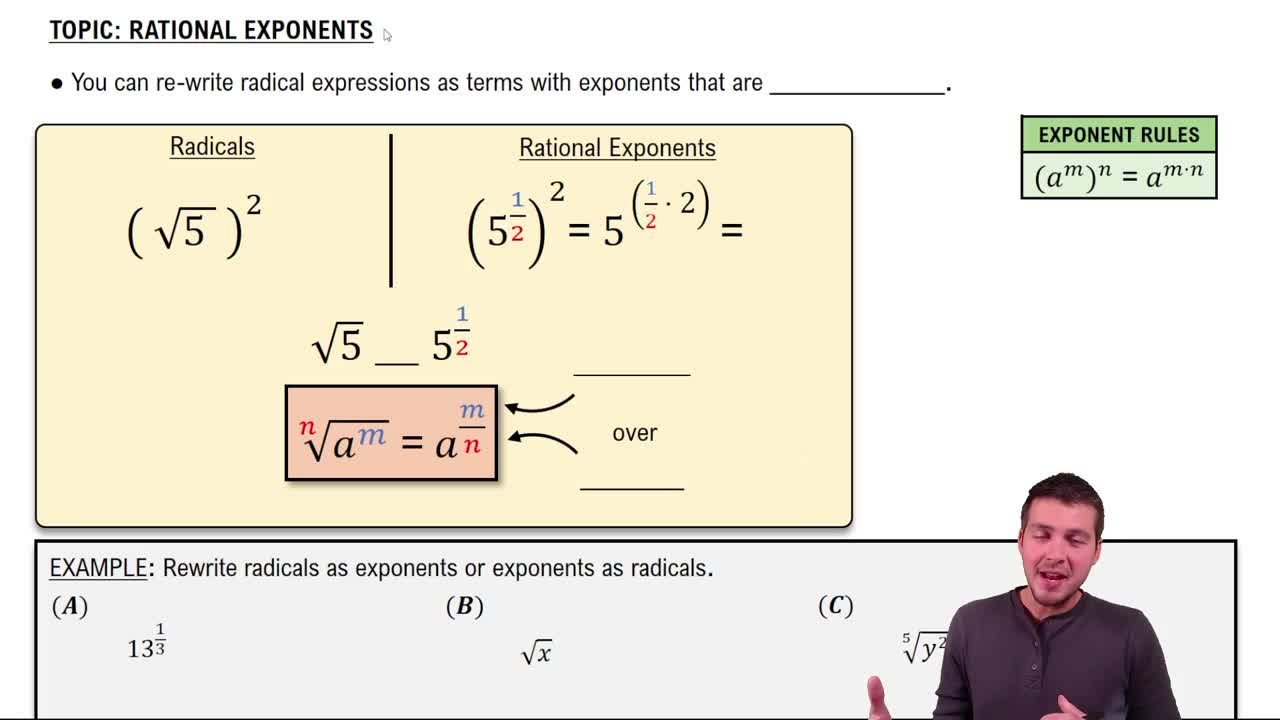
Rational Exponents

Combining Variables with Different Exponents

When variables with the same base but different exponents are multiplied, add the exponents to simplify. For example, y * y⁴ = y^(1+4) = y⁵. This helps in simplifying expressions involving multiple variables.
Recommended video:
Guided course
7:39
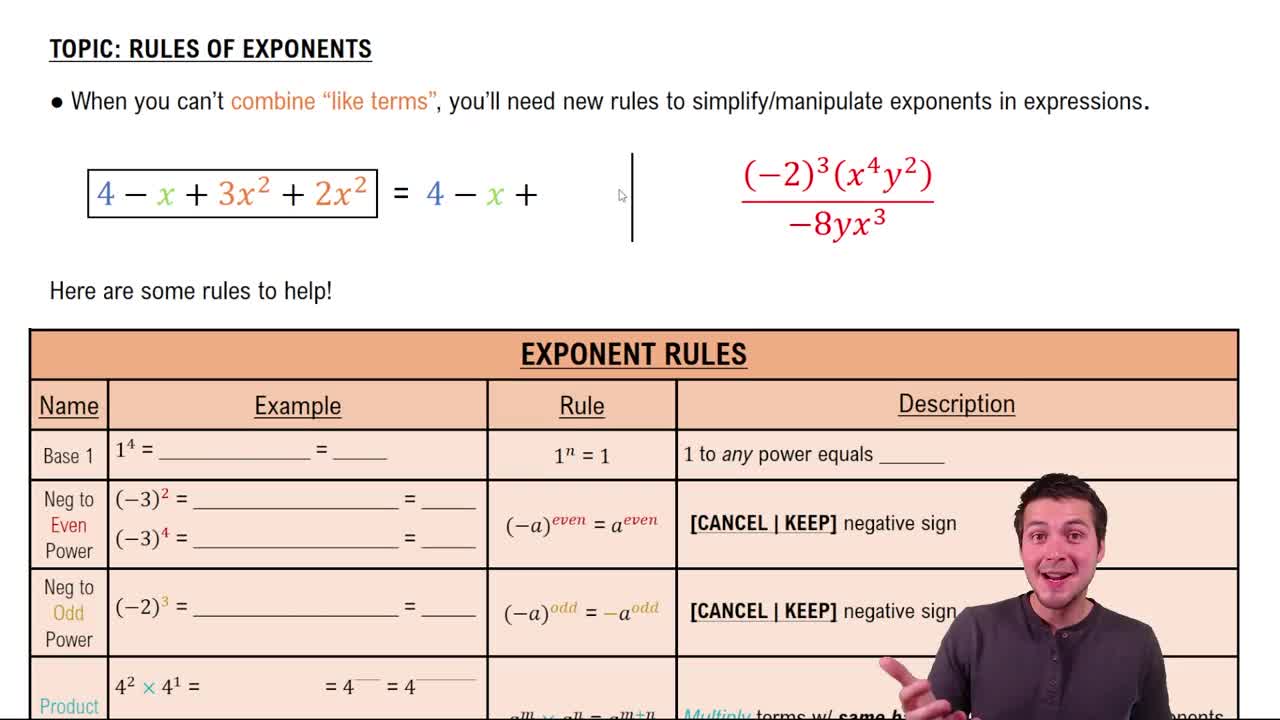
Introduction to Exponent Rules