Identify the type of function given. Since the function is ƒ(x) = \(\left\)(\(\frac{3}{2}\)\(\right\))^x, it is an exponential function with base \(\frac{3}{2}\), which is greater than 1, indicating exponential growth.
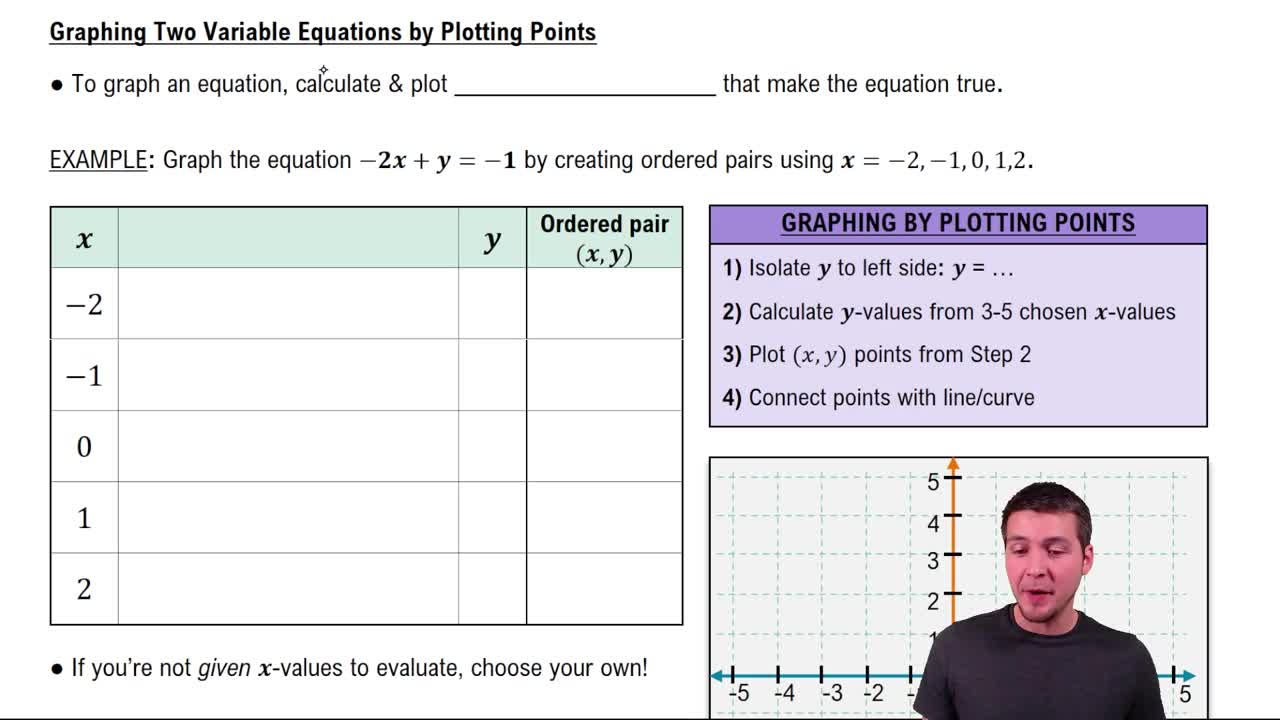
Create a table of values by choosing several values for x (for example, -2, -1, 0, 1, 2) and calculate the corresponding y-values using the function ƒ(x) = \(\left\)(\(\frac{3}{2}\)\(\right\))^x. Remember to apply the exponent rules carefully.
Plot the points from the table on the coordinate plane. Each point will have coordinates (x, ƒ(x)) based on your calculations.
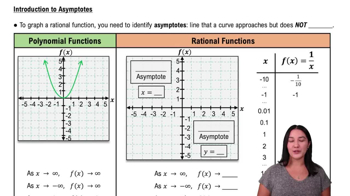
Draw a smooth curve through the plotted points, making sure the graph approaches the x-axis but never touches it (this is the horizontal asymptote y = 0), and that the curve increases as x increases because the base is greater than 1.
Label the graph with the function equation and the asymptote y = 0 to clearly show the behavior of the exponential function.
Verified video answer for a similar problem:
This video solution was recommended by our tutors as helpful for the problem above
Video duration:
5m
Play a video:
0 Comments
Key Concepts
Here are the essential concepts you must grasp in order to answer the question correctly.
Exponential Functions
An exponential function has the form f(x) = a^x, where the base a is a positive constant not equal to 1. It models growth or decay processes, and its graph shows rapid increase or decrease depending on the base. Understanding the behavior of exponential functions is essential for graphing them accurately.
To graph a function like f(x) = (3/2)^x, calculate and plot points by substituting various x-values and finding corresponding y-values. This helps visualize the curve and identify key features such as intercepts and growth trends. Plotting points is a fundamental step in graphing any function.
Graphing Equations of Two Variables by Plotting Points
Asymptotes and End Behavior
Exponential functions have a horizontal asymptote, usually the x-axis (y=0), which the graph approaches but never touches. Understanding this helps predict the function's behavior for large positive or negative x-values, showing how the function grows or decays without bound.