In Exercises 85–96, simplify each algebraic expression. 5(3x+4)−4
Verified step by step guidance
1
Distribute the 5 across the terms inside the parentheses. This means multiplying 5 by each term inside the parentheses: \(5 \cdot 3x\) and \(5 \cdot 4\).
Simplify the results of the distribution: \(5 \cdot 3x = 15x\) and \(5 \cdot 4 = 20\), so the expression becomes \(15x + 20 - 4\).
Combine like terms. In this case, combine the constants \(20\) and \(-4\) to simplify the expression further.
Write the simplified expression after combining the constants. The result will be in the form \(15x + c\), where \(c\) is the simplified constant term.
Verify that no further simplification is possible, ensuring the expression is in its simplest form.
Verified video answer for a similar problem:
This video solution was recommended by our tutors as helpful for the problem above
Video duration:
2m
Play a video:
0 Comments
Key Concepts
Here are the essential concepts you must grasp in order to answer the question correctly.
Distributive Property
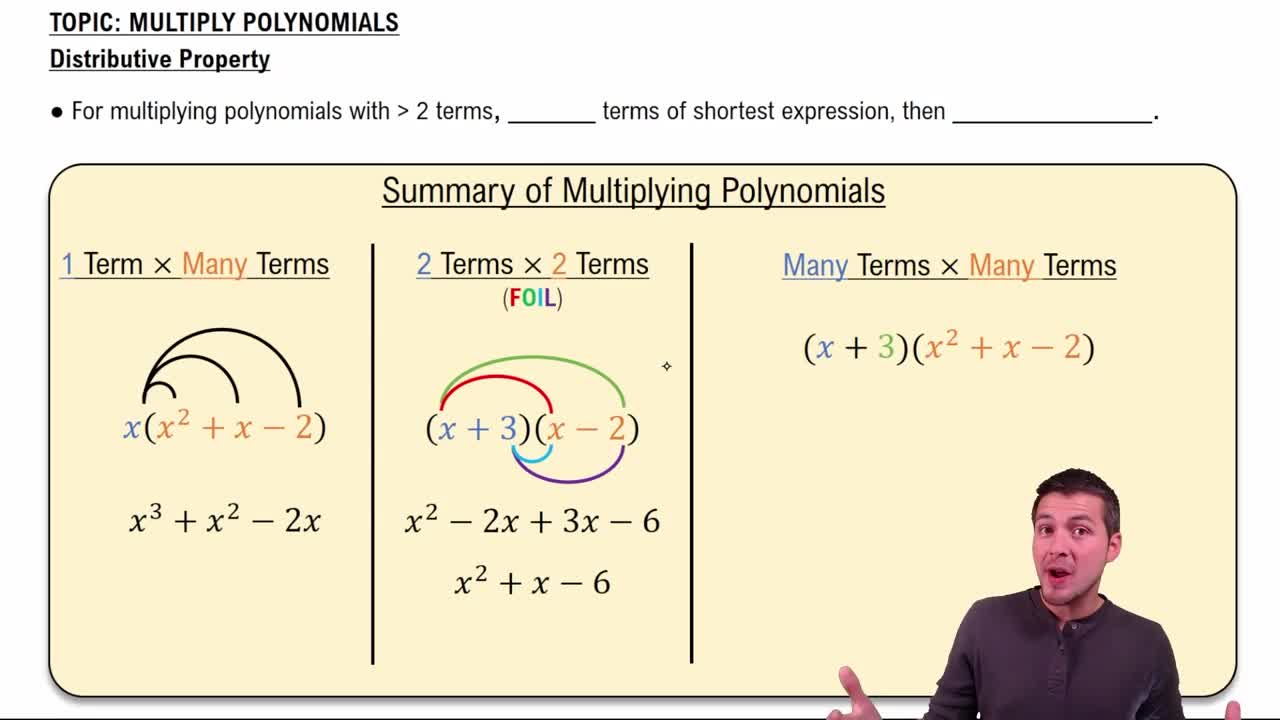
The Distributive Property states that a(b + c) = ab + ac. This property allows us to multiply a single term by each term within a parenthesis. In the given expression, applying the distributive property to 5(3x + 4) means multiplying 5 by both 3x and 4, which simplifies the expression.
Multiply Polynomials Using the Distributive Property
Combining Like Terms
Combining like terms involves simplifying an expression by adding or subtracting terms that have the same variable raised to the same power. After distributing, the expression may contain terms that can be combined, such as constants or terms with the same variable, to further simplify the expression.
The Order of Operations is a set of rules that dictates the sequence in which calculations should be performed to ensure consistent results. The acronym PEMDAS (Parentheses, Exponents, Multiplication and Division, Addition and Subtraction) helps remember this order. In simplifying the expression, following this order is crucial to correctly evaluate and combine terms.

 2:20 minutes
 Verified step by step guidance
 04:15
04:15