Identify the function to be graphed: \(ƒ(x) = 4^{x}\). This is an exponential function with base 4.
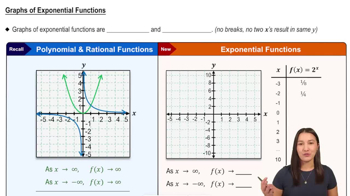
Create a table of values by choosing several values for \(x\) (for example, \(-2\), \(-1\), \$0\(, \)1\(, \)2\() and calculate the corresponding \)ƒ(x)\( values using the formula \)ƒ(x) = 4^{x}$.
Plot the points from the table on the coordinate plane, where the horizontal axis represents \(x\) and the vertical axis represents \(ƒ(x)\).
Draw a smooth curve through the plotted points, noting that the graph will pass through the point \((0,1)\) because any number to the zero power is 1, and the curve will increase rapidly as \(x\) becomes positive.
Label the graph and note key features such as the horizontal asymptote at \(y=0\) (the \(x\)-axis), since \$4^{x}\( approaches zero but never touches the axis as \)x$ approaches negative infinity.
Verified video answer for a similar problem:
This video solution was recommended by our tutors as helpful for the problem above
Video duration:
3m
Play a video:
Was this helpful?
Key Concepts
Here are the essential concepts you must grasp in order to answer the question correctly.
Exponential Functions
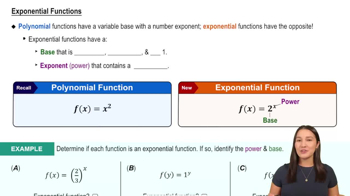
An exponential function has the form f(x) = a^x, where the base a is a positive constant not equal to 1. It models rapid growth or decay depending on the base. Understanding how the function behaves as x increases or decreases is essential for graphing.
Graphing involves plotting points by substituting values of x and calculating f(x). Key features include the y-intercept at (0,1), the horizontal asymptote (usually y=0), and the shape of the curve increasing or decreasing depending on the base.
The domain of exponential functions is all real numbers since any real x can be input. The range is positive real numbers (0, ∞) because exponential functions never produce zero or negative outputs, which affects the graph's position relative to the x-axis.