Graph each function. Give the domain and range. See Example 3. ƒ(x) = (1/3)^(x+2)
Verified step by step guidance
1
Step 1: Identify the base function. The given function is \( f(x) = \left(\frac{1}{3}\right)^{x+2} \). This is an exponential function with a base of \( \frac{1}{3} \).
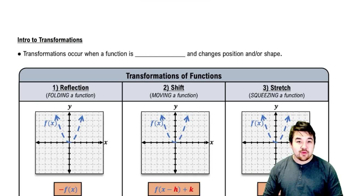
Step 2: Determine the transformation. The function \( f(x) = \left(\frac{1}{3}\right)^{x+2} \) can be rewritten as \( f(x) = \left(\frac{1}{3}\right)^x \cdot \left(\frac{1}{3}\right)^2 \). This indicates a horizontal shift to the left by 2 units.
Step 3: Graph the base function. Start by graphing \( g(x) = \left(\frac{1}{3}\right)^x \), which is a decreasing exponential function passing through the point (0,1).
Step 4: Apply the transformation. Shift the graph of \( g(x) = \left(\frac{1}{3}\right)^x \) 2 units to the left to obtain the graph of \( f(x) = \left(\frac{1}{3}\right)^{x+2} \).
Step 5: Determine the domain and range. The domain of \( f(x) = \left(\frac{1}{3}\right)^{x+2} \) is all real numbers \( (-\infty, \infty) \), and the range is \( (0, \infty) \) since exponential functions never reach zero.
Verified video answer for a similar problem:
This video solution was recommended by our tutors as helpful for the problem above
Video duration:
6m
Play a video:
Was this helpful?
Key Concepts
Here are the essential concepts you must grasp in order to answer the question correctly.
Graphing Exponential Functions
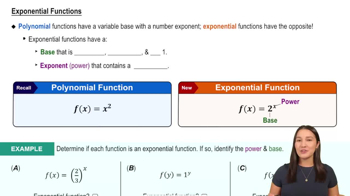
Exponential functions, such as ƒ(x) = (1/3)^(x+2), are characterized by a constant base raised to a variable exponent. When graphing these functions, the base determines the growth or decay rate. In this case, since the base is less than 1, the function represents exponential decay, which approaches zero but never touches the x-axis.
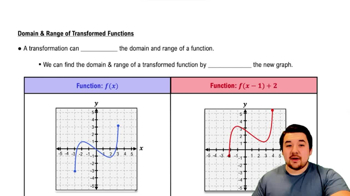
The domain of a function refers to the set of all possible input values (x-values) for which the function is defined. For the exponential function ƒ(x) = (1/3)^(x+2), the domain is all real numbers, as there are no restrictions on the values that x can take. This means you can input any real number into the function.
The range of a function is the set of all possible output values (y-values) that the function can produce. For the function ƒ(x) = (1/3)^(x+2), the range is (0, ∞), meaning the function outputs positive values that approach zero but never reach it. This reflects the behavior of exponential decay, where the function decreases without bound but remains positive.