Determine whether each statement is true or false. If false, explain why. A polynomial function having degree 6 and only real coefficients may have no real zeros.
Ch. 3 - Polynomial and Rational Functions

Chapter 4, Problem 3
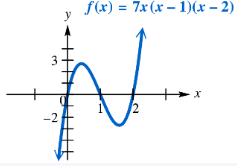
Use the graph to solve each equation or inequality. Use interval notation where appropriate. 7x(x - 1)(x - 2) = 0

Verified step by step guidance1
Identify the roots of the equation from the given polynomial \$7x(x - 1)(x - 2) = 0\(. The roots are the values of \)x\( that make the equation equal to zero. Set each factor equal to zero: \)x = 0$, \(x - 1 = 0 \Rightarrow x = 1\), and \(x - 2 = 0 \Rightarrow x = 2\).
These roots divide the number line into four intervals: \((-\infty, 0)\), \((0, 1)\), \((1, 2)\), and \((2, \infty)\). We will analyze the sign of the polynomial on each interval to solve inequalities.
To solve the equation \$7x(x - 1)(x - 2) = 0\(, note that the solutions are exactly the roots found: \)x = 0\(, \)x = 1\(, and \)x = 2$.
To solve inequalities such as \$7x(x - 1)(x - 2) > 0\( or \)7x(x - 1)(x - 2) < 0$, test a sample point from each interval in the polynomial to determine if the polynomial is positive or negative in that interval.
Use the graph to confirm the sign of the polynomial on each interval: where the graph is above the \(x\)-axis, the polynomial is positive; where it is below, the polynomial is negative. Then write the solution in interval notation based on the inequality.

Verified video answer for a similar problem:
This video solution was recommended by our tutors as helpful for the problem above.
Video duration:
3mWas this helpful?
Key Concepts
Here are the essential concepts you must grasp in order to answer the question correctly.
Roots of a Polynomial
The roots of a polynomial are the values of x where the polynomial equals zero. For the equation 7x(x - 1)(x - 2) = 0, the roots are x = 0, x = 1, and x = 2. These points correspond to where the graph intersects the x-axis.
Recommended video:
Imaginary Roots with the Square Root Property
Solving Polynomial Inequalities Using Graphs
To solve inequalities involving polynomials, analyze the graph to determine where the function is above or below the x-axis. For example, to solve 7x(x - 1)(x - 2) > 0, find intervals where the graph is positive (above the x-axis). Use interval notation to express these solution sets.
Recommended video:
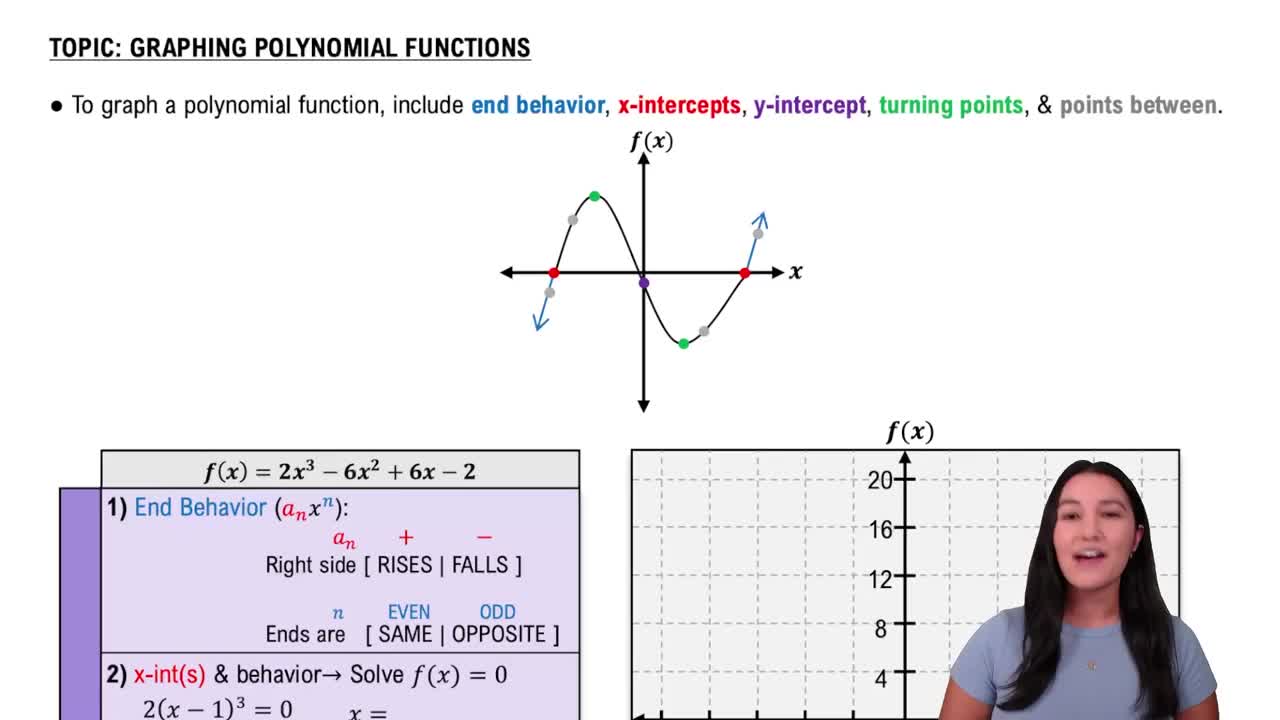
Graphing Polynomial Functions
Interval Notation
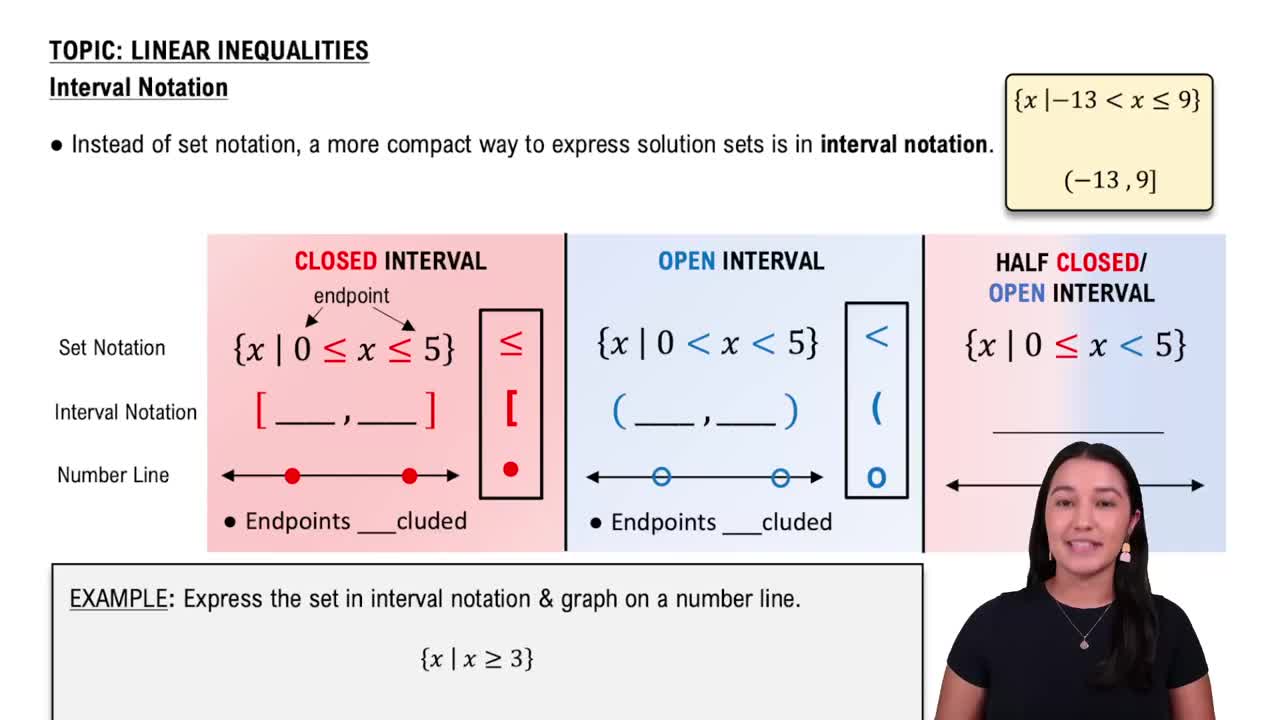
Interval notation is a concise way to represent sets of numbers between two endpoints. Parentheses () indicate that endpoints are not included, while brackets [] mean they are included. This notation is used to express solution sets for equations and inequalities clearly.
Recommended video:
Interval Notation
Related Practice
Textbook Question
704
views
Textbook Question
Use the graph to solve each equation or inequality. Use interval notation where appropriate. 7x(x - 1)(x - 2) > 0
492
views
Textbook Question
Graph each quadratic function. Give the vertex, axis, x-intercepts, y-intercept, domain, range, and largest open intervals of the domain over which each function is increasing or decreasing. ƒ(x)=-3x2-12x-1
1571
views
Textbook Question
Fill in the blank(s) to correctly complete each sentence. The highest point on the graph of a parabola that opens down is the ____ of the parabola.
897
views
Textbook Question
Use the graph to solve each equation or inequality. Use interval notation where appropriate. 7x(x - 1)(x - 2) < 0
528
views
Textbook Question
Determine whether each statement is true or false. If false, explain why. For ƒ(x)=(x+2)4(x-3), the number 2 is a zero of multiplicity 4.
502
views
1
rank