In Exercises 59–70, evaluate each exponential expression. - (-1/2)^3
Verified step by step guidance
1
Identify the base and the exponent in the expression \((-\frac{1}{2})^3\).
Recognize that the base is \(-\frac{1}{2}\) and the exponent is 3, which means you will multiply \(-\frac{1}{2}\) by itself three times.
Write the expression as \((-\frac{1}{2}) \times (-\frac{1}{2}) \times (-\frac{1}{2})\).
Multiply the first two terms: \((-\frac{1}{2}) \times (-\frac{1}{2})\). Remember that multiplying two negative numbers results in a positive number.
Multiply the result from the previous step by the remaining \(-\frac{1}{2}\) to complete the evaluation.
Verified video answer for a similar problem:
This video solution was recommended by our tutors as helpful for the problem above
Video duration:
2m
Play a video:
0 Comments
Key Concepts
Here are the essential concepts you must grasp in order to answer the question correctly.
Exponential Expressions
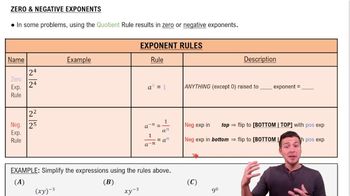
Exponential expressions involve a base raised to a power, indicating how many times the base is multiplied by itself. In the expression (-1/2)^3, the base is -1/2 and the exponent is 3, meaning we multiply -1/2 by itself three times.
When dealing with negative bases, the sign of the result depends on whether the exponent is odd or even. An odd exponent, like 3 in this case, will yield a negative result, while an even exponent would result in a positive value.
To calculate a power, multiply the base by itself as many times as indicated by the exponent. For (-1/2)^3, this involves computing (-1/2) * (-1/2) * (-1/2), which requires careful handling of both the numerators and denominators.

 2:33 minutes
 Verified step by step guidance
 6:39
6:39