Simplify each expression. Write answers without negative exponents. Assume all variables represent nonzero real numbers. x12/x8
Table of contents
- 0. Review of Algebra4h 18m
- 1. Equations & Inequalities3h 18m
- 2. Graphs of Equations1h 43m
- 3. Functions2h 17m
- 4. Polynomial Functions1h 44m
- 5. Rational Functions1h 23m
- 6. Exponential & Logarithmic Functions2h 28m
- 7. Systems of Equations & Matrices4h 5m
- 8. Conic Sections2h 23m
- 9. Sequences, Series, & Induction1h 22m
- 10. Combinatorics & Probability1h 45m
0. Review of Algebra
Exponents
Problem 4
Textbook Question
Determine whether each statement is true or false. If false, correct the right side of the equation. 5-2 = 1/52
Verified step by step guidance1
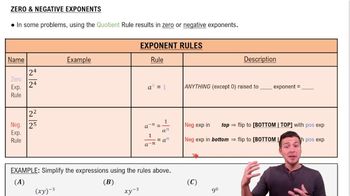
Recall the rule for negative exponents: for any nonzero number \(a\) and integer \(n\), \(a^{-n} = \frac{1}{a^n}\).
Apply this rule to the expression \$5^{-2}\(, which means \)5^{-2} = \frac{1}{5^2}$.
Compare the given equation \$5^{-2} = \frac{1}{5^2}$ with the rule and see if they match.
Since the right side of the equation is \(\frac{1}{5^2}\), which matches the rule, the statement is true.
Therefore, no correction is needed because the equation correctly represents the negative exponent.
Verified video answer for a similar problem:This video solution was recommended by our tutors as helpful for the problem above
Video duration:
1mPlay a video:
Was this helpful?
Key Concepts
Here are the essential concepts you must grasp in order to answer the question correctly.
Negative Exponents
A negative exponent indicates the reciprocal of the base raised to the corresponding positive exponent. For example, a^{-n} = 1/a^n, where a ≠ 0. This rule helps rewrite expressions with negative powers into fractions.
Recommended video:
Guided course
Zero and Negative Rules
Exponentiation Rules
Exponentiation rules govern how to manipulate powers, including product, quotient, and power of a power rules. Understanding these rules ensures correct simplification and transformation of expressions involving exponents.
Recommended video:
Guided course
Cramer's Rule - 2 Equations with 2 Unknowns
Evaluating and Comparing Expressions
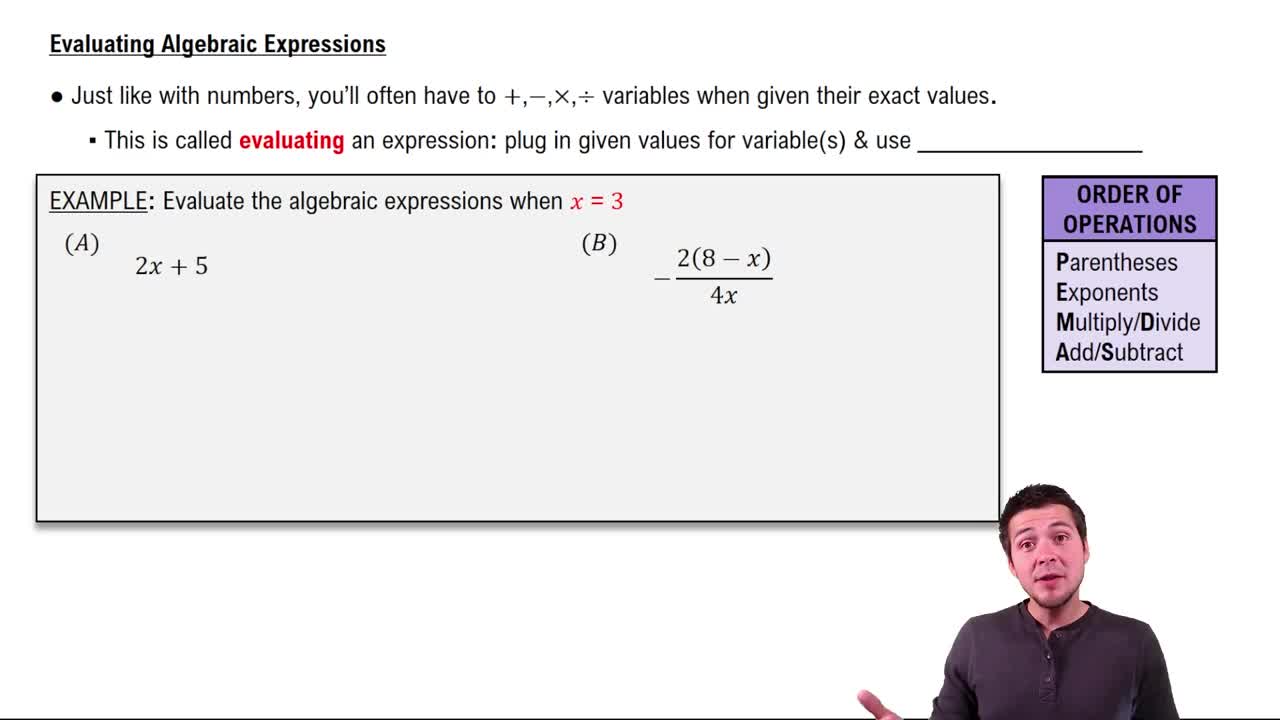
Evaluating expressions means calculating their numerical value or rewriting them in equivalent forms. Comparing expressions involves checking if two expressions represent the same value, which is essential for determining the truth of equations.
Recommended video:
Guided course
Evaluating Algebraic Expressions
Watch next
Master Introduction to Exponent Rules with a bite sized video explanation from Patrick
Start learningRelated Videos
Related Practice
Textbook Question
565
views