Back
Back
Problem 13
Write an equation for each line described. Give answers in standard form for Exercises 11–20 and in slope-intercept form (if possible) for Exercises 21–32. through (-5,4), m = -3/2
Problem 15
Write an equation for each line described. Give answers in standard form for Exercises 11–20 and in slope-intercept form (if possible) for Exercises 21–32. through (-8,4), undefined slope
Problem 17
Write an equation for each line described. Give answers in standard form for Exercises 11–20 and in slope-intercept form (if possible) for Exercises 21–32. through (5,-8), m = 0
Problem 19
Write an equation for each line described. Give answers in standard form for Exercises 11–20 and in slope-intercept form (if possible) for Exercises 21–32. through (-1,3), and (3,4)
Problem 23
Write an equation for each line described. Give answers in standard form for Exercises 11–20 and in slope-intercept form (if possible) for Exercises 21–32. vertical, through (-6, 4)
Problem 25
Write an equation for each line described. Give answers in standard form for Exercises 11–20 and in slope-intercept form (if possible) for Exercises 21–32. horizontal, through (-7,4)
Problem 27
Write an equation for each line described. Give answers in standard form for Exercises 11–20 and in slope-intercept form (if possible) for Exercises 21–32. m=5, b=15
Problem 29
Write an equation for each line described. Give answers in standard form for Exercises 11–20 and in slope-intercept form (if possible) for Exercises 21–32. through (-2,5) having slope -4
Problem 31
Write an equation for each line described. Give answers in standard form for Exercises 11–20 and in slope-intercept form (if possible) for Exercises 21–32. slope 0, y-intercept (0, 3/2)
Problem 37
Find the slope and y-intercept of each line, and graph it. 4x-y =7
Problem 39
Find the slope and y-intercept of each line, and graph it. 4y = -3x
Problem 41
Find the slope and y-intercept of each line, and graph it. x+2y = -4
Problem 45
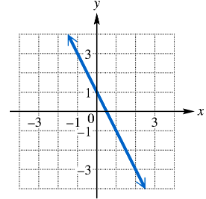
The graph of a linear function f is shown. (a) Identify the slope, y-intercept, and x-intercept. (b) Write an equation that defines f.
Problem 47
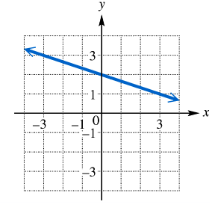
The graph of a linear function f is shown. (a) Identify the slope, y-intercept, and x-intercept. (b) Write an equation that defines f.
Problem 49
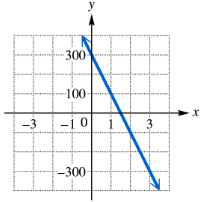
The graph of a linear function f is shown. (a) Identify the slope, y-intercept, and x-intercept. (b) Write an equation that defines f.
Problem 51
Write an equation (a) in standard form and (b) in slope-intercept form for each line described. through (-1, 4), parallel to x+3y=5
Problem 53
Write an equation (a) in standard form and (b) in slope-intercept form for each line described. through (1, 6), perpendicular to 3x+5y=1
Problem 55
Write an equation (a) in standard form and (b) in slope-intercept form for each line described. through (4, 1), parallel to y=-5
Problem 56
Write an equation (a) in standard form and (b) in slope-intercept form for each line described. through (-2, -2), parallel to y=3
Problem 68
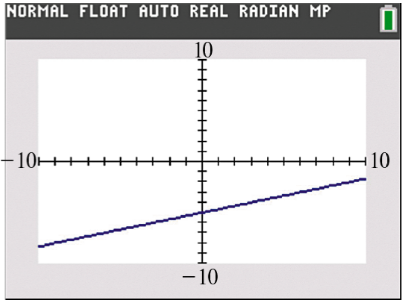
Solve each problem. A graph of y=ƒ(x) is shown in the standard viewing window. Which is the only value of x that could possibly be the solution of the equation ƒ(x) =0? A. -15 B. 0 C. 5 D. 15
Problem 70
Use a graphing calculator to solve each linear equation. 7x-2x+ 4-5=3x+1
Problem 71
Use a graphing calculator to solve each linear equation. 3(2x+1) - 2 (x-2) =5
Problem 75
If three distinct points A, B, and C in a plane are such that the slopes of nonvertical line segments AB, AC, and BC are equal, then A, B, and C are collinear. Otherwise, they are not. Use this fact to determine whether the three points given are collinear. (-1, 4), (-2, -1), (1, 14)
Problem 1
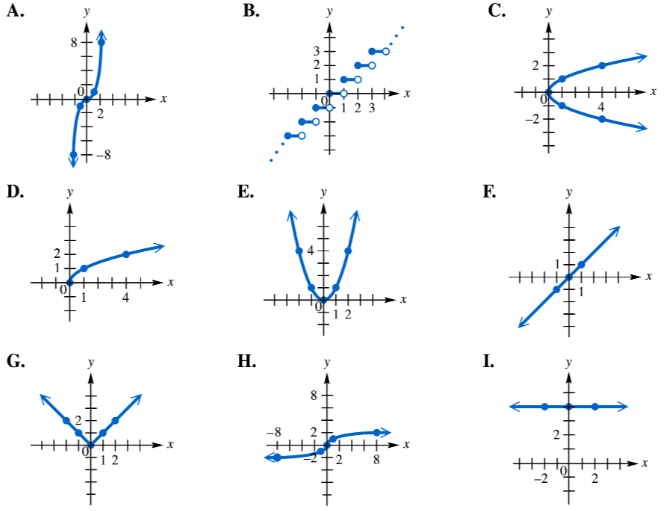
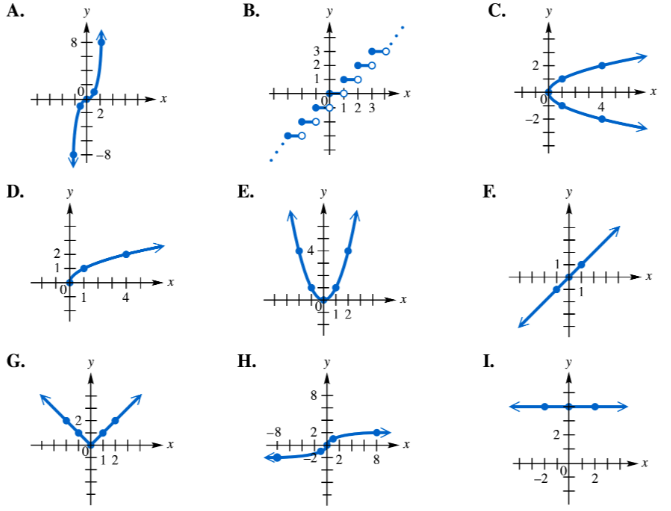
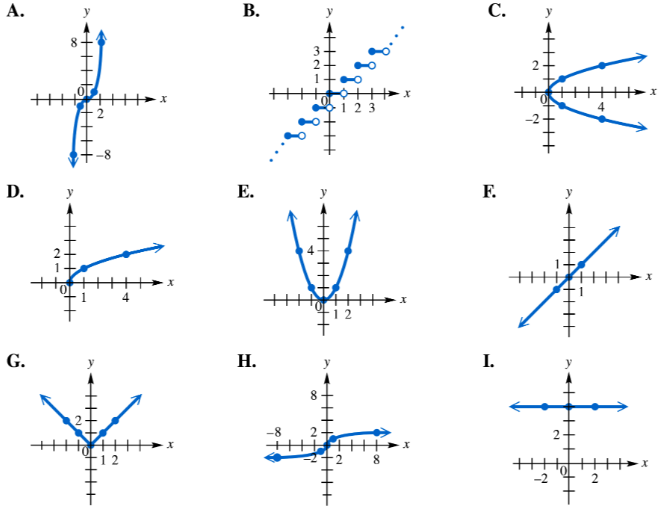
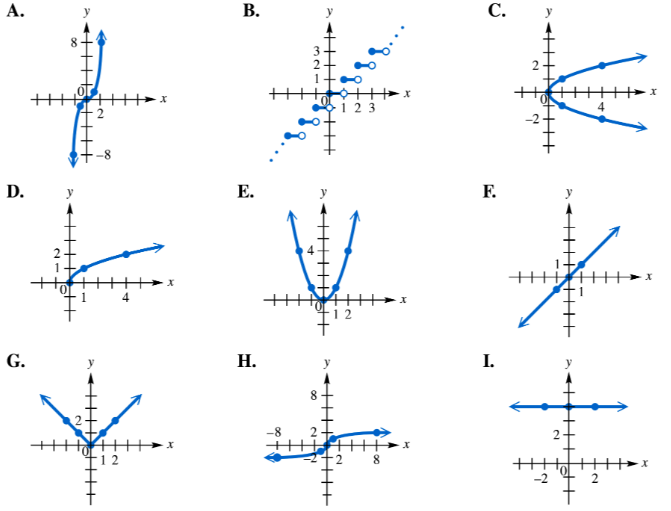
To answer each question, refer to the following basic graphs. Which one is the graph of ƒ(x)=x2? What is its domain?
Problem 3
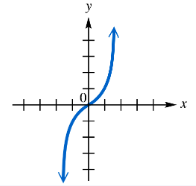
To answer each question, refer to the following basic graphs. Which one is the graph of ƒ(x)=x3? What is its range?
Problem 6
To answer each question, refer to the following basic graphs. Which one is the graph of ƒ(x)=|x|? What is the function value when x=1.5?
Problem 7
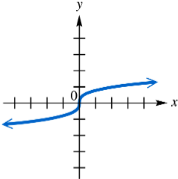
To answer each question, refer to the following basic graphs. Which one is the graph of ƒ(x)=∛x? Is there any open interval over which the function is decreasing?
Problem 11
Determine the intervals of the domain over which each function is continuous.
Problem 12
Determine the intervals of the domain over which each function is continuous.
Problem 13
Determine the intervals of the domain over which each function is continuous.