What is the kinetic energy and velocity of the aluminum sphere in Problem 1.4 at the moment it hits the ground? (Assume that energy is conserved during the fall and that 100% of the sphere's initial potential energy is converted to kinetic energy by the time impact occurs.)
Ch.1 - Introduction: Matter, Energy, and Measurement
Brown14th EditionChemistry: The Central ScienceISBN: 9780134414232Not the one you use?Change textbook
Chapter 1, Problem 27b
Two positively charged particles are first brought close together and then released. Once released, the repulsion between particles causes them to move away from each other. (b) Does the potential energy of the two particles prior to release increase or decrease as the distance between them is increased.
Verified step by step guidance1
insert step 1> Identify the type of interaction between the two particles. Since both particles are positively charged, they repel each other due to electrostatic forces.
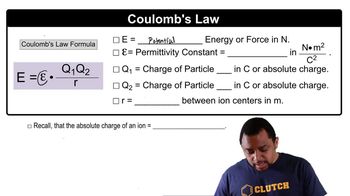
insert step 2> Recall the concept of potential energy in the context of electrostatic forces. The potential energy between two charged particles is given by the formula: U = k * (q1 * q2) / r, where U is the potential energy, k is Coulomb's constant, q1 and q2 are the charges, and r is the distance between the charges.
insert step 3> Analyze how the potential energy changes with distance. Notice that the potential energy is inversely proportional to the distance (r) between the charges.
insert step 4> Consider the scenario where the distance between the particles increases. As r increases, the value of the potential energy U decreases because the charges are moving further apart.
insert step 5> Conclude that as the distance between the two positively charged particles increases, the potential energy decreases. This is because the repulsive force does work on the particles, converting potential energy into kinetic energy as they move apart.

Verified video answer for a similar problem:
This video solution was recommended by our tutors as helpful for the problem above.
Video duration:
3mWas this helpful?
Key Concepts
Here are the essential concepts you must grasp in order to answer the question correctly.
Coulomb's Law
Coulomb's Law describes the electrostatic force between two charged particles. It states that the force is directly proportional to the product of the charges and inversely proportional to the square of the distance between them. For two positively charged particles, this means that as they are brought closer together, the repulsive force increases, which affects their potential energy.
Recommended video:
Guided course
Coulomb's Law Concept 2
Potential Energy in Electric Fields
The potential energy of charged particles in an electric field is related to their positions relative to each other. For two like charges, potential energy increases as the distance between them decreases due to the work done against the electric force to separate them. Conversely, as the distance increases, the potential energy decreases, indicating that the system becomes more stable.
Recommended video:
Guided course
Kinetic & Potential Energy
Energy Conservation
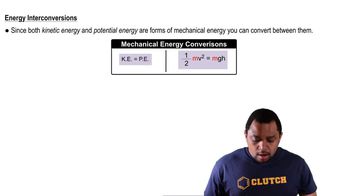
The principle of energy conservation states that energy cannot be created or destroyed, only transformed from one form to another. In the context of the two charged particles, as they move apart due to repulsion, the potential energy decreases, and this energy is converted into kinetic energy as the particles accelerate away from each other.
Recommended video:
Guided course
Law of Conservation of Mass
Related Practice
Textbook Question
424
views
Textbook Question
For each of the following processes, does the potential energy of the object(s) increase or decrease? (b) Water is pumped from ground level to the reservoir of a water tower 30 m above the ground.
455
views
Textbook Question
Convert the following expressions into exponential notation: (a) 3 terameters (tm)
633
views
Textbook Question
(a) Calculate the kinetic energy, in joules, of a 15-g bullet moving at 120 m/s.
696
views
Textbook Question
Two positively charged particles are first brought close together and then released. Once released, the repulsion between particles causes them to move away from each other. (a) This is an example of potential energy being converted into what form of energy?
526
views
1
rank