Pearson+ LogoPearson+ Logo
Ch.10 Acids and Bases and Equilibrium
Timberlake - Chemistry: An Introduction to General, Organic, and Biological Chemistry 13th Edition
Timberlake13th EditionChemistry: An Introduction to General, Organic, and Biological ChemistryISBN: 9780134421353Not the one you use?Change textbook
Chapter 10, Problem 56

Which of the following represents a buffer system? Explain.
a. H3PO3
b. NaNO3
c. HC2H3O2 and NaC2H3O2
d. HCl and NaOH

Verified step by step guidance
1
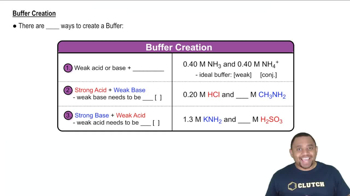
Understand the concept of a buffer system: A buffer system is a solution that resists changes in pH when small amounts of acid or base are added. It typically consists of a weak acid and its conjugate base, or a weak base and its conjugate acid.
Analyze option a (H₃PO₃): H₃PO₃ is a weak acid, but it is not paired with its conjugate base. Therefore, it does not form a buffer system.
Analyze option b (NaNO₃): NaNO₃ is a salt of a strong acid (HNO₃) and a strong base (NaOH). It does not contain a weak acid or weak base, so it cannot act as a buffer system.
Analyze option c (HC₂H₃O₂ and NaC₂H₃O₂): HC₂H₃O₂ (acetic acid) is a weak acid, and NaC₂H₃O₂ (sodium acetate) is its conjugate base. Together, they form a buffer system because they can resist changes in pH by neutralizing added acids or bases.
Analyze option d (HCl and NaOH): HCl is a strong acid, and NaOH is a strong base. A strong acid and strong base do not form a buffer system because they completely dissociate in water and do not provide the weak acid/conjugate base pair needed for buffering.

Verified video answer for a similar problem:

This video solution was recommended by our tutors as helpful for the problem above.
Video duration:
5m
Was this helpful?

Key Concepts

Here are the essential concepts you must grasp in order to answer the question correctly.

Buffer System

A buffer system is a solution that resists changes in pH when small amounts of acid or base are added. It typically consists of a weak acid and its conjugate base or a weak base and its conjugate acid. This equilibrium allows the buffer to neutralize added acids or bases, maintaining a relatively stable pH.
Recommended video:
Guided course
03:04
Buffer Creation Methods

Weak Acid and Conjugate Base

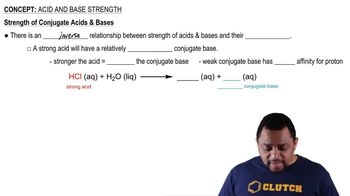
A weak acid is an acid that partially dissociates in solution, meaning it does not completely ionize. Its conjugate base is formed when the weak acid donates a proton (H⁺). Together, they can effectively moderate pH changes, making them essential components of buffer systems.
Recommended video:
Guided course
00:50
Acid and Base Strength Concept 3

Strong Acid and Strong Base

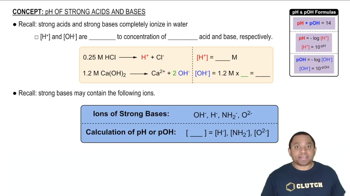
Strong acids, like HCl, and strong bases, like NaOH, completely dissociate in solution, leading to significant changes in pH. Unlike buffer systems, they do not have the capacity to resist pH changes when acids or bases are added, as they do not establish an equilibrium with a weak counterpart.
Recommended video:
Guided course
02:39
Strong Acids and Bases