
Pearson+ LogoPearson+ Logo
Ch.8 Gases
Timberlake - Chemistry: An Introduction to General, Organic, and Biological Chemistry 13th Edition
Timberlake13th EditionChemistry: An Introduction to General, Organic, and Biological ChemistryISBN: 9780134421353Not the one you use?Change textbook
Chapter 8, Problem 64b

Two flasks of equal volume and at the same temperature contain different gases. One flask contains 5.0 g of O2 and the other flask contains 5.0 g of H2. Is each of the following statements true or false? Explain.
b. The pressures in the flasks are the same.

Verified step by step guidance
1
Step 1: Recall the Ideal Gas Law, which is expressed as PV = nRT. Here, P is pressure, V is volume, n is the number of moles, R is the gas constant, and T is temperature. Since the flasks have the same volume (V) and are at the same temperature (T), the pressure (P) depends on the number of moles (n) of gas in each flask.
Step 2: Calculate the number of moles of O₂ in the first flask. Use the formula n = rac{m}{M}, where m is the mass of the gas and M is its molar mass. For O₂, the molar mass is approximately 32.00 g/mol. Substitute m = 5.0 g and M = 32.00 g/mol to find the moles of O₂.
Step 3: Calculate the number of moles of H₂ in the second flask using the same formula, n = rac{m}{M}. For H₂, the molar mass is approximately 2.016 g/mol. Substitute m = 5.0 g and M = 2.016 g/mol to find the moles of H₂.
Step 4: Compare the number of moles of O₂ and H₂. Since the pressure in each flask depends on the number of moles (n) and the number of moles is different for O₂ and H₂ due to their differing molar masses, the pressures in the flasks will not be the same.
Step 5: Conclude that the statement 'The pressures in the flasks are the same' is false, and explain that the difference arises because the number of moles of gas in each flask is different, even though the masses of the gases are the same.

Verified video answer for a similar problem:

This video solution was recommended by our tutors as helpful for the problem above.
Video duration:
3m
Was this helpful?

Key Concepts

Here are the essential concepts you must grasp in order to answer the question correctly.

Ideal Gas Law

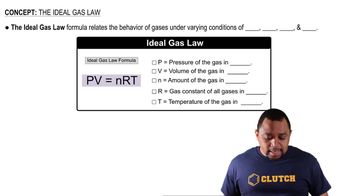
The Ideal Gas Law is a fundamental equation in chemistry that relates the pressure, volume, temperature, and number of moles of a gas. It is expressed as PV = nRT, where P is pressure, V is volume, n is the number of moles, R is the ideal gas constant, and T is temperature. This law helps in understanding how gases behave under different conditions and is essential for analyzing the scenario presented in the question.
Recommended video:
Guided course
01:15
The Ideal Gas Law Concept 1

Molar Mass

Molar mass is the mass of one mole of a substance, typically expressed in grams per mole (g/mol). Different gases have different molar masses, which affects their behavior in a given volume and temperature. In the context of the question, the molar masses of O₂ and H₂ are crucial for determining the number of moles present in each flask, which directly influences the pressure exerted by each gas.
Recommended video:
Guided course
01:10
Calculating Molar Mass

Gas Pressure

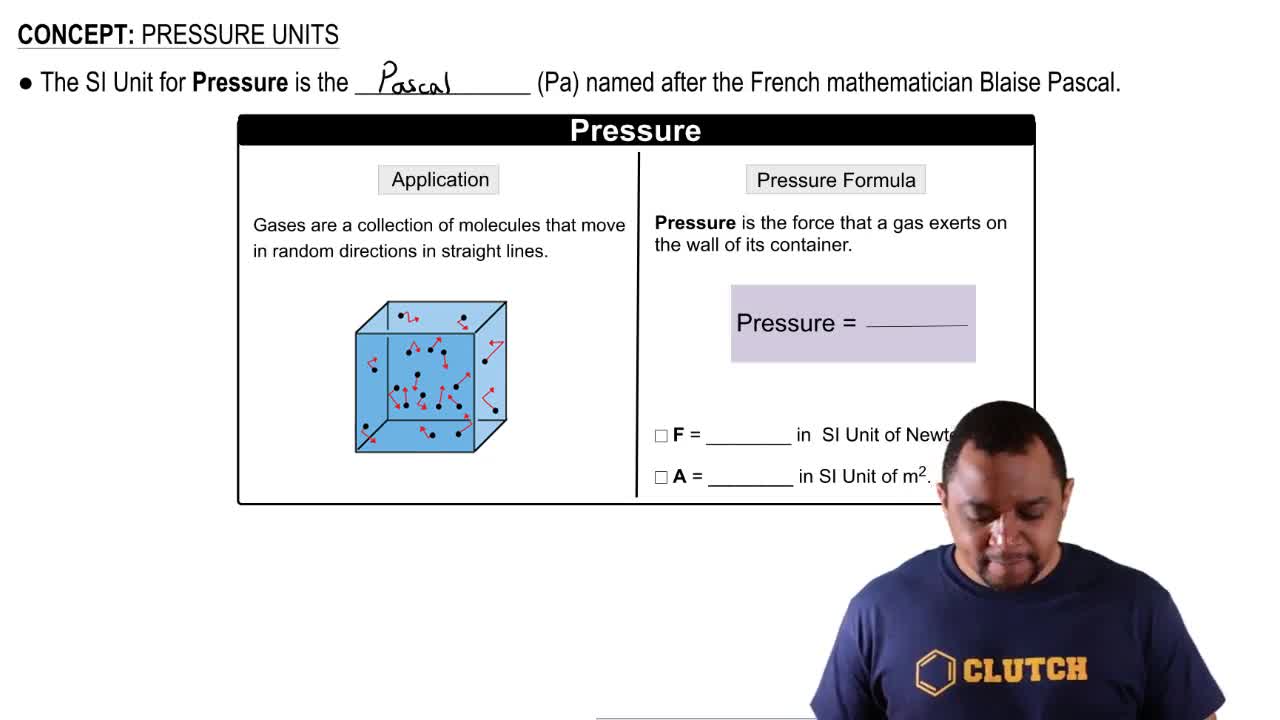
Gas pressure is the force exerted by gas molecules colliding with the walls of their container. According to the Ideal Gas Law, if the volume and temperature are constant, the pressure of a gas is directly proportional to the number of moles of gas present. Therefore, to determine if the pressures in the two flasks are the same, one must compare the number of moles of O₂ and H₂ based on their respective masses and molar masses.
Recommended video:
Guided course
01:15
Pressure Units Concept 1