Pearson+ LogoPearson+ Logo
Ch.13 Carbohydrates
Timberlake - Chemistry: An Introduction to General, Organic, and Biological Chemistry 13th Edition
Timberlake13th EditionChemistry: An Introduction to General, Organic, and Biological ChemistryISBN: 9780134421353Not the one you use?Change textbook
Chapter 13, Problem 70b

Use the Fischer projection for D-gulose in problem 13.69 to answer each of the following:
b. Draw the Fischer projection and name the product formed by the oxidation of D-gulose.

Verified step by step guidance
1
Understand the Fischer projection: A Fischer projection is a two-dimensional representation of a molecule, where the carbon chain is drawn vertically, and horizontal lines represent bonds projecting out of the plane toward the viewer. For d-gulose, the hydroxyl (-OH) groups and hydrogen atoms are arranged around the carbon chain in a specific configuration.
Identify the functional group to be oxidized: D-gulose is an aldose sugar, meaning it contains an aldehyde group (-CHO) at the top of the Fischer projection. Oxidation of the aldehyde group will convert it into a carboxylic acid (-COOH).
Modify the Fischer projection: To represent the oxidation product, replace the aldehyde group (-CHO) at the top of the Fischer projection with a carboxylic acid group (-COOH). The rest of the molecule remains unchanged, with the hydroxyl (-OH) groups and hydrogen atoms in the same configuration as in d-gulose.
Name the oxidation product: The oxidation of d-gulose forms d-gulonic acid. The 'd-' prefix indicates the configuration of the molecule, which remains the same after oxidation.
Verify the stereochemistry: Ensure that the hydroxyl (-OH) groups and hydrogen atoms on the remaining carbon atoms are in the same positions as in the original d-gulose Fischer projection. This confirms that the stereochemistry of the molecule is preserved during the oxidation process.

Verified video answer for a similar problem:

This video solution was recommended by our tutors as helpful for the problem above.
Video duration:
1m
Was this helpful?

Key Concepts

Here are the essential concepts you must grasp in order to answer the question correctly.

Fischer Projection

The Fischer projection is a two-dimensional representation of a molecule, particularly useful for depicting the stereochemistry of carbohydrates. In this format, the vertical lines represent bonds that are oriented away from the viewer, while horizontal lines indicate bonds that are coming towards the viewer. This method simplifies the visualization of chiral centers and helps in understanding the spatial arrangement of atoms in sugars like d-gulose.
Recommended video:
Guided course
0:48
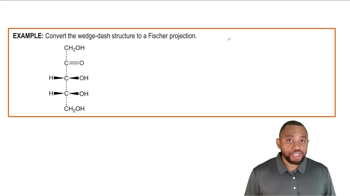
Fischer Projections Example 1

Oxidation of Sugars

Oxidation of sugars involves the chemical reaction where a sugar molecule loses electrons, often resulting in the formation of a carboxylic acid or an aldehyde. In the case of d-gulose, oxidation typically converts the aldehyde group at the anomeric carbon into a carboxylic acid, leading to the formation of d-gulonic acid. Understanding this process is crucial for predicting the products of sugar reactions.
Recommended video:
Guided course
1:01
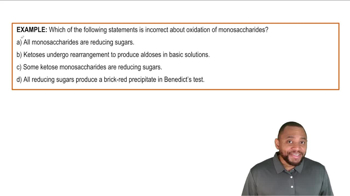
Ketoses as Reducing Sugars Example 2

D-gulose

D-gulose is a six-carbon aldose sugar that is part of the aldohexose family. It has specific stereochemical configurations at its chiral centers, which influence its reactivity and the types of products formed during chemical reactions. Recognizing the structure and properties of d-gulose is essential for accurately drawing its Fischer projection and understanding its oxidation products.
Recommended video:
Guided course
1:30
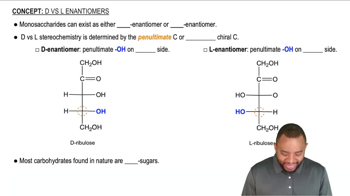
D vs L Enantiomers Concept 1