Pearson+ LogoPearson+ Logo
Ch.5 Nuclear Chemistry
Timberlake - Chemistry: An Introduction to General, Organic, and Biological Chemistry 13th Edition
Timberlake13th EditionChemistry: An Introduction to General, Organic, and Biological ChemistryISBN: 9780134421353Not the one you use?Change textbook
Chapter 5, Problem 56b

Use the following decay curve for iodine-131 to answer problems a to c:
<IMAGE>
b. Complete the number of days on the horizontal axis.

Verified step by step guidance
1
Step 1: Analyze the decay curve provided in the graph. The graph shows the decay of radioactive Yb-169 over time, with the horizontal axis labeled as 'Days' and the vertical axis labeled as 'mg of radioactive Yb-169'. The curve decreases exponentially, indicating radioactive decay.
Step 2: Identify the half-life of the substance from the graph. The half-life is the time it takes for the amount of radioactive material to decrease to half its initial value. For example, if the initial amount is 200 mg, the half-life is the time it takes to reach 100 mg.
Step 3: Observe the points on the graph. At 0 days, the amount is 200 mg. At 32 days, the amount is approximately 100 mg, indicating that the half-life of Yb-169 is 32 days.
Step 4: Use the half-life to complete the horizontal axis. Since the half-life is 32 days, subsequent points on the axis can be calculated by adding multiples of 32 days. For example, 64 days corresponds to two half-lives, and so on.
Step 5: Label the missing points on the horizontal axis. Based on the pattern, the point labeled 'A' corresponds to 96 days (three half-lives), and the point labeled 'B' corresponds to 128 days (four half-lives).

Verified video answer for a similar problem:

This video solution was recommended by our tutors as helpful for the problem above.
Video duration:
2m
Was this helpful?

Key Concepts

Here are the essential concepts you must grasp in order to answer the question correctly.

Radioactive Decay

Radioactive decay is the process by which an unstable atomic nucleus loses energy by emitting radiation. This decay occurs at a predictable rate, characterized by the half-life, which is the time required for half of the radioactive substance to decay. Understanding this concept is crucial for interpreting decay curves, as they visually represent the decrease in quantity of a radioactive isotope over time.
Recommended video:
Guided course
02:52
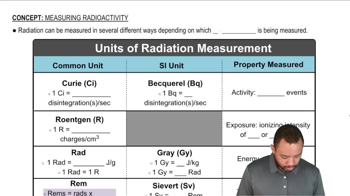
Measuring Radioactivity Concept 1

Half-Life

Half-life is a specific measure of time that indicates how long it takes for half of a given quantity of a radioactive substance to decay. For iodine-131, the half-life is approximately 8 days. This concept is essential for calculating the remaining amount of a substance at any given time on the decay curve, allowing for predictions about its behavior over time.
Recommended video:
Guided course
02:09
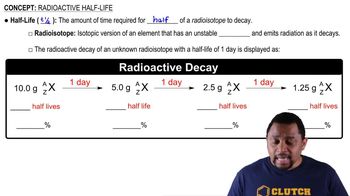
Radioactive Half-Life Concept 1

Decay Curve

A decay curve is a graphical representation that shows the decrease in quantity of a radioactive substance over time. The x-axis typically represents time (in days), while the y-axis shows the remaining amount of the substance. Analyzing the decay curve helps in understanding the rate of decay and the half-life, providing insights into the behavior of radioactive materials like iodine-131.
Recommended video:
Guided course
05:54
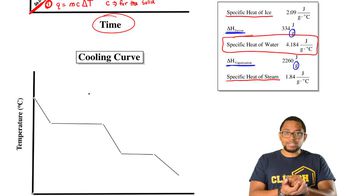
Heating and Cooling Curves Concept 2