Ammonium sulfate, (NH4)2SO4, is used in fertilizers to provide nitrogen for the soil. c. How many moles of ammonium sulfate contain 7.4 × 1025 atoms of N?
Verified step by step guidance
1
Step 1: Begin by identifying the chemical formula of ammonium sulfate, (NH₄)₂SO₄. This compound contains two ammonium ions (NH₄⁺), each of which has one nitrogen atom. Therefore, there are 2 nitrogen atoms per formula unit of ammonium sulfate.
Step 2: Determine the relationship between the number of nitrogen atoms and the number of ammonium sulfate formula units. Since each formula unit contains 2 nitrogen atoms, the total number of nitrogen atoms is twice the number of formula units.
Step 3: Use Avogadro's number (6.022 × 10²³ atoms/mol) to relate the number of formula units to moles. Divide the given number of nitrogen atoms (7.4 × 10²⁵ atoms) by 2 to find the number of ammonium sulfate formula units, and then divide this result by Avogadro's number to convert formula units to moles.
Step 4: Write the mathematical expression for the calculation: \[ \text{Moles of ammonium sulfate} = \frac{\text{Number of nitrogen atoms}}{2 \times 6.022 \times 10^{23}} \].
Step 5: Perform the calculation using the provided values to determine the number of moles of ammonium sulfate. Ensure units are consistent throughout the calculation.
Verified video answer for a similar problem:
This video solution was recommended by our tutors as helpful for the problem above
Video duration:
1m
Play a video:
Was this helpful?
Key Concepts
Here are the essential concepts you must grasp in order to answer the question correctly.
Moles and Avogadro's Number
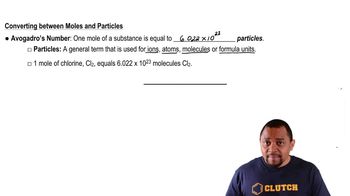
A mole is a unit in chemistry that represents 6.022 x 10²³ entities, such as atoms or molecules. This number, known as Avogadro's number, allows chemists to convert between the mass of a substance and the number of particles it contains. Understanding moles is essential for calculating the number of moles from a given number of atoms.
Ammonium sulfate, (NH₄)₂SO₄, consists of two ammonium ions (NH₄⁺) and one sulfate ion (SO₄²⁻). Each ammonium ion contains one nitrogen atom, meaning that one formula unit of ammonium sulfate contains two nitrogen atoms. Knowing the chemical composition is crucial for determining how many moles of ammonium sulfate correspond to a specific number of nitrogen atoms.
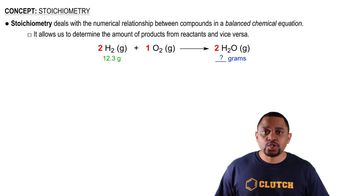
Stoichiometry is the branch of chemistry that deals with the quantitative relationships between the reactants and products in a chemical reaction. It allows for the calculation of the amounts of substances involved based on their chemical formulas. In this context, stoichiometry helps in determining how many moles of ammonium sulfate are needed to yield a certain number of nitrogen atoms.